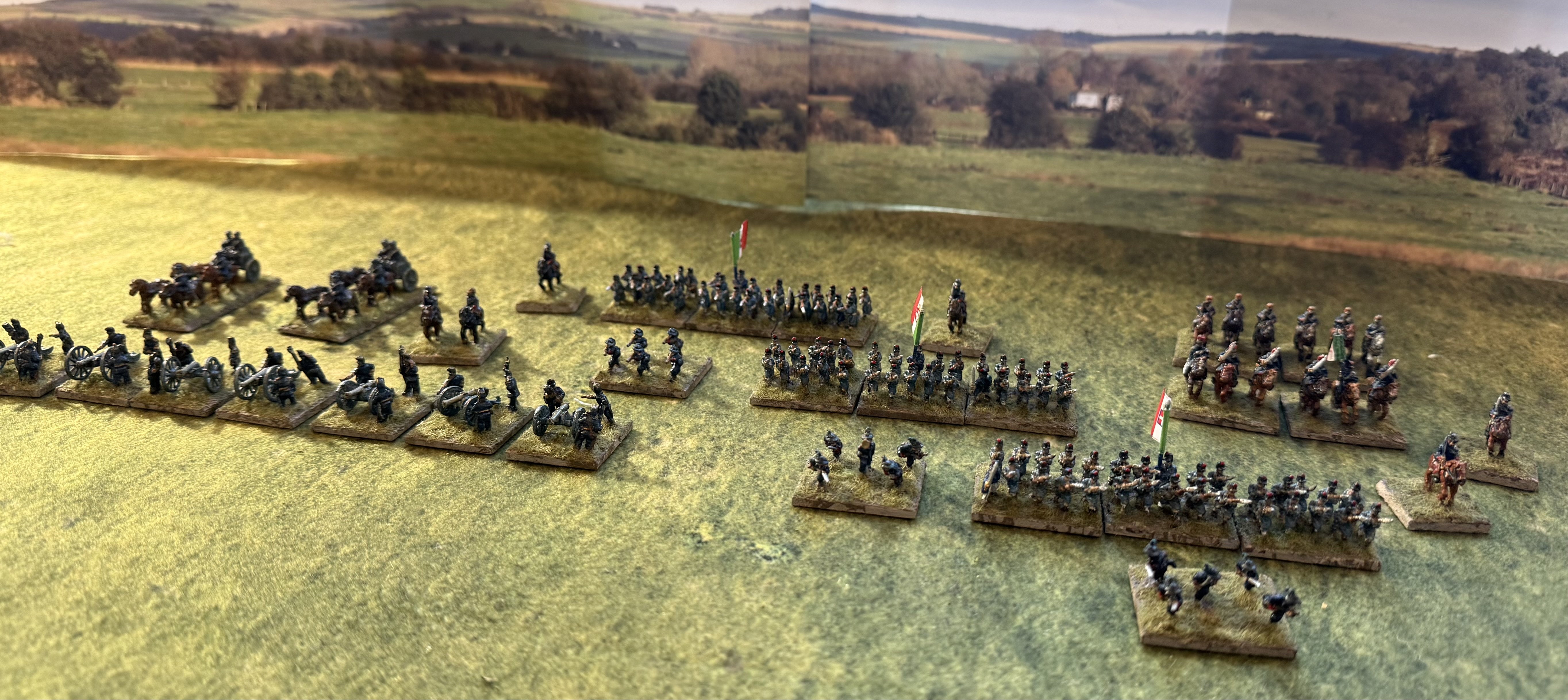
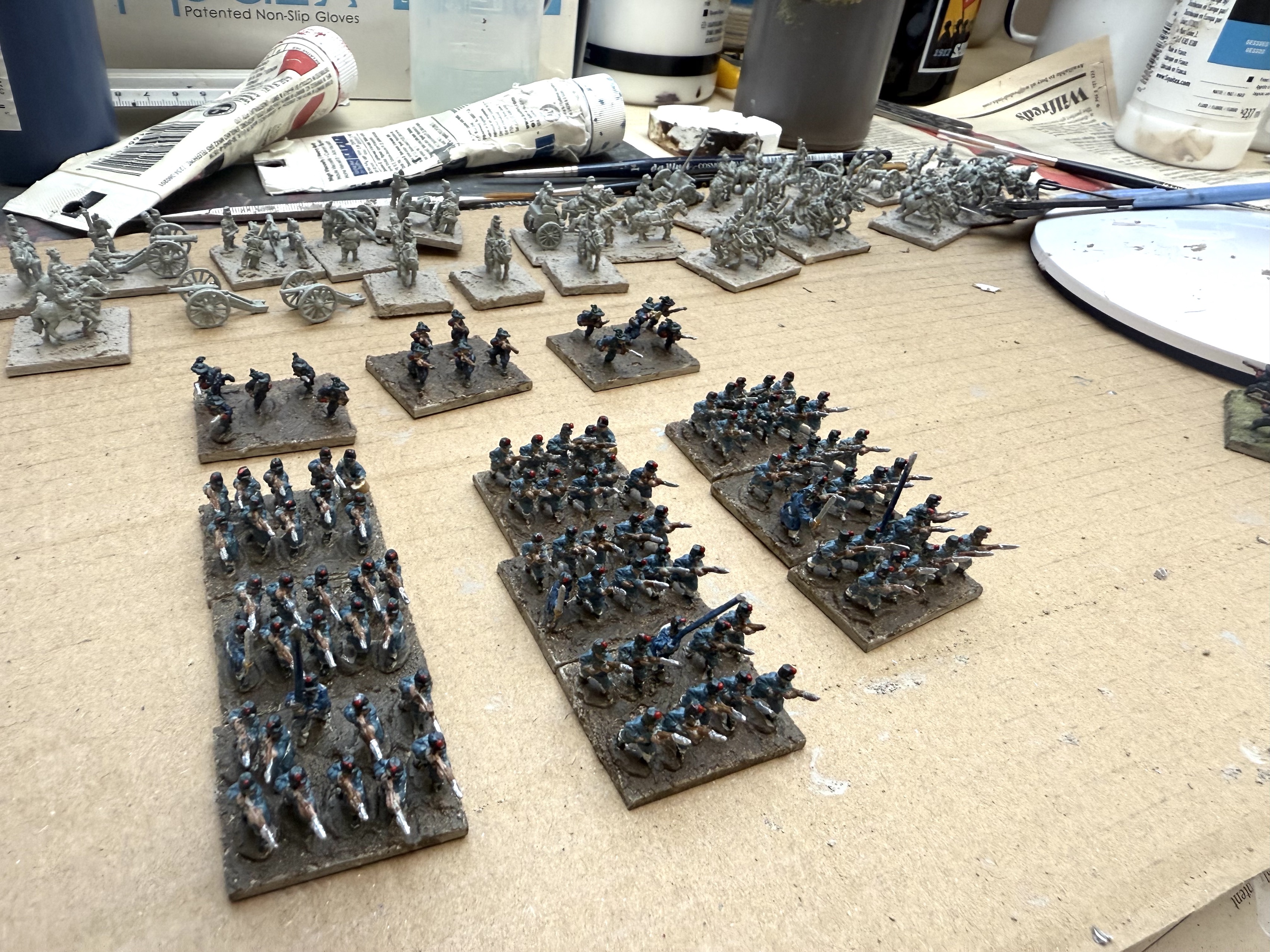
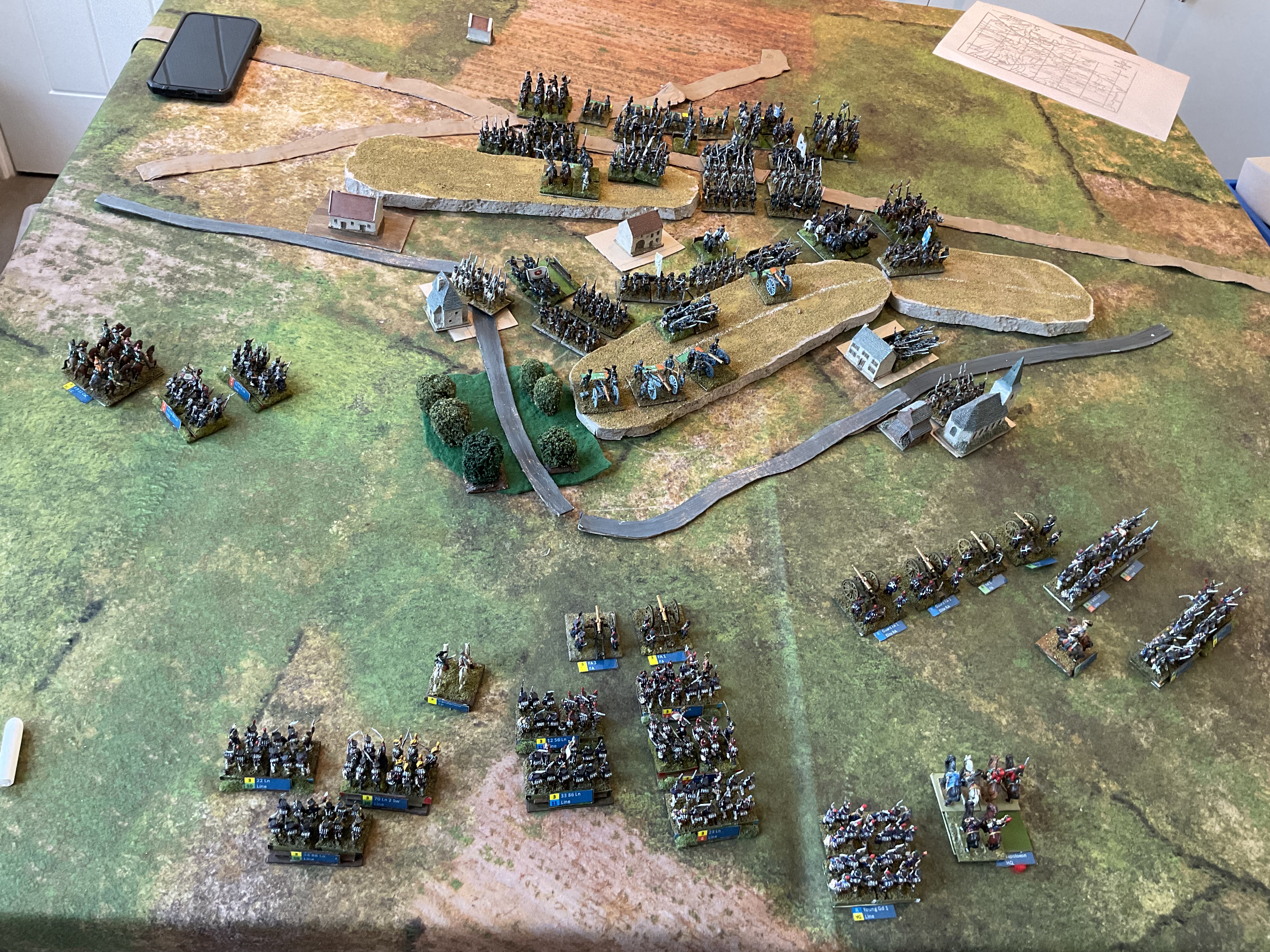
At last I have had more time to spend in the studio to work on painting my little men. In the remaining days of December since my last update, the 10mm 1866 Italians were finished. In the new year I started my next project: 6 battalions of 1815 French infantry. I’m on course to finish these by month end! Alas the early January club game had to be cancelled because my wife wasn’t well.
10mm 1866 Italians
This relatively modest batch has taken me months of elapsed time as I have not been able to spend much time in the studio across October to Christmas. There are nine bases of line infantry, three of Bersaglieri , four of cavalry, a more impressive seven of artillery, plus two limbers and five generals.
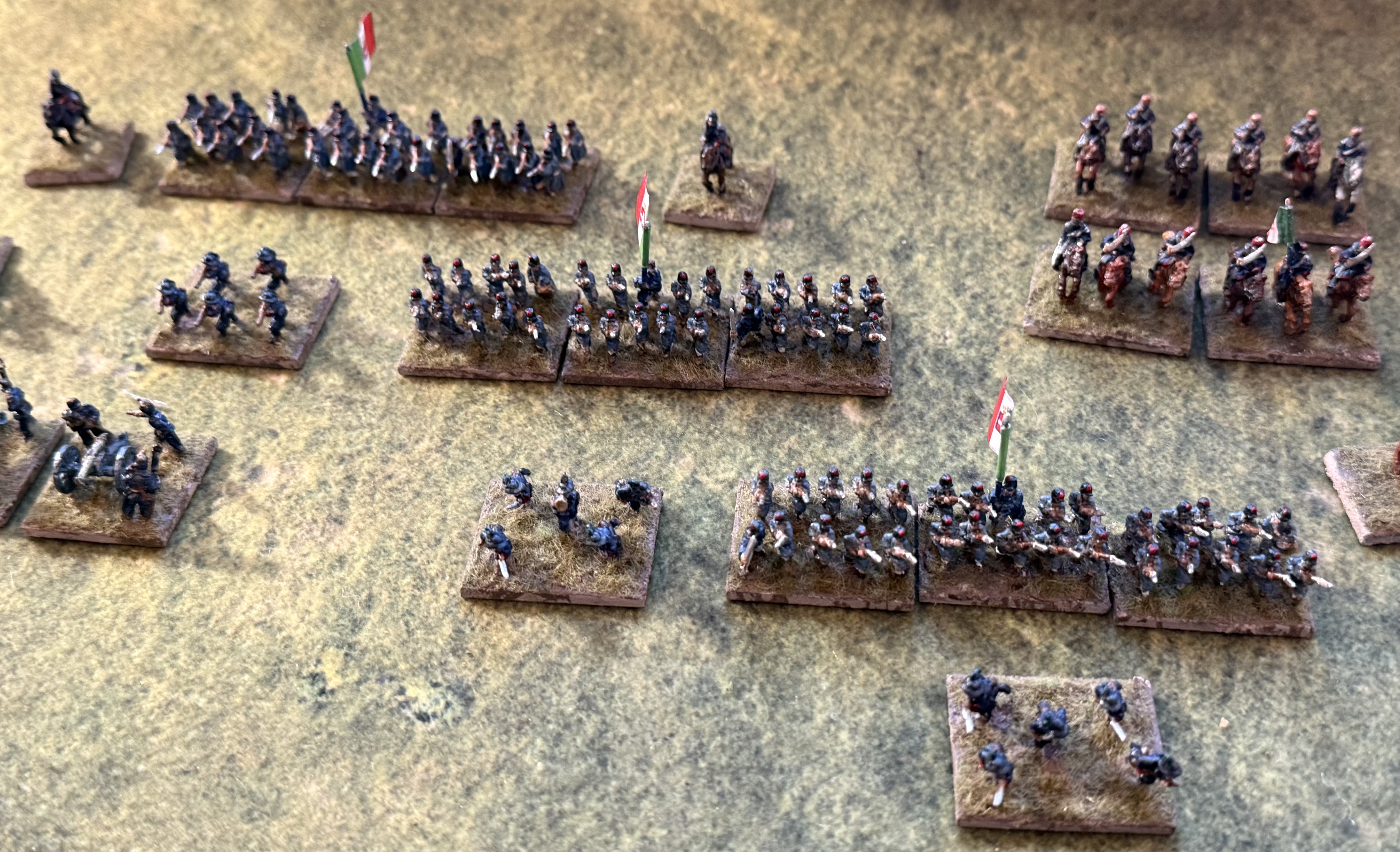
A closer look at the infantry
10mm is a new scale for me, and I’m starting to understand that they are small. And as my efforts show, difficult o photograph! You can’t see much in these pictures. There isn’t actually a huge amount to see. The 1866 uniform meant that the men were in grey greatcoats (as were the Austrians), notwithstanding the heat. No regimental distinctions are visible. The red pompon on the shako is about the only feature to lighten the dull appearance. The greatcoats are described as blue-grey, and illustrations show variations from almost French-style dark blue, to neutral mid-grey. A went for a paler blue-grey (reminiscent of French WWI troops) – as I want to there be a clear difference with the mid-grey Austrians. The Bersaglieri are only slightly more interesting in their dark blue uniforms. My original plan was to put them on 30mm by 20mm bases, but when basing I started using the pile of 30mm by 25mm bases (my new standard for 18mm troops), and all but two are on this deeper bases. They look fine, but I prefer things to be a bit more compact.
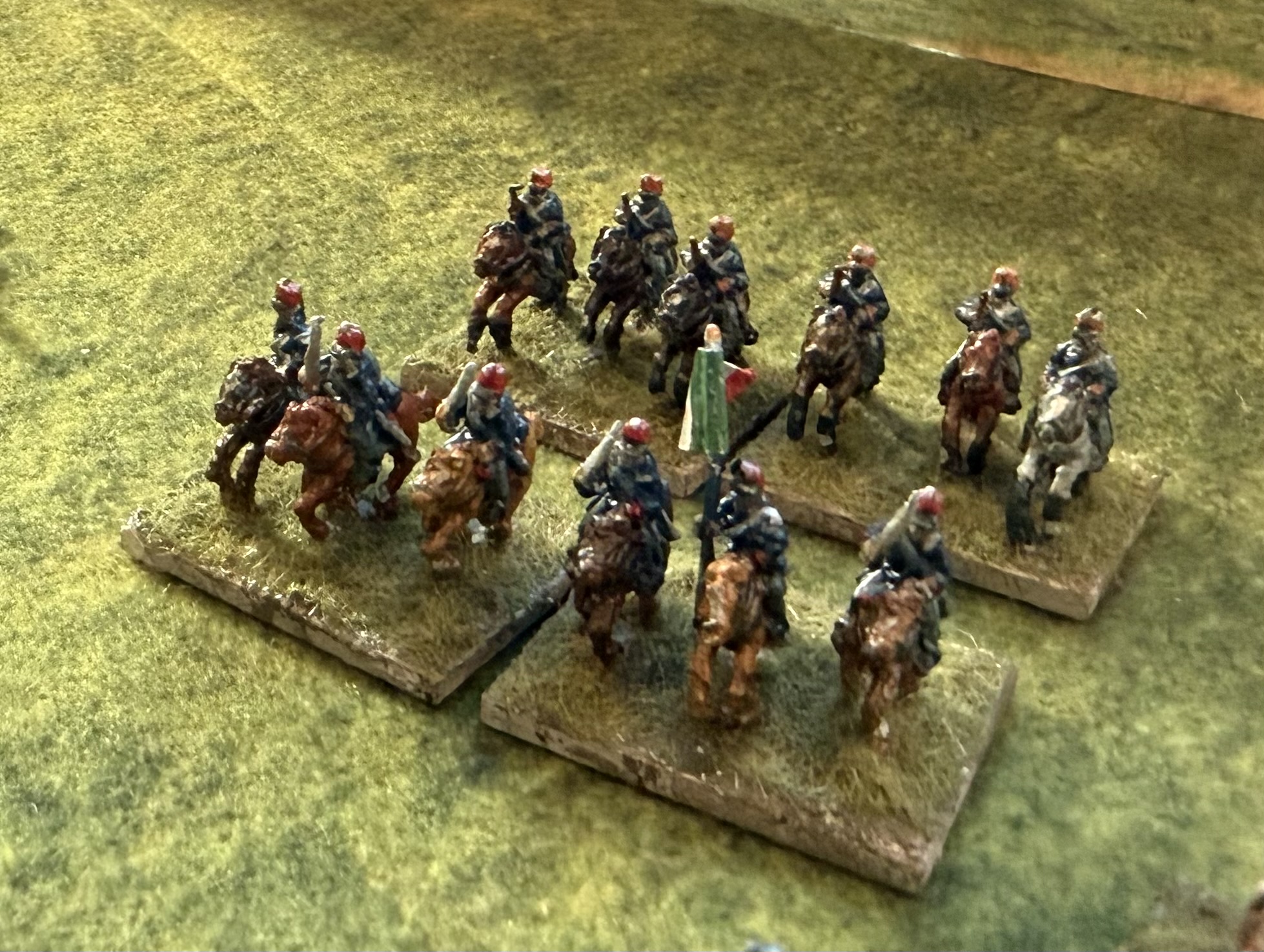
A closer look at the cavalry – not that there is much to see!
Th cavalry are a bit more interesting – each regiment has a distinguishing colour for facings and kepi. I painted up four bases from two regiments. I had to make and paint my own flag using foil – not too hard to do fortunately. Foil is nicer than the printed paper I use mainly, though I struggled a bit with paint adhesion, as my usual gesso primer didn’t fully stick at first pass.
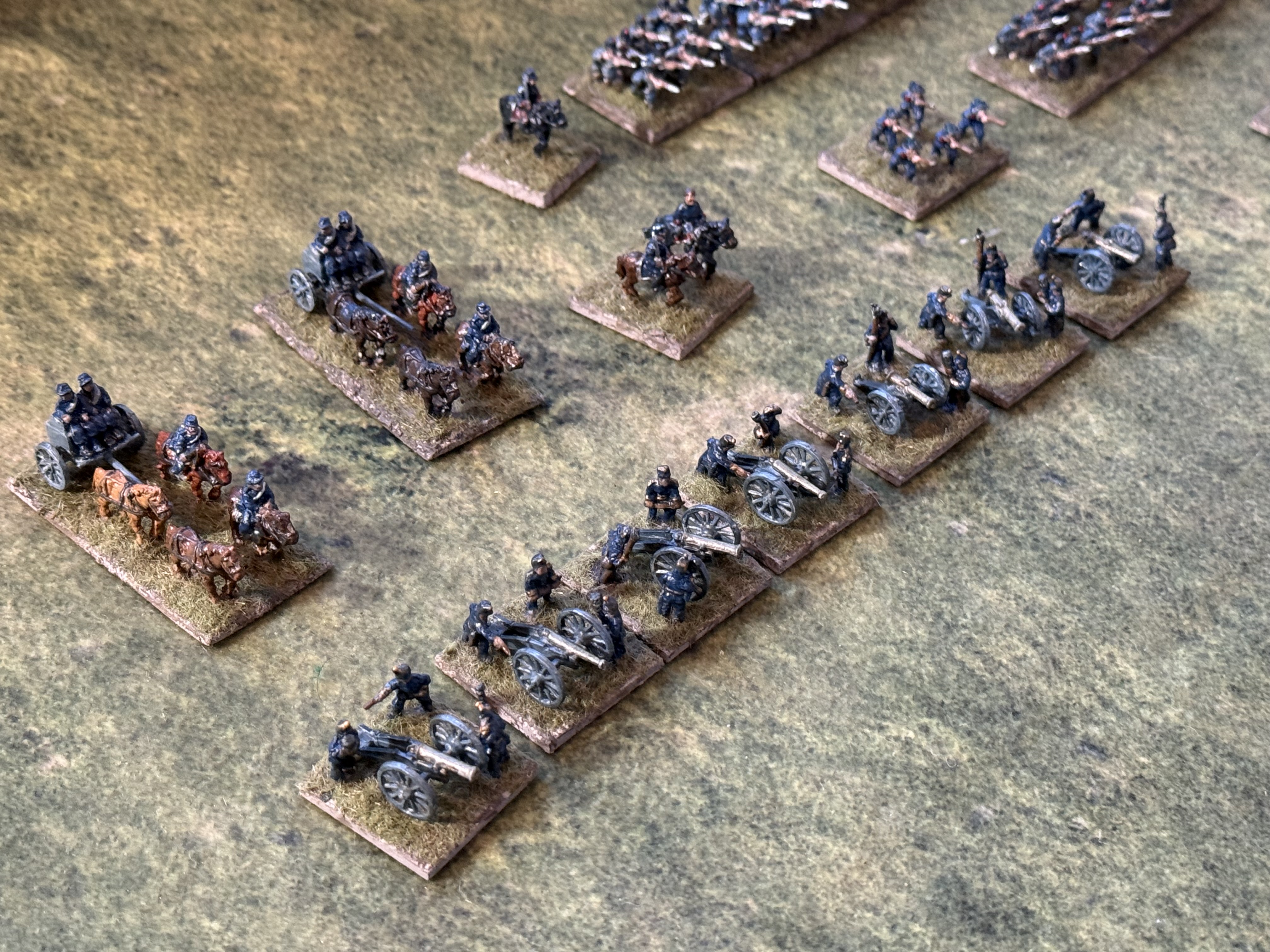
Artillery -four smoothbore 8-pdrs on the left, and French rifled 4-pdrs on the right.
Artillery is proving a bit of a headache for this project. The main Italian piece was the 8-pdr. In this era the use of pounds to denote calibre had lost all comparability between nations. But this ordnance was heavier than the main Austrian piece, the 4-pdr. The models in the Pendraken 8-pdr pack look like smoothbores, though, which would be suitable for 1869, but not 1866, when the Italians had rearmed with rifled weapons. Apparently these were based on the French 4-pdr RML guns – so I bought a pack of these (complete with French crew). I painted these up to use with my Italian crews, but they look a bit small! If I get to 1859, I will have a use for the French crews anyway. The limbers are French – the uniforms are slightly different, but I don’t think that matters too much.
I will write more about this army when I finish it. This will require as many as 40 more bases of infantry, which is quite a daunting prospect. I am going to finish the Austrians first.
1815 French
My Napoleonic French infantry are mid-war (1807-1812) and have been working very hard. GDA2 uses a lot of miniatures, and it’s been clear that the troops need reinforcements. Since their main opponents these days are my late war (1812-1815) Prussians, clearly these should also be from the late war period. AB have a relatively new range of late-war French, and I wanted to use these. My New Year’s resolution for 2025 was to get 6 battalions into action. But I decided to prioritise six battalions of Prussians, and then got distracted by WW2 and 1866. As my painting schedule became dislocated in the late part of 2025, the resolution went unfulfilled. But I had bought the miniatures and I have been at it with a will this month. They should be ready in time my club game on 1 February, just a month behind schedule.
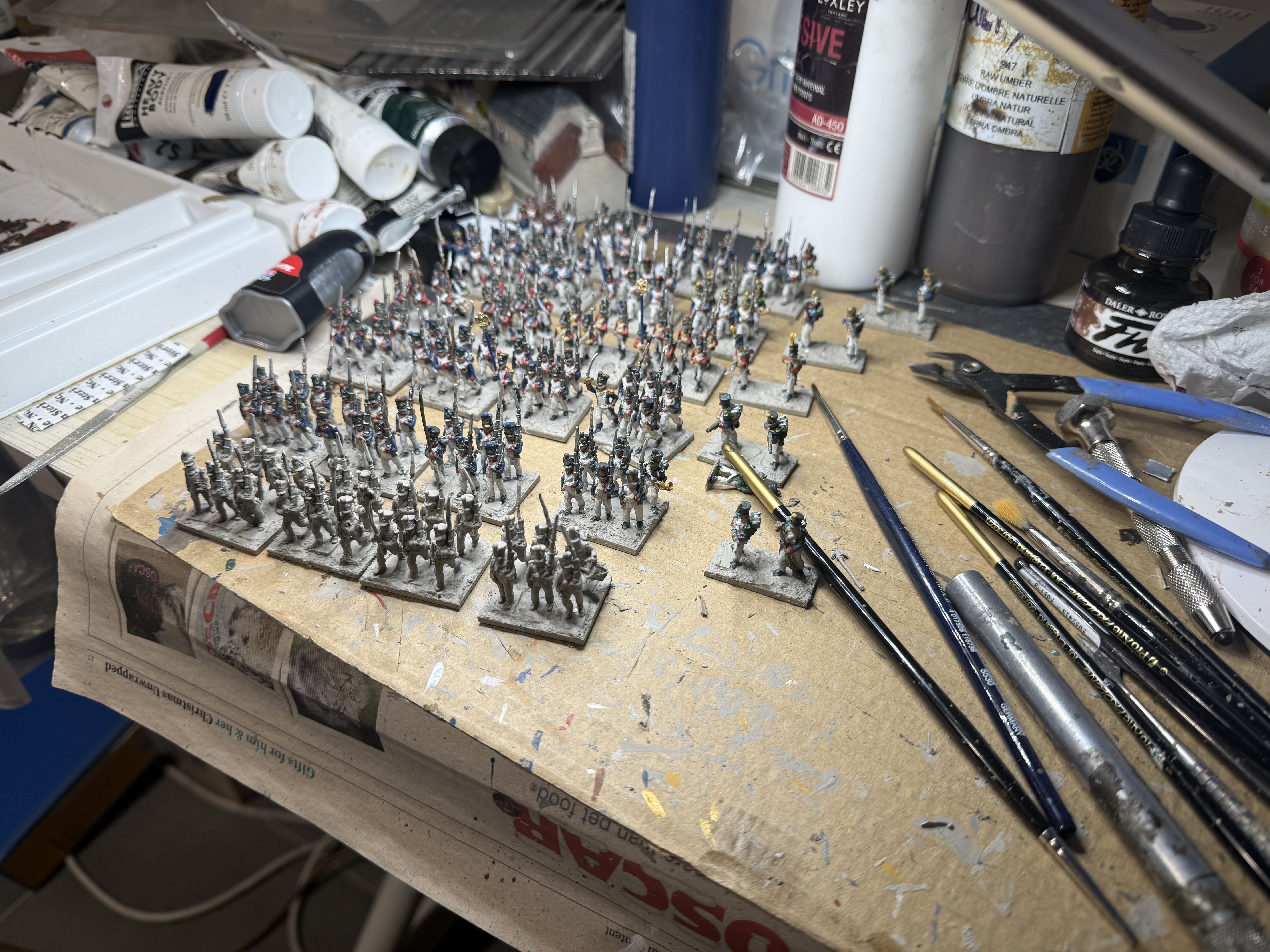
The picture shows where I’ve got to: five of the six battalions are ready for finishing (bases and a wash). The remaining battalion will take another couple of sessions to do – so I’m on track!
I will post more about these when I’m finished. The AB castings are a joy! These are much more fun to paint than the small 10mm figures I’m doing for 1866. I might need to rethink things in future. I am now hatching a scheme to do another six French late-war battalions.
January isn’t over – but I will report on the last week in my next monthly update. I hope to do a post specifically on my new French battalions too.
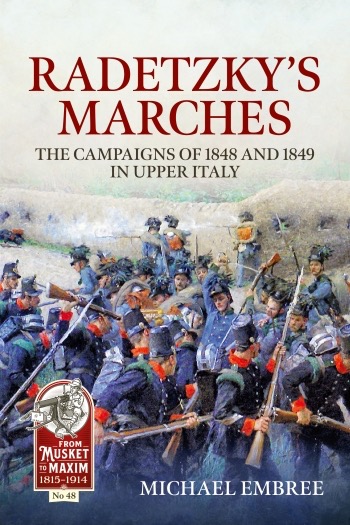
Current edition – mine has a slightly different cover
I have recently read Michael Embree’s Radetzky’s Marches – the campaigns of 1848 and 1849 in Upper Italy. I bought it at last year’s Salute show – the hard back version, a limited edition and signed, bought for the same price as the current paperback edition (£35). I finally got around to reading it last month. It proved to be an interesting read – will it open up a new period for me?
This book piqued my attention for three reasons. First, Radetzky is a familiar name from the Napoleonic wars, but his achievements in the 1848/49 were what made him famous – inspiring the Radetsky March from Johann Strauss the Elder, his most famous work; I wanted to know more. I am increasingly interested in the Italian wars of unification, with plans to refight the second (1859) and third (1866) wars: what about the first? As a regular visitor to Italy on holiday, I’d like to know more. And finally I am interested in the evolution of warfare in the 19th Century. I know a lot about Napoleonics, and I’m gathering more knowledge of the wars from 1859-1866 (encompassing the American Civil War). The wars of 1848-49 (also including the Hungarian uprising) are a way marker in that evolution.
I found the book itself a bit on the dry side. There is all the detail you would want as a wargamer, with the forces involved in each engagement, right down to many minor skirmishes, listed meticulously, with casualties as far as they were known. In this it recalls George Nafziger’s works. The detail of what happened in each battle is a little vaguer: he follows the popular route of using verbatim quotations from eye witnesses to do quite a bit of heavy lifting. For historians to attempt more than this requires an enormous amount of work though: this is as good as it usually gets. What’s missing is atmosphere, and descriptions of the personalities and how many of the decisions were taken – and especially from the Austrian side. I have no better feel for Radetzky’s personality that I started with. There is almost nothing on the political background, especially from the Austrian side. I also missed a narrative on the balance of forces through the various phases of the campaign, or rather campaigns – the actions of 1848 and 1859 were separated by an armistice, and the rise and fall of the Venetian rebellion is separate again. This is in complete contrast to Lieven’s book on the Russians in 1812-1814 – and its strong grasp of the strategic and personalities. Still, it clear why people have suggested that Radetzky’s grasp resembled that of Napoleon in the same theatre in 1795-97.
What about the wargaming possibilities? By this I mean refighting the battles – rather than strategic conflict, which would be very promising for a boardgame or kriegsspiel. There are four biggish battles, but none are particularly easy to wargame. The battles of Santa Lucia and Goito were a bit tentative, without a clear objective for either side – though they could be turned into more decisive scenarios. The critical battle of Custoza is a three-day sprawling affair with none of each day’s actions being lop-sided (first day to Austria, second to Italy; last day to Austria); the grand-tactical level is interesting enough, but this plays out over too big an area for a wargames table, and the whole point is that each side doesn’t know where the other is or where it is moving. Of course, scenarios where one side is badly outnumbered and making the best of things can work, but this is not classic wargames play. The final large battle, Novarra, in 1849 is maybe more promising. The Austrians are outnumbered but have substantial reinforcements on the way – but the difficult terrain could pose a challenge. Overall, if restricted to historical battles, the 1859 and 1866 wars are better. There are lots of skirmish level possibilities though, which this books documents thoroughly.
What about the evolution of warfare? Technologically, this is very close to the Napoleonic period. The muskets were fitted with percussion locks rather than flint locks, which would make them more reliable. The Austrians made extensive use of rockets (which also make an appearance in 1859, but not 1866 as far as I know). Napoleonic rulesets don’t take rockets very seriously and would need attention. The main point of them, as far as I can see, is that they were lightweight and much more mobile than conventional artillery – but much less lethal, although they had their moments.
Tactics seem to be strongly Napoleonic, but the regular forces would be better drilled than was usual in Napoleonic times, and I suspect tactical doctrines a bit more rigid. Both sides made use of specialist light troops, unlike French Napoleonics, though line troops could skirmish if required. There were quite a few irregulars on the Italian side, which were often given light infantry tasks. On the Austrian side, Grenz infantry were still used as light troops alongside the jagers. The quality of the Austrian troops is generally good, including their commanders – these are not the Bruce Quarrie Austrians! The Piedmontese regulars were generally good too in 1848, but seem less well-led, and perhaps cracked under pressure a bit earlier. In 1849 their quality was diluted by massive conscription, and doubtless the confidence of their leaders had been dented.
One striking feature, though, is that casualties seem quite low, when compared both to many of the Napoleonic bloodbaths, or many of the battles of 1859 (Solferino led to the founding of the Red Cross). The casualties in 1866 were also high, but aggressive Austrian tactics can explain that. The terrain was generally quite cluttered, and probably the tactical leadership more conservative when it came to exposing their men. There weren’t many glorious artillery targets, as there were at Waterloo, Borodino, etc., or classic volley moments against dense targets.
After an initial bout of enthusiasm, I don’t think I will be pursuing this. At a pinch I could reuse many miniatures from 1859/66 or even Napoleonics (for the Austrians – though the shakos wouldn’t be right). And terrain pieces would be reusable too. But I have to many other irons in the fire!
However, for a detailed understanding of this interesting and historically consequential campaign, I recommend Mr Embree’s book, though you might want to skip through some of the lists of units and leaders.
Alas another slow month, with little hobby progress. The cold that I mentioned in my November update developed into a rather vicious virus that took weeks to shake off. I was banned from going to the studio to paint my little men, and I had to pull out of two games. I did do lots of reading though!
I’ve also had some email issues. The notification from my last post (on d’Erlon’s attack at Waterloo) had a large number of bounces. This was due to a change to the WordPress software. I’ve had to upgrade my mailing application, taking me into technically dark territory – but I hope I’ve solved the problem. While I was at it I noticed that scores of dummy names had been added to my mailing list, and I’ve deleted the obvious ones.
Reading
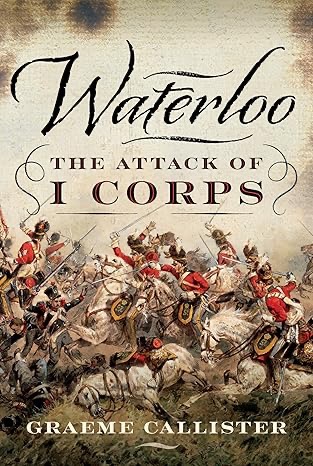
The first new book I read was Graeme Callister’s book Waterloo – the Attack of I Corps. I have already posted on this, together with the reflections it provoked on that battle.
Next up is Michael Embree’s Radetzky’s Marches: the Campaigns of 1848 and 1849 in Upper Italy. Another period! But I had always been a bit curious about this famous campaign (which caused the Strauss senior’s Radetsky March to be written) about which so little has been written in English. When I saw this book second-hand at Salute I could not resist the urge to buy it. Since I have visited Italy a few times over the years, I have become more curious about Italian history, and I’m slowly being drawn into the Risorgimento – and the series of wars through which the modern state of Italy was formed. Custoza 1866, my main current project, is almost the last of these wars (there was some unfinished business in the Papal States afterwards). These 1848-49 campaigns were fought over largely the same ground as 1866, including another battle of Custoza. And after this year’s holiday to Lake Garda, I now have a much clearer idea of the geography. I am also curious about how warfare evolved from the Napoleonic period to 1870 and beyond. The 1848 wars are an interesting link.
More on this when I finish the book. Will I be drawn into wargaming this war? I could re-use some of the terrain. I might, but I would need to reuse my 1866 armies, which won’t look quite right. The Austrian uniforms were closer to the Napoleonic era. Too many other projects come first before I indulge in building yet another army!
Gaming
Alas I had to cancel two games due to my virus. A game with 17th Century sailing vessels in the Caribbean with my friends in Beckenham, and a Général d’Armée 2 game I was setting up at Tunbridge Wells.
On the subject of GDA2, Iain Fuller, from South London Warlords, kindly shared with me the modifications to the GDA2 command system that he and this friends use. These are quite radical. I want to try out some of these ideas, along with others I have. To that end I have drafted some house rules for use in my next game at Tunbridge Wells. More on that after the game.
Painting
My 10mm 1866 Italians in progress, with the cavalry bases in the foreground
I finally got back to the studio last week. Some of the paint on my wet palette was still usable, but a layer of mould made using it unappealing. I set up a new wet palette, recovering some of the paint. I have had two sessions on my remaining 10mm Custoza Italians – cavalry, artillery and generals. The cavalry are now nearly there – just the flags and finishing (base decoration and wash). It shouldn’t take too many more to finish. Meanwhile the figures I need to finish the Austrians arrived from Pendraken. The 10mm figures are proving reasonably quick to paint – helped quite simple uniforms for the period. This scale is much closer to 6mm in style than 18mm. Still there’s a lot to do! After the Italians my plan is to switch to 18mm late Napoleonic French.
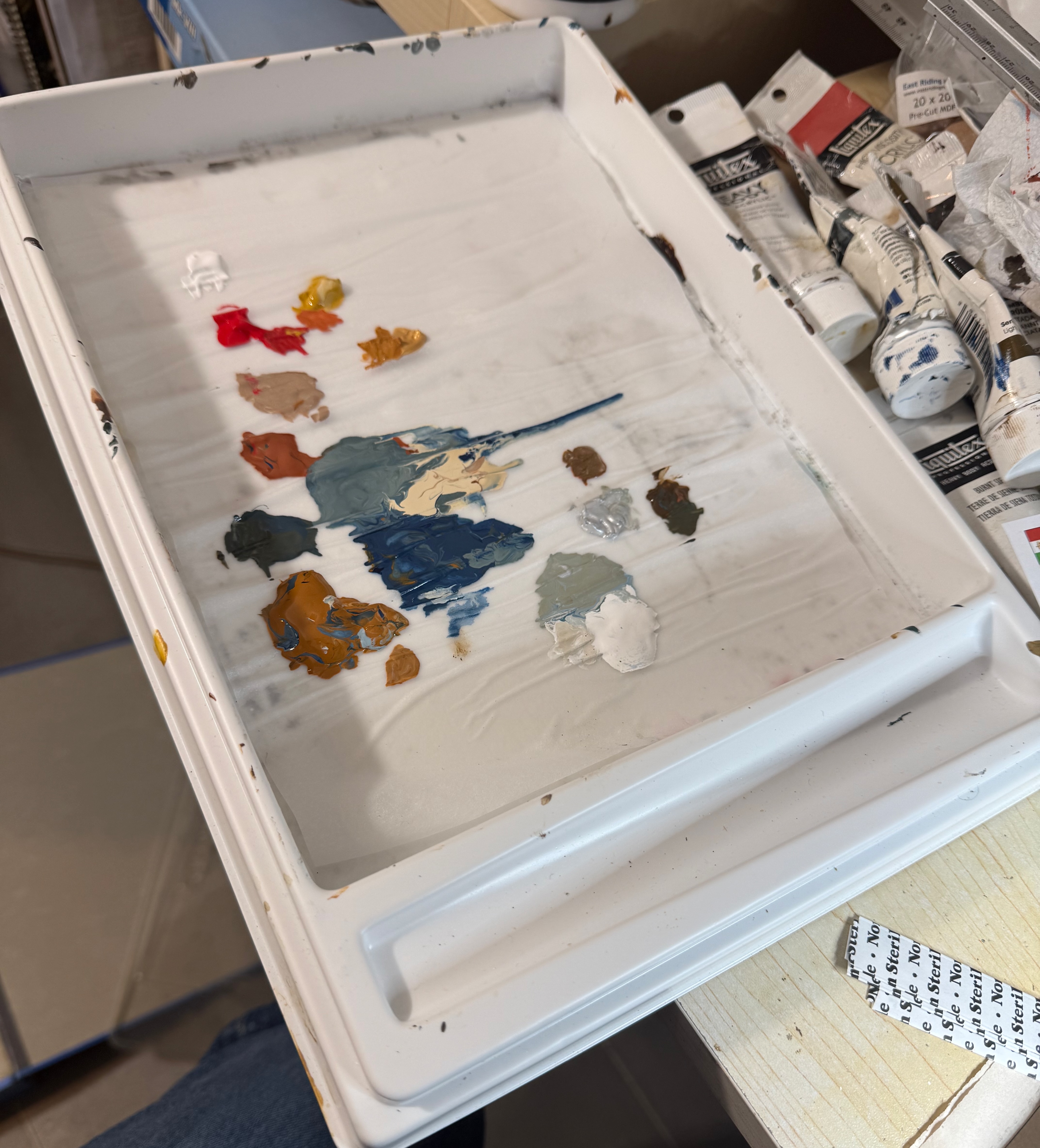
While I’m here, with a short post, it’s worth saying a little about my wet palette. Ken Reilly, the Yarkshire Gamer, hates them almost as much as round dice. A wet palette consists of a sheet of greaseproof paper, sitting on a sheet of blotting paper, enclosed in a shallow box with a tightly fitting lid (but not so tight it’s a challenge to lift it!). You soak the blotting paper with water, and put your paint on the greaseproof paper. After your session you put the lid on and it should be ready for you to resume your painting where you left off. How long the paints last depends on things like temperature – it can be weeks in winter, if the mould is kept at bay. You can buy these from artists’ suppliers (the one I use is from Rowney), and the usual hobby sharks have their own versions. They are also easy to make yourself at a lot less cost, though you need to find a suitable container.
Here’s my wet palette. There has been some running of the paint.
The reason I use one is that I use artists’ acrylics rather than hobby paints (e.g. those from Vallejo). Hobby paints are more liquid and come ready mixed in a huge variety of colours. Artist paints come out of tubes, are quite thick and are generally pigment-based. Almost every colour you use on the miniatures is mixed – that’s the fun! So it helps to preserve your mixes for multiple sessions. And the stiffer consistency means that the paint behaves well on a wet palette – usually. Every so often the pigment runs a bit – presumably when the blotting paper reservoir is too wet. I’ve read that poorer quality pigments (usually sold as student grade) have a greater tendency to do this – though it’s not something I have particularly noticed. I tend to use student grade paints for terrain.
And so Happy Christmas to all my readers. Over the festive period I hope to catch up a bit on the painting, and get started on that French infantry. But theatre’s a lot to do in the garden too – as I wasn’t well enough for that either!
I have just finished Graeme Callister’s Waterloo – the Attack of I Corps. This book was published last year, and is interesting as an up to date history of what has always been for me the most interesting episode of the battle. I can’t help but to view it through a wargamer’s eye though!
And that has always posed a challenge. They say hard cases make bad law. In the same way Waterloo makes for bad wargames rules – it is such an exception battle in so many ways. That is truer of D’Erlon’s attack than any other part of the battle. Indeed it is a test of any set of rules I write: how well it copes with this episode is a challenge indeed. All I ask is that the overall outcome is within the range of possibilities. It rarely is.
Mr Callister’s book follows all the usual sources: the limited number of eye-witness accounts and official reports. To this he has added a detailed examination of the official French personnel records. This was the new trove of data first trawled by Paul Dawson in his very flawed works on the campaign. This helps give a detailed picture of the French units that took part. The Allied units were always more familiar territory, but he has examined the records for these too. He starts the story from Napoleon’s seizure of power and re-formation of his army, and tracks the units of both sides up to the attack of I Corps on 18th June, the counterattack by British cavalry, and the interventions by French, British and Netherlands cavalry after this. I Corps’s Waterloo does not end there, but Mr Callister does not explore its later history – which is a pity.
A thorough analysis of the personnel records does help us rate the troops – though Mr Dawson has done something similar before, with similar conclusions. The French infantry can be rated as “Line” in GDA terms. The ranks were filled with veterans, but they hadn’t had the time to be knocked into fully cohesive units. And many of the veterans were ex-prisoners who hadn’t seen combat for some time. The British of Pack’s and Kempt’s brigades were genuine veteran formations, which can this be Veterans or Drilled Grenadiers. The exception was 2/44th – Line or Grenadier. The Netherlands militia would count as Reservist. It should be noted that these British and Netherlands troops took heavy losses at Quatre Bras, and might be down-graded as a result (the same would apply to Bachelu’s division on the French side, not involved in this combat). The British Heavy cavalry were well-mounted and had high esprit, though not a great deal of battle experience: genuine heavy cavalry, with a Grenadier rating – perhaps Elite for the Life and Horse Guards. The rule about British cavalry not rallying after a Victory very much applies though – including to the Light Dragoons. I’m not so sure where to put the rest of the cavalry, as I haven’t really internalised how the GDA classifications work.
Mr Callister makes one suggestion that I haven’t read before: he says that the French practice of putting the taller men in the front rank would have limited their effectiveness in musketry duels, as the second and third ranks would have been blocked. He expands this idea at length. I’m not entirely convinced. If this was a serious problem I’m sure that we’d have heard more about it. It’s the sort of thing that re-enactors could help us get to the bottom of. Beyond this the book gives an admirably clear account of the course of the combat and the evidence that we have of what happened. He does not discuss the suggestion made by Mr Dawson that Donzelot’s division had dropped behind the divisions on either side and so suffered little in the attack. But he does observe that this division remained largely cohesive after the attack, along with the 85th regiment detached from Durutte’s division.
It is interesting to see how the generally accepted history has evolved over the years. I first read about Waterloo in the 1970s. At this time British historians (and they are the only ones I read) painted the whole episode as a standard French attack as seen repeatedly, so they suggested, in the Peninsula War. Wellington adopted a reverse slope position, which sheltered his troops from artillery fire, and allowed British infantry lines to deliver a decisive ambush attack on the French columns. Then the cavalry went in and finished the job off. Wellington himself talked of the French coming at him in the “same old way”. Bijlandt’s Netherlands division, which was not inured into Wellengton’s cunning ways and stood on the forward slope as “Continentals” were wont to do, got carved up by artillery, and broke as the French approached. This general narrative was supported by numerous accounts of veterans published in the 19th Century.
Then came the revisionists. They had a lot to work with. It wasn’t a classic reverse slope position (which was not a tactic unique to Wellington) as these slopes were gentle and rolling – and not good protection against artillery. Bijlandt withdrew to sheltered position before the artillery bombardment started and his men stood and fought before being pushed back – a record not dissimilar to Pack’s British brigade (which, like the Netherlanders, had suffered badly at Quatre Bras two days before). Kempt’s British did better, but only after Bijlandt’s men had done their bit. The French columns were in fact gigantic brigade or divisional affairs unlike the battalion columns used in the Peninsula, with different strengths and weaknesses (more on that later). Then various details were questioned. The 80-gun grand battery mentioned by early sources (not least Napoleon himself) was perhaps just over 50, and not positioned on the Belle Alliance ridge with the main army, but deployed 400m or so further forward on a slightly lower ridge, which became known as “Grand Battery Ridge”. The infantry started behind the battery on the Belle Alliance ridge and pushed through it to deliver the attack. This is how it is shown in Mark Adkin’s lavish Waterloo Companion, which is everybody’s favourite Waterloo book (including me!).
Then Mr Dawson came along to revise the revisionists. Mr Callister stands alongside this in a much more measured and coherent way – but upholds many of Mr Dawson’s conclusions. I recommend this book.
And now readers, if you tuned in just to find out about this book, and you are a sane and normal person, I advise you stop reading reading right here. I’m now going to scratch the Waterloo itch and talk about a number of issues that this book has raised with me, and which have a bearing on wargaming, as well as historical interpretation. I will divide this with headings into a number of topics.
Gaiters
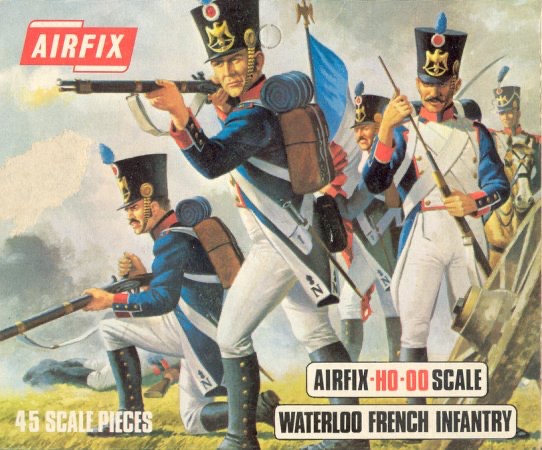
The box artwork for the Airfix infantry that I remember so well. These miniatures have a special place in my heart.
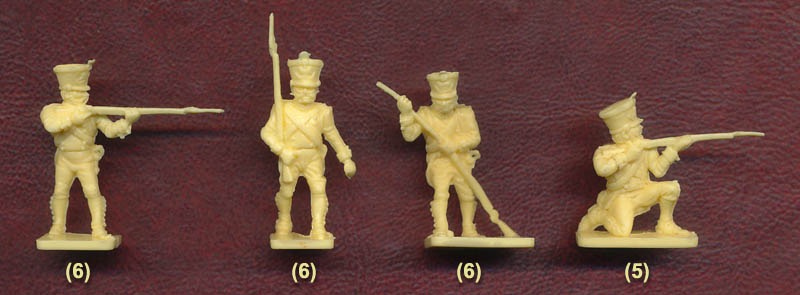
Let’s start with the most trivial. I got into Waterloo back in the 1970s thanks to Airfix’s OO/HO soft plastic figures, produced mostly in a ghastly pale yellow. The French line infantry were not especially accurate (having cross belts and sabres), but they were wearing gaiters and breeches in accordance with parade regulations. I have always felt this is the way French infantry should look. And it is how the bulk of my little men are turned out – they are in mid-war uniform with the gaiters going above the knee.
Some of the figures in the box
Alas virtually all figure manufacturers, including my beloved AB, have them wearing trousers, in the belief that this is how they looked on campaign. This is not without evidence. Some contemporary pictures show this. It was clearly how it was in Spain after the troops had been there a few months, and had to source clothing locally. One (not entirely reliable) memoirist French officer claimed that the first thing infantry did on campaign was throw out the gaiters and breeches and replace them with more comfortable trousers. And yet.
I saw a programme on TV many years ago about excavations of French mass graves outside Vilnius, where many soldiers met their end in the winter of 1812. They were wearing breeches and gaiters (the above knee ones too), even after a gruelling campaign (of course they may have purloined fresh stocks on their retreat).
Two of the French soldiers in this account of Waterloo mention that the difficult ground that d’Erlon’s troops had to cross broke their gaiters. They were wearing gaiters! Of course they may have been wearing trousers over the top, but it is small scrap of evidence.
I am planning six battalions of new infantry for my French. These will be the first of my 18mm collection in late war uniforms (gaiters below the knee). These are mainly AB and wearing trousers, as the core is a number of Young Guard figures I bought from a friend a few years ago. However I bought one battalion’s worth in gaiters from Eureka’s own-label range. Unfortunately these don’t have as wide a range of poses, but the core will be properly turned out.
The reverse slope
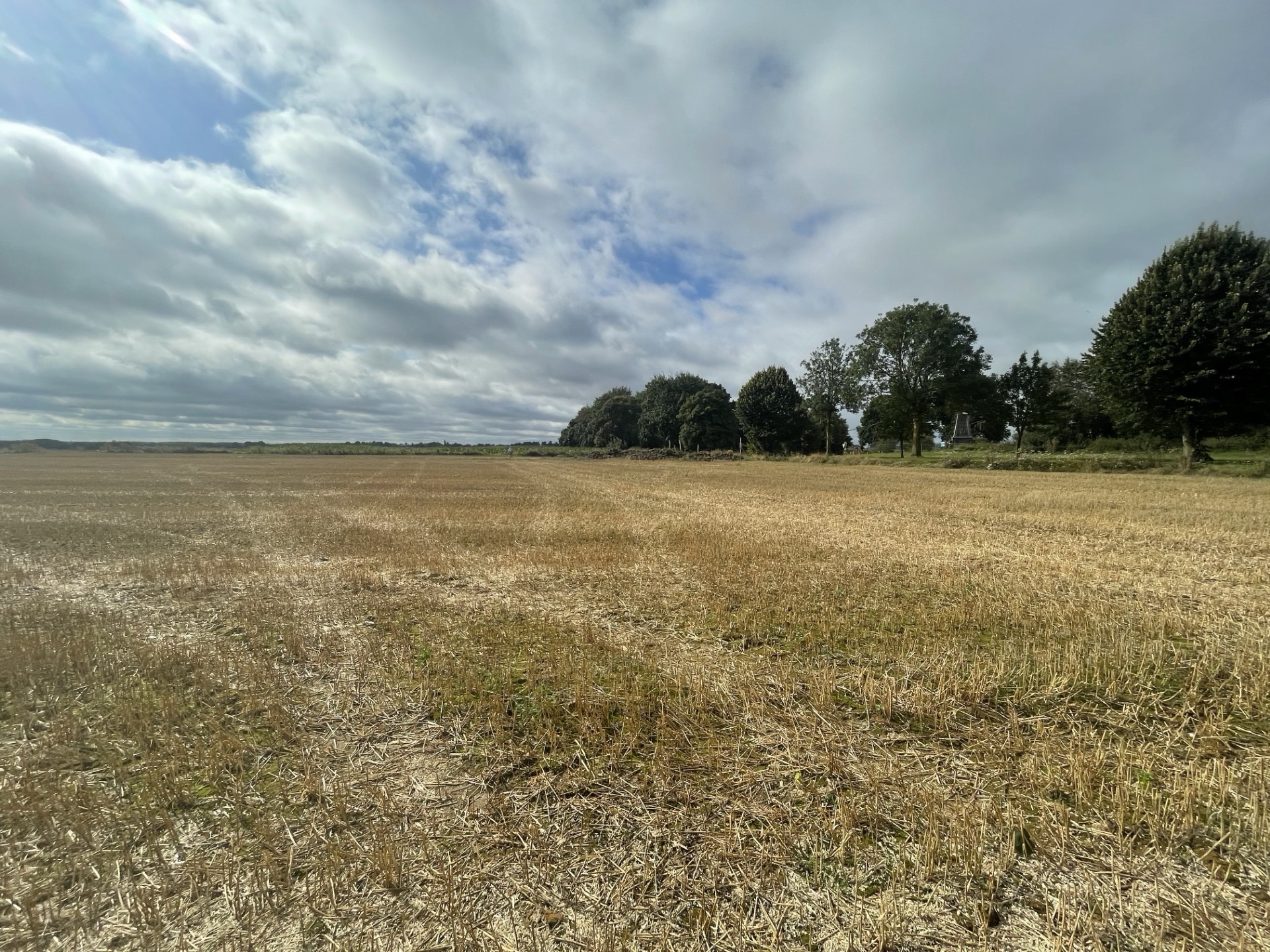
Photo: Andrew Jones posting on Waterloo Association FB page
Mr Callister doesn’t discuss the topography much. He goes along with the general narrative that the Allies occupied a reverse slope position, with only artillery and skirmishers visible from French positions, once Bijlandt had pulled his men back. This is widely corroborated from his sources, from both sides. It was interesting, however, to pick up on Facebook post by Andrew Jones on the Waterloo Association page drawing attention to an article in the Waterloo Journal challenging this. It features the above picture, which is close to the Brussels road, on the eastern side, looking towards the French position – in other words the general area where Bijlandt and Kempt were deployed. It’s hard to discern much relief! It’s possible the ground has been flattened a bit from the building of the memorial mound, and a couple of centuries of agriculture – though the main terrain alterations are to the west of this.
The contention of the article, I think, is that the allied deployment area was in fact visible from the Belle Alliance ridge, and not concealed by a reverse slope. The main evidence cited is the heavy casualties suffered by the British 27th later in the battle when it was in square in this area – mainly from artillery it is thought: it must’ve been visible. Of course while this position may have been visible from the Belle Alliance ridge, which was slightly higher – and which I think is visible on the horizon in this picture – once off that ridge and into the valley, including on the “grand battery” intermediate ridge, then these positions would have been invisible. That might account for the eyewitness accounts saying that the main British positions could not be seen.
What is clear is that Napoleon had a pretty decent idea of where the Allied army was deployed. D’Erlon’s attack was precisely targeted at its weakest point. It is also clear that allied positions, as far back as the third line of cavalry, were exposed to the fire of the grand battery – and sought out hollows for shelter, according to one witness. The British position was more of a plateau with slight folds than a ridge – and still less a reverse slope.
This all reflects an attempt by British historians to ram the battle into a Peninsular War template that not even the Peninsular War, fits that well. It is also suggested that the reverse slope tactic was not widely adopted by “Continental” generals. None of this stands up to close scrutiny. The British position bears a striking resemblance to that adopted by Austria’s Archduke Charles on the first day at Wagram in 1809, fought on another gently undulating plain. That didn’t go well for the French either.
The grand battery
Mr Callister does spend some time discussing the grand battery – and rightly so. It is an interesting topic. Initially it was widely accepted that a battery of 80 guns was deployed on the Belle Alliance ridge – as described by Napoleon himself. But as researchers dug into the data, two problems emerged. The first problem was that while generally corroborating this account, the artillery general of I Corps, Desales, mentions only the batteries from his corps, reinforced by the 12pdr batteries from II and VI Corps. That’s just 56 guns, or 62 if you include the horse battery. The numbers can be reconciled if you include an extra three batteries (24 guns) from the Guard sent over by Napoleon. There isn’t much direct evidence for this, but one eyewitness does mention the presence of guns from the guard. These are usually identified as 6pdr batteries attached to the Guard (not the three batteries of 12pdrs, “Napoleon’s daughters”) – some of which were manned by the Navy. I’m happy enough that these were indeed deployed here, though perhaps under a separate command.
The second problem was the location. The Belle Alliance ridge was located about 1km from the Allied positions, and more like 1,400m to the rearward echelons. Effective artillery range is usually described as no more than 700m. My GDA rules suggest that the Allied forward positions were just within the extreme range of 6pdrs firing from an elevated position (which would count here), but the rearward positions would have been completely out of range of even the 12pdrs.
But fear not! Modern historians found a solution. If you reposition the battery further forward by about 400m to an intermediate ridge, the problem is solved. I think this is a clear case of wargamers trying to rewrite history so that it conforms their rules. This idea took hold after wargaming become fashionable in the 1970s. The trouble is that there is little or no direct evidence for it. And the forward position is very exposed; the left of the position is not far from the forward Allied position of La Haye Sainte. A further problem is that it would have presented a significant obstacle to the advancing infantry. This narrative requires the infantry to form up in their divisional columns on the Belle Alliance ridge, and advance through the battery. This is easily done on the wargames table – most wargames rules allow for the easy passage of troops through deployed batteries – but surely less easy in life, considering the limbers, caissons and such associated with them, and the density of the infantry formation used. There is no eyewitness account of this awkward passage.
Instead Mr Callister suggests that the infantry advanced through the battery before it started firing as individual battalions and assembled into divisional formations in the dip in front of the battery. Once they moved off at least some of the battery’s units then moved forward to the intermediate ridge, as indeed Desales’s account suggests. These advanced batteries were then caught exposed by the British cavalry in their follow-on charge (along with perhaps some still on the ridge behind). This all fits the evidence much better.
And that leaves wargamers with a headache. Why did the foremost military leader of the age, and an artilleryman at that, order an artillery bombardment whose targets were out of range? As it turned out, the artillery did not do much damage – though eye witnesses attribute a lot of this to the soft ground. Others suggest that the fire was too elevated (!). The fire was worrisome enough for the cavalry, some 1,500m away, to take evasive action.
On weapons ranges, incidentally, the von Reisswitz Kriegspiel, a near contemporary source, puts the 12pdr range as 1,500 paces for elevation fire and 2,000 paces for “rollschuss” (i.e. ricochet), that is 1,125m and 1,500m. The equivalents for 6pdrs were 1,200 (900) and 1,800 (1,350); howitzers could reach up to the same range as the guns they were posted with. This is for Prussian ordnance – but these were pretty similar weapons to the French. This puts the Allied troops within extended range, though the rear echelons would have been subject to ricochet rather than bounce through fire. Wargamers often restrict these long ranges not because the weapons couldn’t reach, but because they regard them to be ineffective, based on quotes from soldiers at the time.
Another notable point is that overhead fire by artillery was clearly Standard Operating Procedure. I mention this because the generally excellent rule-writer Sam Mustafa adamantly states that it never happened, so bans it in his rules systems. To be fair in his Blücher grand scale, I don’t think the artillery range issue would be a problem. Neither range nor overhead firing is a problem (or not much) for Bloody Big Battles, a system that is sometimes used for Napoleonics, either. The key is that when designing big battle rules to keep maximum artillery ranges long. The problem comes when trying to scale up rules designed for smaller battles. Ranges that are ineffective for a single battery might not be so for three or more batteries firing together. Also the French seem to have been using something of an area fire tactic – but then again note my comments on the reverse slope that wasn’t. Having said that, fall of shot would be very hard to see at these long ranges, accounting for the poor ranging noted by some observers.
Those columns
Which brings me to the biggest issue raised by this episode: the formation adopted by I Corps’s four divisions. These were divisional columns by battalion. In two cases all 8 battalions in the division were deployed in line and arrayed one behind the other, as little as three paces apart. The other divisions deployed with fewer battalions as they detailed troops on flanking operations (including an attack on La Haye Sainte). This was a huge dense mass of men. I don’t think it has much precedent, perhaps beyond massive pike blocks deployed in early modern times, and by Alexandrian armies in ancient times. It was not an accident; it may have been on Napoleon’s direct orders. Some of the officers thought it unwise, but they all seem to understand what was required.
The first question is whether this formation was unprecedented, or part of SOP, and perhaps used more often than we realise. I remember reading that it was a formation used by French conscripts in the revolutionary wars. I don’t think this was based on much in-depth research. I’m no expert on those wars, and in my various readings I have found no definitive reference to the French having adopted such a formation. Indeed I think that far from being a good way of deploying raw conscripts, it required pretty well-drilled troops to operate. In my various readings I have found just two possible examples, both used by the Austrians in the war of the Second Coalition, 1799-1800.
The first is at the battle of Novi (I think) and it is so insubstantial that it hardly counts. Apparently the Austrians are shown as using the formation on a contemporary map. I don’t know which particular units, and which map. There are some candidates when I search for the battle. I don’t know the history of the battle at all, and I wouldn’t even mention it if it wasn’t for the second example.
This is the attack of the grenadiers at the end of the Battle of Marengo in 1800. David Chandler shows them having adopted this formation. What gives this a bit more substance is that the formation was routed by a small number of French cavalry – in a something close to a rerun (pre-run?) of the events that befell Marcognet’s column at Waterloo.
All of which is a very long time before Waterloo, with no examples from the Empire period that I know about. What did the French think they were doing? One suggestion has been that with a full battalion in line, its firepower would match opposing infantry. Mr Callister dismisses this – citing his theory about the weakness of French infantry fire because of putting the tallest men in the front rank. Regardless of whether this makes sense, it is evident that the troops themselves expected to plough on without a shot. In fact it seems to have been a momentum thing. The front ranks had nowhere to retreat and would be carried forward by the troops behind them. The formation was also very compact, allowing the French to drive all their troops into the target area quickly. Splitting into battalion level formations would have taken much more space. Indeed the French would probably have not been able to send more than two divisions in on the first wave. And managing 30-odd battalion columns would have created its own issues.
The interesting thing is that this appears to have nearly worked. Bourgeois’s two regiment (four battalion) formation on the left pushed Bjlandt’s men out of the way. They were then attacked by Kempt’s brigade. It does seem to have been pushed the column back, but it was by no means broken when the cavalry struck. Something similar is reported with Donzelot’s column, the next in the sequence. The first ranks were pushed back, but the column as a whole did not break. Donzelot’s column also largely withstood the cavalry attack (from the Inniskillings) that followed. It is likely that the thin British line would have exhausted itself before defeating the whole column.
The situation is a bit clearer with Marcognet’s column. It encountered two waves of British troops (the 2/44th and 3/1st, followed by the Highlanders of the 92nd). The first wave seems to have been brushed aside; the second led to some hand to hand fighting (a bit of a rarity in open ground in the horse and musket era), which the French started to get the better of – doubtless the numbers started to tell. And then the cavalry (the Scots Greys) struck, and the French column collapsed completely.
The conclusion from all this is hard to avoid: without the cavalry counterattack, the French would have overwhelmed the troops facing them and reached Mont St John, leaving a pocket on their right – two Hanoverian brigades, a Nassau brigade and two brigades of cavalry, which would have been contained by Durutte’s division. Wellington did have reserves to call on face this breakthrough, but it would have been a very different battle. If the cavalry had struck later, the chances are that the French would have seen it, and closed up their columns to be invulnerable. Uxbridge saved the day.
The massive column is not a formation catered for in wargames rules. Insanity awaits rule-writers who try to devise rules that cover every historical peculiarity. In most rules, battalion is king, and multi-battalion formations are not catered for. In fact multi-battalion squares were commonplace. There are two examples from this episode alone. One of the Hanoverian brigades formed a four-battalion brigade square. The French 85th Line, detached from the rest of Durutte’s division, formed a two battalion regimental square, which withstood the British breakthrough charge easily (which the rest of Durutte’s division appears not to have done – though casualties were much fewer than for Marcognet and Bourgeois). Functionally these big squares are not so different from the small ones, so not a great deal is lost.
The multi-unit column is another matter. When do you treat the units as individuals? When do you look at the formation as a whole? The Waterloo experience points to treating the units individually for the infantry combat, but collectively for the cavalry one. There’s no easy way of doing this. When replaying this attack, players will doubtless form their French units in battalion columns. In grand tactical rules, with units representing brigades or even larger (as with BBB), it is easier to fudge.
Conclusion
The difficulties for wargamers don’t stop with the columns. The cavalry attacks pose interesting challenges too. The British follow-up charge was pretty devastating – especially for the French artillery. The French lancers adopted a sort of open order formation in their pursuit. But in general these are the types of things that wargames rules handle reasonably well.
The challenges posed by long-range artillery fire and multi-unit columns are headache enough if you want to try and recreate this dramatic episode on the tabletop!
Postscript. Andrew Jones got in touch about his reverse slope posting – and I have made some corrections to this post.
Alas the course of wargames projects rarely runs smoothly. I’ve been suffering from a cold this last week, and not felt well enough to go to the studio above the garage to keep my painting going. My Custoza project is barely further forward from last month. But it has given me more time to read. Attention has shifted to Napoleonics.
Games
I went to my club (Tunbridge Wells Wargaming Society) for my first game there in ages. We played Général d’Armée 2. I have already reflected on that game and pondered on the rules at length. Sunday after next I should be returning with another GDA2 game with much the same forces but a fictitious scenario. Whether I will try out some the new house rules I was pondering is yet to be decided!
Projects
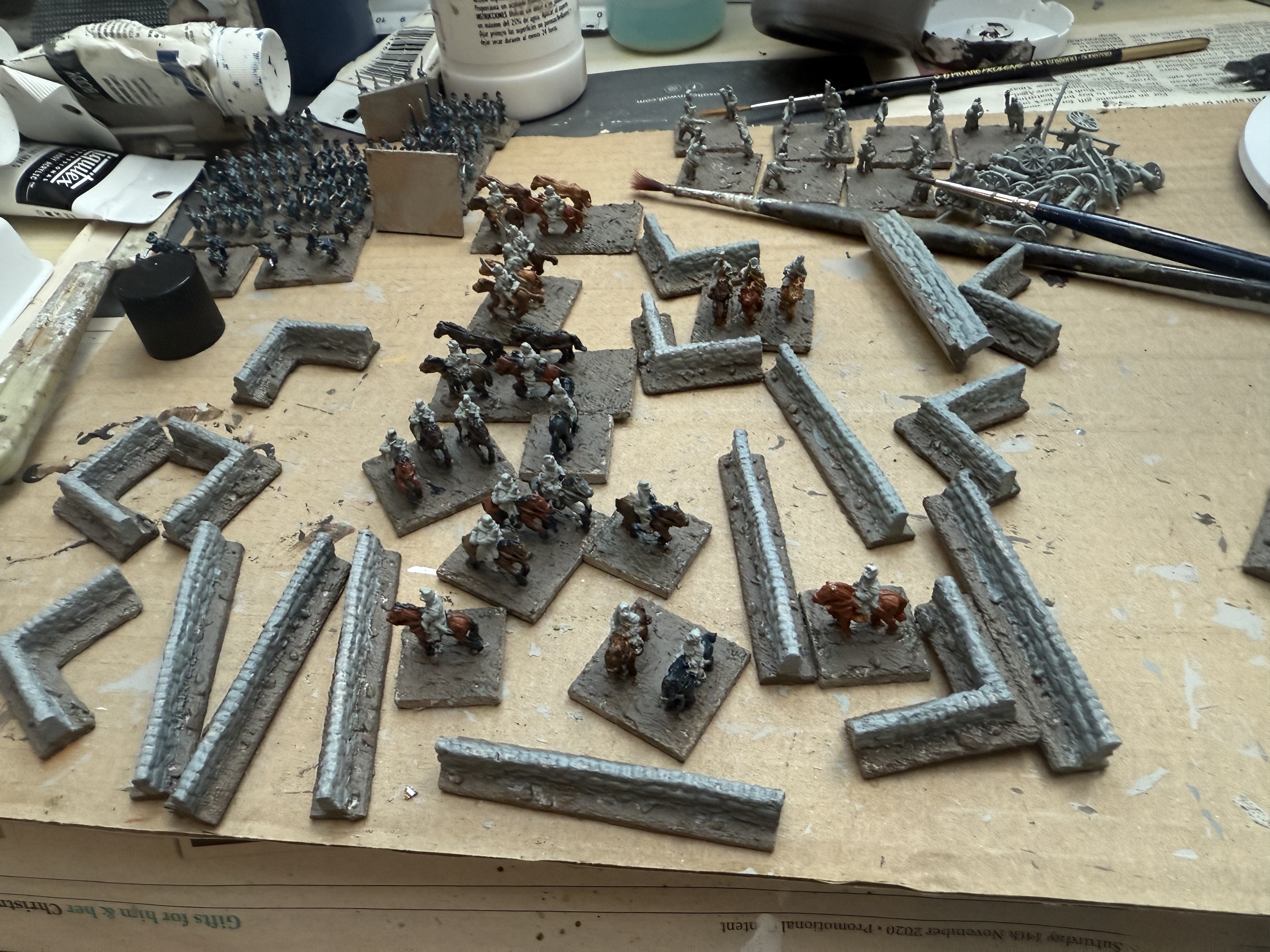
My incomplete Italian project amid the new stone walls.
I was a bit distracted by getting ready for the game, and then by things going on in my life, before the cold took hold. So my 10mm Custoza Italians are in much the same place as a month ago: I have painted the horses and bases. It won’t take long to finish these once I get going though. Meanwhile I ordered from Pendragon all the figures I will need to complete the Austrian army. My plan is to is to do this in one mega batch. Once I get going with this, I will order the remaining Italians. This won’t be done by Christmas!
One of the distractions came because when getting ready for the Lützen GDA2 game I found myself short of buildings. I also found a box of 10mm Total Battle Miniatures buildings unpainted. I promptly got on with painting them. They just need finishing (weathering and a wash). There were also some stone walls.
The Total Battle Scenic buildings before finishing
Once the Italians are done I have decided to switch back to my 18mm Napoleonics. I have been reminded that my overworked French infantry need reinforcements. I have the figures for six battalions of late war infantry, and I want to get these done (three line infantry, one Swiss and two Young Guard is the plan).
Rules
I have finished drafting my 1866 rules Forge of Nations. These need to be play tested. I am also contemplating some house rules for GDA2, as noted. And I am working on my own version of a quick reference sheet for those rules – which I will post about when it’s done.
Research
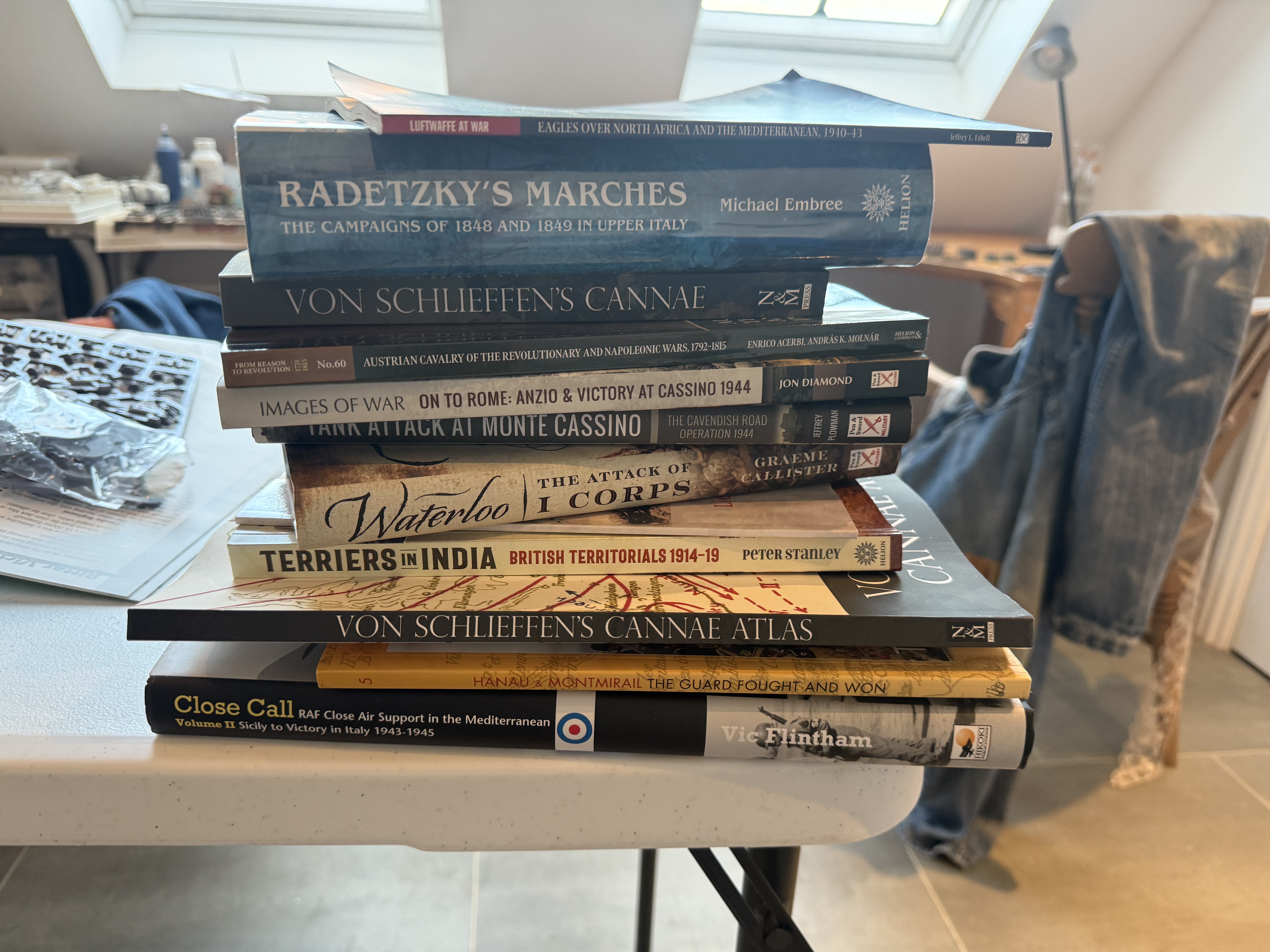
The stack of unread military books
One of the things I have been doing has been tidying up my study. This has produced a whole pile of books on military subjects that I haven’t read yet. So what did I do? I went and bought another book and read that!
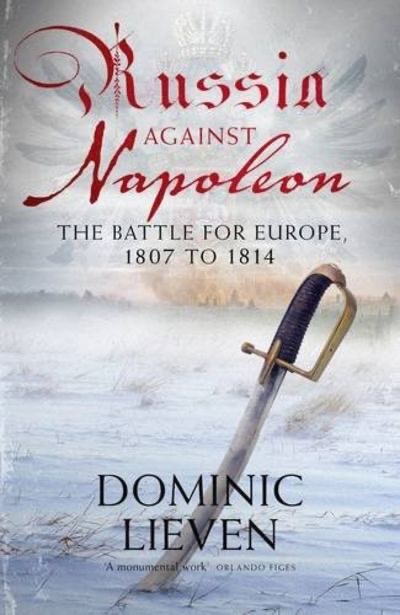
This was Russia against Napoleon – The Battle for Europe 1807 to 1814 (2009), by Dominic Lieven. It was a recommendation I picked up from Facebook.This served to give me a better understanding of both Russia in the Napoleonic wars, and the 1813 campaign, which is of growing interest. I wasn’t disappointed. The scope of the work is strategic, so there wasn’t much detail of the type that wargamers like. But it was a wonderful overview, making use of the massive additional level of information available post Cold War. There lots of pen portraits of a long cast of characters. Mr Lieven paints a very positive picture, not least of Tsar Alexander. This is a necessary corrective after neglect from French, German and British historians, and the rather negative picture painted by Leo Tolstoy in War and Peace. Absolutely fascinating. I also got a much clear picture of the 1813 campaigns than I could get from Nafziger’s trilogy – which was never been presented as a strategic study.
I remember back in the 1970s when I set out on Napoleonics that the Russian army got a good write-up from Bruce Quarrie, the author that got me going – along with the French and British. This book shows how justified that was.
Of course this means I will have to start introducing some Russians to my 18mm collection. I will start with some cavalry, I think.
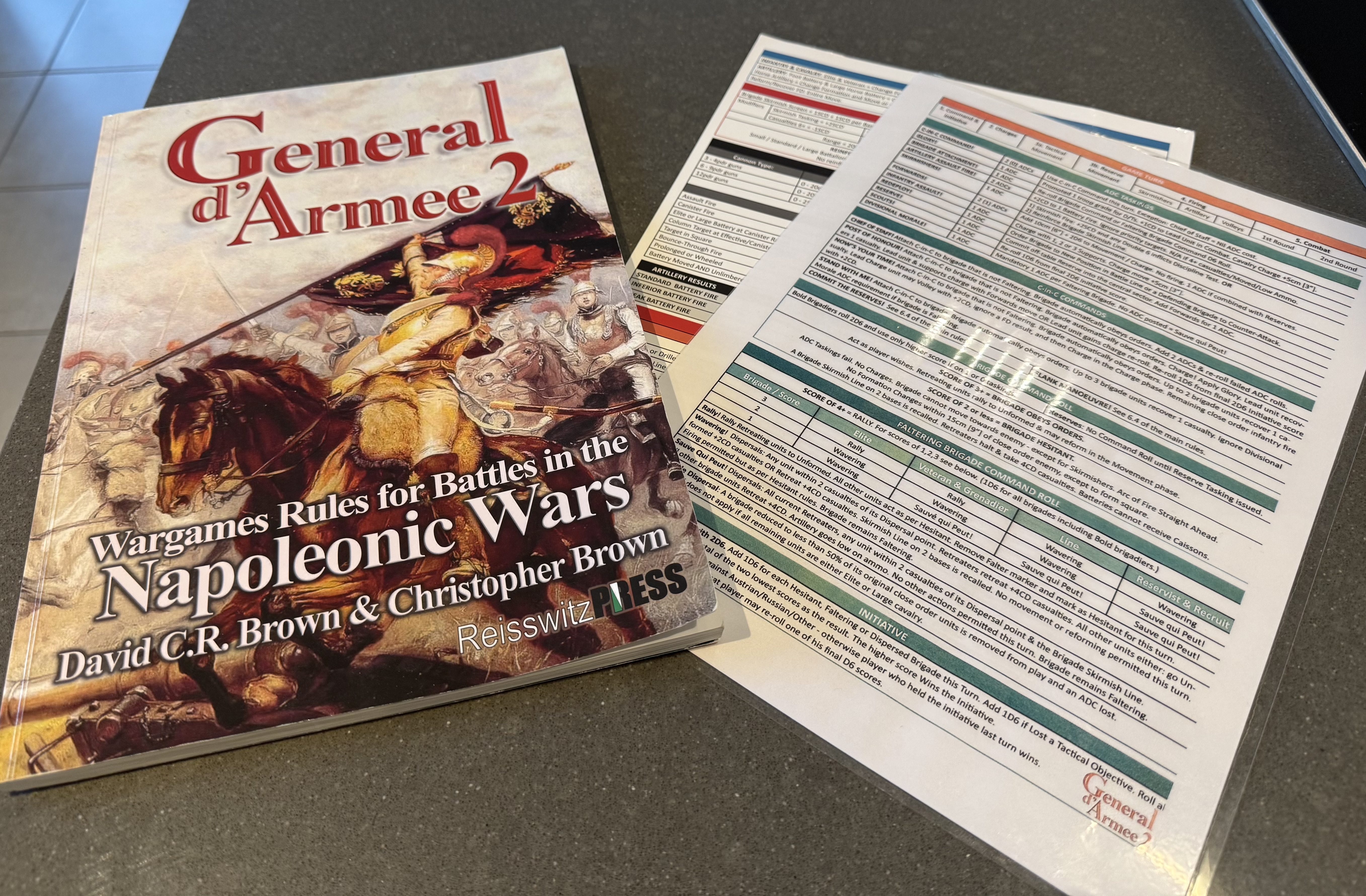
In my last post I expressed a some frustration with GDA2 rules, which I have now been using for some time. This moves on to the question of house rules to improve the system. But the rules are widely used and are comprehensive. Messing around with them is not to be done lightly. So I am writing this piece to try and clarify my own thinking.
What I like
But first we need to get this into some perspective. Why do I like GDA2? I was previously using Sam Mustafa’s Lasalle 2 rules, which are in roughly the same game space. Each side has typically 5-6 brigades of 3 to four infantry battalions or 2-3 cavalry regiments, each typically consisting of four bases, with two bases for an artillery battery. For my 18mm miniatures they can be happily played out on 4ft by 6ft table. Each set has been thoroughly thought through and play-tested by the designers, who both have a deep understanding of Napoleonic warfare.
But the period feel from GDA is so much better than it is for Lasalle. That comes at a considerable cost. Lasalle rules are simpler and so play faster; Sam has put a huge amount of thought into explaining the rules in the simplest possible way, giving them an exemplary clarity. But they are very abstracted and “gamified”. The role of commanders and skirmishers, for example, is abstracted almost out of existence. I, and my fellow gamers, much prefer GDA.
How do the rules achieve this Napoleonic feel? Two things stand out for me. First is the system of “Taskings” and “CinC commands”. These confer specific powers or bonuses to the brigades to which they are awarded. If the rules were written by me I would not use the word “tasking”, which is not a widely used word in English (it means “taskwork” in my dictionary, which is “work done as a task, or by the job” – definitions that don’t really apply here). I would call them “orders” – though that isn’t quite right either. But whatever you call them they do give the feel of a Napoleonic commander directing his troops, without all the problems of doing so more literally on the tabletop. The CinC commands – which are limited to two per game – also reflect the more dramatic interventions that senior commanders sometimes made, and are referred to in battle accounts. The command mechanisms in Lasalle 2 are very clever, and to be fair are better at reflecting move-and-response dynamics, but they feel more like a game than battlefield engagement; they are also harder to adapt to a multi-player format.
A second aspect that works really well is only allowing only one unit from each brigade to conduct a charge in the same move – which may be supported by other units in the brigade. This is the first time that I have seen it in wargames rules, and it really helps give a realistic feel. It stops the common wargame practice of two or more battalion columns bunching up and attacking a battalion deployed in line. This happened to devastating effect in one of my more recent games of Lasalle. It didn’t happen historically – one of those things that look simple on the tabletop that are impossible to accomplish in real life. This changes the dynamics of the battle in ways that give it a more authentic feel.
There are other things. The system has found a way to represent skirmishers that is consequential but not too fiddly – another rare accomplishment. Brigade commanders are represented on the table and have a role. Rules for built-up areas achieve a realistic balance that few systems achieve (though Lasalle 2 isn’t too bad either, unlike its upscale cousin, Blücher).
Minor quibbles
Overall then, it’s an excellent system. I am not tempted to try and design my own system to replace it – which, alas, I often am with rules, though rarely successfully. But there are things I don’t like. Not so much on the detail – I think they are harsh on the firepower of columns, for example – but even there I know that things are the way they are for a reason, based on deep knowledge of the period and experience of game play.
I would be tempted to redo the troop classification system, and change some of the names (e.g. grenadiers ranking below veterans). I would replace the six main categories with four: elite, professional (=veteran & grenadier), conscript (=line) and militia (= reservist & recruit). I would then add a number of special characteristics that could be overlaid (such as “drilled” already in the rules, which I might extend to rapid formation changes as well as firing). I haven’t completely got my head around to the many different sorts of cavalry classification, but I’m sure that could be simplified too. I would be tempted to give 8-gun batteries more resilience (or 6-gun ones less). But I won’t do any of this as it is sure to create more confusion amongst my fellow players, while not really changing anything much.
Another issue I discussed in my previous post is the slow speed of movement of troops outside the immediate combat area. I was a little frustrated by my attempt to move cavalry from one flank to the other in the last game. Of course you might react that it served me right for posting them in the wrong place to start with! A more serious problem is bringing up reserves for an attacking side. The table edge can be a long way from where the troops need to be deployed. These are things that I think are worth fixing with house rules, but that is quite straightforward.
Command system
That leaves two more serious problems: command friction and rules layout. To take the second, the rules are quite detailed but they aren’t laid out very clearly. If you want to refer to a particular rule that you know you’ve read somewhere, it’s often hard to find it in the rulebook (though there is an index which helps enormously). There are four sides of quick-reference sheet on two separate laminated pieces of paper. When trying to find something it is common to pick up the wrong one first, and, especially when a bit tired, it takes much longer to find things there than it should. I am in the process of putting together my own version of the QR sheet, though whether that will work any better remains to be seen. I have already put together my own version of the main rules (but not including the tables in the QR sheets), which is much more compact than the original, which a number of my fellow gamers like, but I still find myself usually going to the main rule book to look things up. All this slows the game down, though as we get more familiar with the rules, this is less of a problem.
Which brings me to the command system, which I discussed at length in my previous post. One issue I didn’t discuss is a problem with rules for bigger battles (of six brigades and more). There is a system for a corps battles, which I’ve read up, but never used. This involves a system of Corps Orders, which are quite detailed and not intuitive. In a big game this year I was asked to command the Austrians at Castaglione – which involved supervising three other players, each with their own GDA divisions. So I read up these rules to be ready – but I was relieved when the games master decided not to use them. It’s an added level complexity that could easily slow the game down. What the games master did instead was to reserve the CinC commands to the army commanders, including the limit of two per game. That worked fine, as it operated within the players’ rules knowledge.
But this points to a curiosity. The typical larger game is played using the divisional game rules as if each side was a large division. That is how the scenarios in the GDA scenario books are set up (though that is based on GDA1 – I don’t know if the Corps game rules are in them). The armies actually consist of two or more divisions. That was the case for the Lützen scenario we played for the Prussians (Ziethen and Klüx)(the French divisions and brigades of the time were large; each brigade was split in two for the scenario, and the infantry all came from the same division). It is true that the typical corps of this period were bigger than this, though. Still, the officer coordinating the battle on each side would surely have been a corps commander, even if there had other troops not on the table to look after as well (Blücher in the case of the Prussian at Lützen). What is more, the CinC commands correspond quite well to the sorts of intervention this corps commander might make (as I pointed out in my previous post). The roles of divisional commander (who would typically have two brigades and a battery) is not represented separately – it is simply integrated with the brigade command roles.
This represents a widespread game design problem. On the wargames table, with the players’ helicopter vision and compressed spaces, representing the full command hierarchy is often impractical. And it is the divisional layer that is usually skipped. But these feature historically important commanders. How to solve?
The Napoleonic command system
I think it is helpful first to reflect on the actual historical roles of generals in this era. Let’s start with the brigade. This was the basic unit of battlefield manoeuvre, consisting usually three or four infantry battalions, or two cavalry regiments. For the Austrians it was bigger: typically two infantry regiments, or six battalions. The Prussians in the later wars operated a more flexible system, with ad hoc groups of battalions being the main battlefield unit, and brigades being the equivalent of divisions in other armies (with 9 battalions and artillery). Earlier in 1813 (including Lützen), Prussian brigades look more typical, with often four battalions. But as reserve and landwehr regiments became incorporated, the brigades got larger.
Brigades would typically be commanded by a Major General (Generalmajor in German) or Général de Brigade for the French (renamed Maréchal de Camp in 1815). Colonels were often brigade leaders too. The Prussians were short of senior officers, so we often find brigade level formations led by Lieutenant- Colonels or even Majors. This is also the case for Hanoverians and other German allied armies in 1815 – doubtless for similar reasons. Note the lack of the rank of Brigadier-General (let alone the 20th century one of Brigadier – a field officer rather than a general). It did exist in the British army at the time, but it was not widely in use in the field, for reasons that I don’t know. “Brigadier” more usually referred to a French NCO. It is interesting that wargamers usually ignore ranks. Of course rank in this era was hardly a guarantee of tactical savvy – but it did convey authority. I think that lower level Prussian tactical leadership was often a bit lacking in 1815 – and the relative lack of seniority of the officers does point that way. This is rarely reflected in wargames rules. Since rank is widely available information in orders of battle I think this is a lost opportunity.
But I digress. The brigade (or perhaps the regiment where brigades comprise six battalions) was the critical tactical element in battlefield organisation, and wargames rules do a good job of reflecting this. A brigade commander would surely spend pretty much his entire time directing his battalions or squadrons. Overall I think GDA does a good job of representing command at this level. It does try to reflect quality of brigade commander (with provision for bold or poor ones) but in the games I have played we tend to ignore this. This is supposed to be determined at random at the start of a battle. The reason I don’t bother is a prosaic one. It’s an extra complication and I don’t have a good way of discreetly labelling it – my labels are typically printed a long way in advance of the game. There’s plenty of random friction in the command system anyway. It would be one way to reflect variations in command quality though – so perhaps Prussians in 1815 would have a high share of “poor” ones. However it would easier to do this by defaulting all an army’s brigade commanders: I haven’t had the courage to do this yet!
Divisions were a major innovation of the Revolutionary-Napoleonic era. Their main role was as a manoeuvre element on campaign, consisting typically of two or three brigades and an artillery battery. It would usually be led by a Lieutenant-General or French Général de Division – but it wasn’t uncommon for the more junior ranks to act up. The Prussians used over-sized brigades instead, consisting, eventually, of three regiments (nine battalions), but typically commanded by a Generalmajor. The battalions were then organised into groups of two to four ad hoc task groups, with the different regiments usually mixed up. These should form the wargames brigades.
A divisional general would typically have only a small staff, but operate in close proximity to his troops. His job was to receive and implement instructions from his superiors, and to communicate back to them. It would also be his job to maintain a wider situational awareness than would be the case for the brigade commanders. They would make direct interventions fairly frequently, often delivering orders in person.
And then we have the corps d’armée, which consisted of a variable number of infantry divisions, together with cavalry support and reserve artillery. These would be commanded by a senior general, in the French case often a Marshal. This was meant to be able to operate as a self-contained army, if need be independently of the main army. There would usually be a substantial staff. The French were the first to adopt this system, but the Austrians, Russians and Prussians had caught on by the mid-war period. Indeed by 1813 their corps commanders were rather more effective than the French ones, in my view. The system never caught on in Wellington’s armies. In the Peninsula he did create what were effectively corps under Hill and Graham, but the main body remained under his direct control. There was a nominal corps system for Wellington’s army in 1815, but this was long way from proper grand-tactical system of other major power armies. On occasion the French dispensed with the corps system too: for example Marmont’s army in 1812, which was organised in a very similar way to Wellington’s.
The problem for GDA is that games are typically bigger than a division but smaller than a corps. The solution is to pretend that the smaller ones are just large divisions, and to have a special corps superstructure for the bigger games. I don’t think this really works, and I want to try and imagine how this might work differently.
GDA command system reimagined
The starting point is that there would be no distinction between divisional and corps games. All games are corps games, though they may not represent a complete corps d’armée, but are played using the Divisional game as a basis. There is a CinC, who might be a corps commander, a divisional officer taking the lead, or even the army commander.
We need to recognise the divisional role. Each side would be divided up into a number of divisions and independent brigades, following the historical order of battle. Divisions would have a divisional commander represented on the table. My inclination is that batteries would not be not treated as part of brigades but as separate parts of a division – unless assigned to support an independent brigade. This needs thinking through, though. Corps reserve batteries may be formed into their own independent brigades of up to two batteries, with a brigade commander.
Start the turn like the Divisional Game. Throw a D6 for each allocated ADC across the whole army. The CinC player then allocates these to divisions and independent brigades, and decides whether to use one of his CinC commands. The Chief of Staff operates at Division level, but all others are brigade interventions.
Players controlling the divisions then throw a D6 for their divisional commanders, unless the division or one its brigades is subject to a CinC command. A score of 3+ means that they may intervene. This means that they are committed to one brigade (or battery), which automatically obeys orders, unless Faltering. This counts as one ADC for Taskings, but no Brigade Attachment tasking is required. In the case of a Faltering brigade, add one to the Command roll die. It replaces the Divisional morale ADC. In this case a Brigade Attachment tasking is allowed (costing a further ADC), and this allows a re-throw.
What is the ADC allocation? I think keep this at the current level, with a maximum of six (dependent on quality). This is clearly more generous than in the current game, as each divisional officer (there are likely to be two) becomes a super-ADC. However, I am proposing to treat batteries as a separate “brigades”. The maximum limit represents the fact that corps commanders could be stretched, and would struggle to manage more complex operations. There is a case for giving the attacker a bonus (or defender a penalty) at the start of the game – perhaps lasting until the move after the first time the defending side wins the initiative.
What about officer quality? There are four grades for CinC, though I hate their names (Blusterer, Commissariat, Campaigner and Incomparable). It is not just personal ability that should reflect this grade: seniority, staff resources and off-table responsibilities (i.e. trying to manage a bigger battle than the one represented on the table) affect this too. Which category should be clear from the historical context. Perhaps rename the categories: Passive; Tentative; Active; Exceptional. I would be inclined to be a bit more generous with the CinC interventions (add one). Or perhaps allow a one ADC interventions to ensure that a particular divisional officer or brigade commander is under control.
For brigades I think that leaders belonging to divisions should be rated as poor (i.e. capable of a single tasking only when left to themselves). Independent brigades would be standard, or bold if the historical context pointed that way. Occasionally they might be poor – perhaps a reluctant attachment from another formation.
Which then leaves divisional leadership. It is doubtless a good idea to represent different levels of effectiveness – and easiest to copy the nomenclature for brigade commanders. Simplest is to vary the score required on the activation die. A poor leader activates on a 4, as they spend more time on dithering and in displacement activity. A bold divisional leader may be activated on a 2. Each of these categories should be quite rare
Which leaves us with the question of initiative. There is no necessity to change the existing rules, which can be based on the number of Hesitant/Faltering brigades. However this is one of the aspects that annoy some gamers. What does it represent? I suppose an army with lots of hesitant brigades is less likely to seize the moment – but there’s an element of that old wargaming vice of double jeopardy there. Isn’t it enough that the brigades are hesitant? Besides some of those hesitant or active brigades may be quietly sitting in the rear or on an inactive flank on standby, not affecting the wider battle. A better idea (one of a number of suggestions from my friend Malc) is to base it on a single die throw based on the CinC rating. So this might be a D10 modified by quality rating (the system used in Age of Eagles, apparently). Or use different types of die depending on quality (a D10 for Active, D8 for Tentative, etc.). This might be modified upwards if the CinC is using Post of Honour, or Scouts and downwards for other CinC interventions (in these cases best to be a die modifier rather than move the quality rerating). Draws preserve the status quo, except Turn 1, which goes to the attacker.
A lot to ponder there. I will let you know how it goes get on!
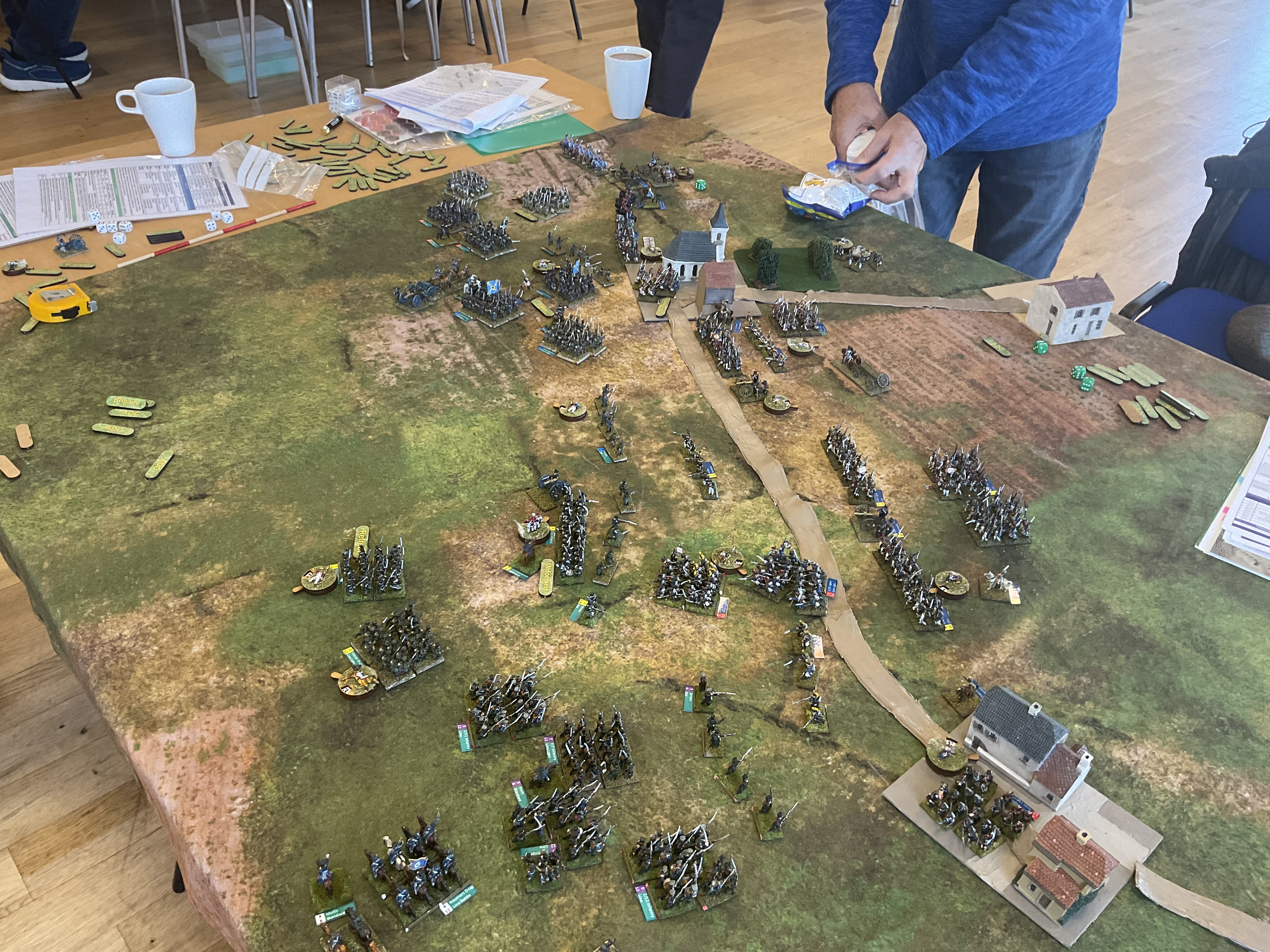
Our Lutzen game at the club at lunchtime – turn 5 I think. Prussians on the left.
Last weekend I got back to my club (Tunbridge Wells Wargaming Society) after a long break for a game of Général D’Armée 2 (GDA2). We attempted the shorter Lützen scanario in the GDA scenario book. We got as far as turn 7 after five hours of play of a supposedly 20 turn game. It was in fact clear by this point that the Prussians (played by me) weren’t going to win. Is it realistic to expect us to get through a scenario of this size in 6 hours – which I think is the effective maximum playing time for a club day? I need to know because this is not a big scenario by the standards of the GDA books.
How the game went
First a little bit of after action report. If you’ve been click-baited into this article by the title, then move on to the next heading. The French (played by regular club partner Malc)had four brigades of infantry, joined by a cavalry brigade in Turn 3. They had to defend four villages (three visible from the picture, and one off to the right) and an area of high ground (at the top of the picture). There objective was to ensure that no more than two of these fell into Prussian hands. He deployed one brigade each in and around each of the two forward villages, one in between and one as an off-table reserve.
My Prussians had three infantry brigades and one of cavalry at the start, with a further brigade of infantry arriving on turn 4. Alas I was meant to have a further brigade of cavalry, but I left it at home (along with a foot battery on each side, meaning that we had to represent each battery with a single base). The missing cavalry was two units that were supposed to be there at the start. I did bring the second brigade of one unit and one horse battery – and I deployed this at the start rather than wait to turn 3. My plan was to refuse my right and send two brigades to the left to take the high ground and village on the left (Rahna), with the remaining brigade to pin down the French centre. The cavalry covered the right flank. This plan proved defective – and Malc had correctly anticipated it.
On the left, my best brigade could not reach the high ground in time. Up popped the French cavalry reinforcements in that spot, pinning it down for the rest of the game. My cavalry was on the opposite flank and although I did redeploy it, it took too long to get it where it needed to be.
On the right my brigade ran into the fire of two batteries. At this early stage the French had plenty of of spare ADCs and so could afford Artillery Assault taskings. In the first turn they scored a double six each. After that the French artillery managed two or three 11s! The centre brigade reached the Rahna, but with one unit ragged from artillery fire. Stupidly I led the attack on the village with this unit, and it got destroyed in the attempt (more artillery fire on the way in, including one of those 11s). A second attack took the village; helped by the fact that the French were hesitant and could not reinforce the combat. But they were able to retake it the following move, when it was my turn to be hesitant. I decided to use my reinforcing brigade to shore up the collapsing brigade on my right (having been severely mauled by artillery fire), and to keep pinning the French brigades of right and centre. It did this successfully, even attacking the village (Gross Gorschen) on one occasion, but with little prospect of being able to take and hold the village.
And so we came to Turn 7. Malc had one entirely fresh brigade. All of my brigades were looking battered, with one on the edge of destruction. A final humiliation was the loss of one of my batteries (see below). The French brigade defending Rahna was getting a bit battered by now, but the others looked in reasonable shape, and I still hadn’t unpinned the brigade from the French cavalry, which was slowly being destroyed by the horse artillery. I had used both my CinC commands in a desperate attempt to keep the attack on track. I decided to throw in the towel. A throughly deserved French victory.
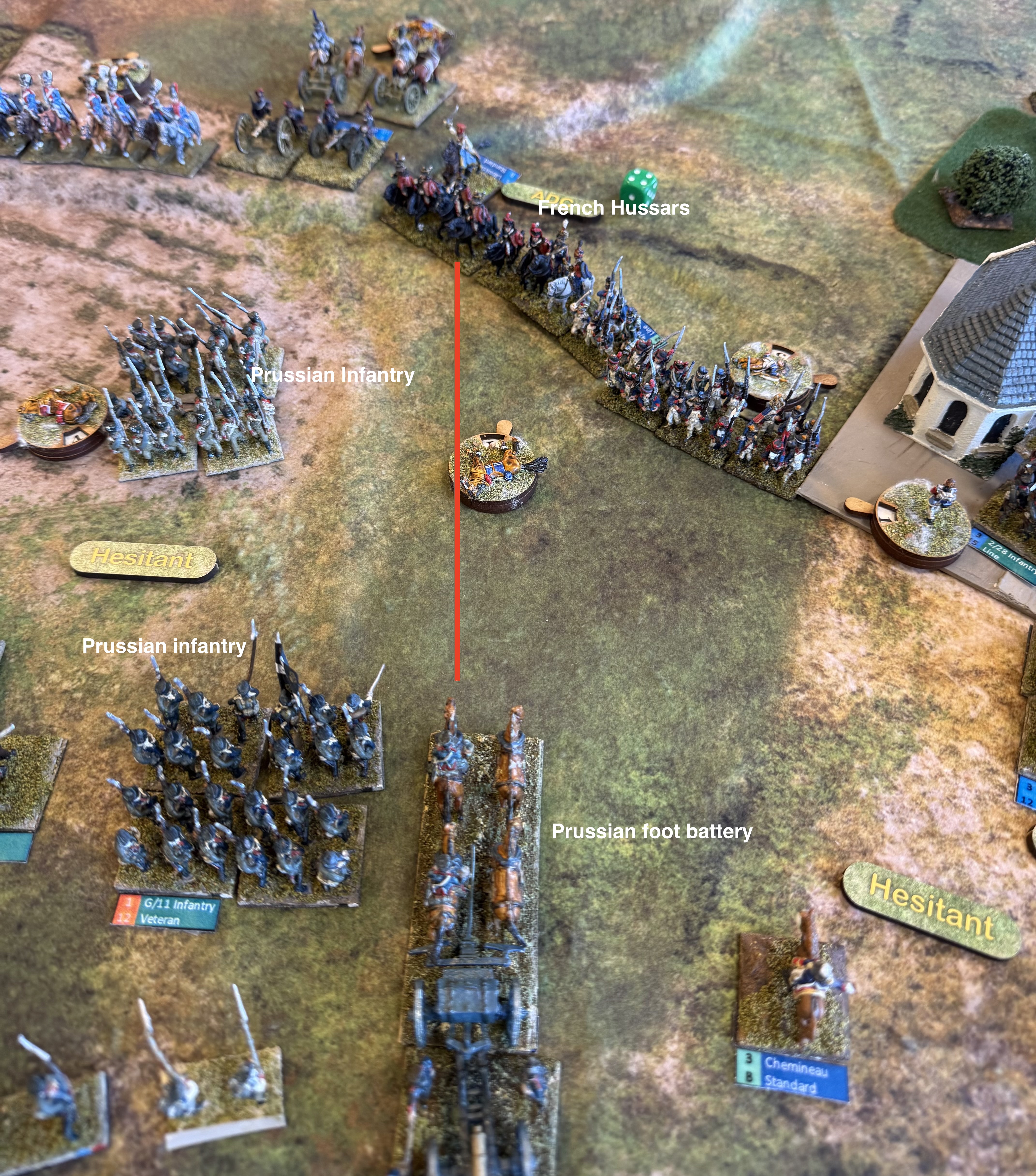
One item of interest, which I raised on the GDA Facebook group, is worth mentioning here. On turn 6 the French Hussar unit pictured below decided to attack the artillery battery I had brought up to assist the pinned brigade, but which hadn’t unlimbered. That was nasty because attacking an unlimbered foot battery means automatic dispersal. The cavalry went on to attack the Prussian column next to it, but this was beaten off with losses to both sides.
I decided this was legal, even though it meant brushing past a Prussian infantry unit in square at closer than 5cm. I thought that the rules said this could be done in a charge move – but I hadn’t read them closely enough. The only time units can get closer than 5cm to the enemy is in the final step of a charge, after reaching the 5cm point when the charge process is resolved. Thanks to FB group for setting me right! The FB group also suggested that the hussar unit could not legally manoeuvre past the infantry unit to its left. But I’m pretty liberal on such things, as I think there is more flexibility in practice – especially for cavalry which manoeuvred by squadron.
Making the game faster
This scenario is by no means large by the standards of both the 1813 and 1815 scenario books. So if I want to run these at club days we are going to have to get through them much quicker. A 20 move game needs to be do-able. First of all I will cover things that don’t involve modifying the rules.
One thing to do is have more players. We had originally planned to have a third member of our group, Rod. He would have taken charge of the Prussians, while I did the game mastering, perhaps assisting the Prussians a bit. We could easily have had two players a side with an additional game master. But I’m not sure how much faster this would have made things. At the start of turn everything focuses on the overall commander of each side; and the turn is structured into a number of phases which apply across the whole table, which means there would be quite a bit of waiting for players to finish. And more players ,more chat! But it would help.
Secondly, is to spend less time referring to the rules. I’m afraid that I’m a bit of a rules lawyer, and I really like to get things right. Many players prefer to keep things moving even if it means getting things wrong. And GDA2 is difficult to master in detail. I have written a summarised version of the rules to speed things up, but this isn’t all that helpful (though an excellent introduction to the rules). The things that I need to look up tend to be in the main book – and I found myself turning to this first. The index is a godsend. Still we were checking rules much less than in earlier games, now that I’m much more familiar with the rules. The FB group is a help here. I read the rule queries coming through there, and try to answer the ones if somebody else hasn’t got there first. And I do try to make decisions quickly at the risk of being wrong – as I was about the attack on the battery. I will think about doing my own version of the quick reference sheets (4 sides) which are notoriously hard for finding the bits you are looking for. But as a game master I need to focus on keeping things moving.
Another idea we actually implemented is to make the table a bit smaller. The scenario recommends that if possible the games should be played on a table 5ft deep and 6-8ft wide. We played on my standard battle mat which 4ft by 6ft (actually a little over). It helps that my bases are only 25-30mm wide, with four to a standard battalion. That means a standard battalion is 10-12cm frontage in line rather than the recommended 15cm. The game table wasn’t overcrowded. Since no adjustment was made to the move distances or ranges, this means things should happen a bit more quickly. And I think that was so – by move 7 it was quite clear how things were heading. That would justify knocking a few turns of the game length.
After that I’m running out of ideas. Movement sabots for columns might speed up pushing the metal around the table. I could do this relative discreetly since my bases have magnetic bottoms, so this could be done with a relatively thin piece of metallic card. Still I think bases are thick enough as they are, and sabots are usually a bit unsightly.
Fiddling with the rules
Now to consider moving beyond the pale to think about any house rules that might might things happen a bit more quickly. David Brown, the author, has done a lot of this for version 2 of GDA, and I think the combat mechanisms should be left alone. the troop quality system it could be simplified a bit, that is likely to be more trouble than it is worth. We’re getting used to the existing system fast.
Instead I want to think about making things happen more quickly at the command level, and in movement outside the combat area. I’ll tackle the second issue first. Both of these should reduce dead time and help battles get resolved in fewer turns – they won’t make the turns any quicker to resolve.
Moving reserves into combat can take quite a few moves, soaking up ADCs as you try to avoid the risk of hesitancy. This applies especially to attackers bringing in off-table reserves after having advanced deep into enemy territory. There is also an issue in moving uncommitted troops from one flank to the other, as I tried to do. I don’t think either of these was particularly difficult historically, and it’s a well known wargames design conundrum that troops more quickly outside the combat area than when you approach the enemy. At 2 mph troops could be expected to cover 30cm on the tabletop for the minimum turn length of 5 minutes; the column move distance is 15cm. When following an order to reposition, outside a combat zone, things should happen much more quickly.
My current thought experiment on this works for the Redeploy and Reserve taskings. Outside the combat zone (perhaps defined as 20cm from the nearest enemy troops, perhaps 30cm) troops with these taskings should be able to move faster – perhaps using the Forwards move rate, or simply double standard, or a fixed bonus of 20cm, say, provided units are in column or limbered. I think a road bonus could be added – to reflect their use as a navigation aid as they are too narrow to handle combat formations. The tasking is not removed at the end of the turn provided the unit is outside the combat zone. However it would still be subject to brigade command rolls, and would be lost if the brigade became hesitant. (This is actually similar to the current rule for Redeploy – though I’m not sure about losing the tasking if hesitant).
If reserves are deployed far from the front line, and the Reserve tasking or is lost because of hesitancy, then this can be replaced with a Redeploy tasking.
An alternative house rule is to allow reserves to be deployed anywhere on the table where there is a clear line of march outside the combat zone from the entry point. Where troops are forced to deploy in the combat zone, then they can do so deployed. But there would be no reserve movement. On reflection, this may be a better way of handling the reserve tasking as it is altogether quicker.
Command rules
Changes to non-combat movement amount to tweaks of the existing system. I next want to consider something much bigger, which will be beyond what most players of GDA2 will want to contemplate. But not all: because I know some people who have done this already. Iain from my old club, South London Warlords, explained this to me when we were involved in a big reconstruction of Castaglione played using GDA2 – though I’ve forgotten what he said his replacement system was! But it went to the point that I am now going to make.
The issue is the brigade command roll: this has a one-third chance of failing, reduced to one-ninth if you invest in a Brigade Attachment tasking for that brigade. This is often severely disruptive. In many cases it is entirely realistic. The brigade commander (incidentally I think the use of the word “brigadier” in this context is an anachronism – I suspect the word more usually referred to an NCO at this time, and certainly for the French, where it still does) might well get confused, or orders might get lost. But this is unlikely under the nose of his superior officer, and certainly not for more than one move in a row (a not infrequent occurrence in GDA). If the brigade was the divisional/corps commander’s focus of the time, then the brigade was very likely to do as wished. But Commander interventions are limited to two in the whole game. The rules don’t reflect this commander focus well. In any case hesitancy would be pretty obvious to the CinC in the relatively small battles in scope of GDA.
Let me digress a little at this point. The Napoleonic (and Revolutionary Wars) era was a period of command transition. In the earlier 18th century command was focused on the commander, who would array his army in one or more lines. Junior officers were expected to hold their place in the line until ordered to move by the commander. The commander would take himself to the main locus of the action and take control there. The classic pattern was Frederick the great’s “oblique order”. The commander would start on one flank and progress towards the centre as the battle unfolded. Nothing much would happen on the opposite flank unless the enemy was able to seize the initiative there. The best Napoleonic example of this was Wellington at Salamanca. Wellington’s command model was very much in this 18th century mode, though he adapted it with an intermediate divisional command instead of the inflexible lines of battle.
Roll on to Bismarck’s wars of the later 19th Century (and maybe the American Civil War or the same era – but I’m less family with this). Here the battlefields were vast and a delegated model of command was in operation. The role of the battlefield commander during the battle was limited. His main contribution was to plan of battle the night before and issue orders to his subordinates. Battles could get very muddled. We can see this devolved model developing in the Napoleonic era. Napoleon’s marshals had wide discretion when Napoleon was not breathing down their necks. In my view the most developed example was the Allied armies of 1813/14 (especially Schwarzenberg’s Army of Bohemia) – battles often turned on intermediate commanders using their initiative, while central command looked distant.
In wargames terms the best way to reflect the old model is Phil Barker’s PIP system – players get a variable allocation of PIP points which they allocate to junior commands, with those further from the commander model being harder to allocate to. No PIP, no movement. The new model is best reflected by the Fire and Fury system developed for the American Civil War, and used in Chris Pringle’s Bloody Big Battles for Bismarck’s Wars, where junior commands are subject to activation throws (called movement throws) to see if they move, and the commander has little influence over this. GDA uses elements of both: ADCs are its version of PIPs, but the brigade command roll is like the Fire and Fury movement throw.
But GDA2 games (in spite of their name) reflect smaller battles between extended divisions – so their model should be closer to the commander-centred one – which in any case was far from dead in bigger battles. So how might the rules be tilted to reflect this?
My thinking revolves around a more active Commander. The commander model can be placed with any brigade, which automatically then operates under orders, and may take on one or two taskings (two would cost an ADC). Perhaps there would be a distance restriction for moving the model around between brigades at the start of the move. ADCs and taskings would be issued to other brigades as usual. But the very powerful CinC commands would disappear. That would be a pity as these add a lovely touch of drama. They might be used to represent the intervention of a more senior commander on the field – but if so they would not be under the complete of the player. Also something on the Destiny table should knock out the CinC figure for one or more moves.
This needs more thought. One idea might be to use an event card system – cards drawn at the start of the turn might allow a senior officer intervention (i.e. CinC command), take the CinC out to deal with staff, comms or intelligence tasks, and perhaps other events. There also needs to be some mechanism for allowing for the difference between more active and passive generals.
This all needs a lot more thought – but I thought I’d put it out there!
This bottle of Custoza wine was as close as I got to the battlefield during my recent holiday on Lake Garda.
I’ve decided to do things a bit differently on this blog. I’m not posting stuff often enough. This isn’t helping me to get engagement with other hobbyists. The problem is that I haven’t been posting until I feel I have something to say – which usually means finishing a project – or perhaps exploring an issue in (like mixing paints), which takes quite a long time to write about. But my life, even though I’m retired, has quite a few other things in it other than the hobby. We go on holidays; we have people to stay; I’m chair of governors at the local primary school; I’m on a number of online committees; sometimes I just like to go for a walk or see something with my wife; and there’s the garden. The hobby has to squeeze into this agenda, and often involves a number of parallel activities which take time to resolve. There a quite long stretches when I don’t finish something, or don’t feel I have time to write a long blog piece.
But often people just like to know what you are up to. My plan is to do regular hobby updates – at least one a month. These may not take long to write (though this one is quite long) – but should be enough for any followers to have an idea about what I’m doing. This is the first and I’ll cover what I have up to since the last post, in July, following my rather unsuccessful game for the Battle of Medenine (1943) in June, featuring innovative game mechanisms.
Games
I have played just one miniatures game in the period – an Arab-Israeli scenario from the 1967 war, using Cold War Commander. This was with my regular London group of players (mainly from my ex-club of South London Warlords). This was entertaining but a bit one-sided (to the Israelis) – though John, who put the game on, didn’t think it was unrealistic. We used John’s 6mm miniatures – I particularly liked the way he used colour flashes on the back of the base to denote unit ID, without the use of labels. The rules I was a bit less impressed with. I had used the very similar Blitzkrieg Commander before, with a similar reaction.
After this the London group has met a couple of times, but playing a board game – Here I Stand – representing the Reformation in Europe. We played it quite a bit a few years ago – it’s an excellent game but no miniatures! We have one more round to go, in November.
Meanwhile my commitments conspired against my regular club’s days. I haven’t been able to play there since March. Thankfully I’ll be back on 2 November. We haven’t decided on a game yet.
Projects
The Medinine game was a bit of a downer for me. I am a long way from having a decent system for brigade level games in 1943, after having devoted to quite a bit time to trying, and getting things ready. And as for my attempt to create sangars from modelling clay and bits of model railway ballast – I really don’t want to relive that. I decided to give 1943 a long rest. I have plenty else I want to do.
So I have returned to the battle of Custoza in June 1866 in the Third War of Italian Unification (there was also a battle there in the First War in 1848), using home-produced rules. This has been interesting on a number of levels.
Custoza was the main land battle in that war. Taking advantage of Prussia’s attack on Austria, the Italian army attacked the Austrian-occupied province of Venezia. It ran into the Austrian army near Custoza, just southeast of Lake Garda and southwest of Verona. The Austrians were outnumbered but won, forcing the Italians to retreat across the Mincio. However the outcome of the war was soon decided by the Prussians at Koniggratz a few days later, and the Austrians gave up Venezia. The Italians also suffered a naval catastrophe at Lissa.
The battle looks as if it would make a great close-fought and evenly balanced war-game. It is especially interesting because the Austrians used their system of stosstaktik, which proved so disastrous against the Prussians, and is usually written off as being utterly stupid. The Austrian infantry formed into close columns (in divisions of two companies, in contrast with the more typical Napoleonic battalion columns), and went as quickly as possible for the enemy in a bayonet charge. It was no disaster at Custoza, but the Austrians suffered heavily casualties (more than the Italians), so the evidence isn’t conclusive. But it should create an interesting dynamic on the tabletop.
I started this project in 2023 (here and here), and painted up my first batches of figures then, using Pendraken’s 10mm figures. I did one batch each of Italians and Austrians. I also started work on some rules – named Forge of Nations.
Miniatures
I cleared up the considerable mess from the Medenine game from the Studio – the hobby room I have above the garage, nominally shared with my wife, though she has almost never used it. And I then did practically nothing until last week. I picked up the Italians from my last order from Pendraken, featuring all arms and generals. After basing and priming the complete batch, I decided to focus on the infantry – 9 bases of 10 line infantry, and three of 5 bersigelieri. After three sessions these are now ready for finishing (wash/glaze with a dark shade; flocking the bases).
The Italian infantry are ready for finishing. The cavalry, artillery and generals are primed in the background
Research
As it happened we went on holiday to Lake Garda a couple of weeks ago. We stayed at Salo on the western shore, but were taken bus to Verona on two occasions. The route crossed the northern edge of the Custoza battle site (from which the Austrians advanced), but it was difficult to see much. The modern motorway was a corridor of ugly modern engineering and the view across country was often obscured. This is the best I could do:
View from our coach. I think this is looking towards the village of Custoza itself. The vineyards in the foreground are doubtless modern, but this provides some indication of elevation and tree cover.
It was interesting to get a general feel for the terrain. The hills dominate the battlefield, but were surprising gentle. This is an area of morainal hills sitting between the mountainous pre-Alps and the flat plain of the Po River. The land is agricultural, and there are a lot of vineyards (the produce of which we sampled, see above), and trees, especially on field boundaries. This limits line of sight, though artillery still played an important role in this battle – doubtless because there were elevated spots with better visibility. It will also be interesting to consider how to present the table visually. The miniatures are relatively boring in appearance (both sides fought in greatcoats, notwithstanding the heat) – so good looking terrain will help. It would be quite nice to take the game to a show but that’s a long shot.
Interestingly, the coach also passed San Martino, at the northern end of the battlefield of Solferino (1859), from the Second War of Unification). I played the Piedmontese (Italians) in a beautiful recreation of this battle hosted by Bruce Weigle at Newbury. The road went right through where my troops were operating. There’s a monument to the battle, which is seen as a glorious Italian victory.
Rules
I have probably spent more time on this activity than anything else. I can do this from the study in the main house, meaning that it’s easier to do short sessions between other activities.
Forge of Nations is designed to cover 1866, including the Austro-Prussian war and 1859. This is but the hors d’oeuvres to the Franco-Prussian war in 1870-71, of course – but that is still a distant prospect.
I had produced a first draft in my first pass at the rules in 2023. This copied quite a bit from my Carolus Rex Great Northern War rules. However, I moved away from the randomised activation of different commands to a more conventional I go/you go system, which is easier to run in multiplayer games. But I wanted to use the card system described in my previous post – with a Move deck to regulate movement, and a Cohesion deck to evaluate combat and rallying.
I think the Move deck is a sound idea, and I want to persist with it. But I have been reflecting on the feedback I received on the Cohesion deck. It replaces dice throws, but comes over as a bit of a black box. Gamers have an intuitive idea about dice odds – and seeing how they land is part of the entertainment. Game design is a careful blend of innovation and conservatism, so I thought I would create a dice system that largely replicates what the cards were meant to do.
My idea is to have one distinctive die to reflect unit quality (D6 for D class, D8 for C, and so on, and then one D6 in place of each card in the old system, which reflect the attacker’s circumstances, such as weapon and range. You add each D6 result to the unit quality die – and see whether it meets a target number – which is adjusted to the unit circumstances. Each fail is a hit. A high score might an Elan result. We’ll see if it works.
Philisophical reflection
It is quite common to design a rules system based on one campaign or period, and then extend it into others. It is interesting to understand how this starting point influences the system. I am hoping to extend my 1866 rules into not just the 1870 war, but back into the Napoleonic and Revolutionary wars, and even into the next version of Carolus Rex, my Great Northern War system.
This is evident from the two different rule systems that I have used that have this battle in scope. One is Bruce Weigle’s 1866 – which is a development of his 1870 system. An interesting feature of this is that it makes extensive use of a “suppression” result for firing. 1870 was probably the first major war where troops often went to ground when fired on – as breech-loading weapons could be fired from the prone position. It is one reason why, in spite of a huge advance in the lethality of firearms, casualties did not escalate (or so I read – casualities in the FPW were still high). This doesn’t seem to have been a feature of the 1866 wars – perhaps the last in history where this applies. The Prussians had breech-loaders, but since their opponents didn’t, they don’t seem to have gone to ground. Still “suppression” could still reflect a hesitancy to move when under fire, and doubtless that is why bruce retained it.
The second system is Chris Pringle’s Bloody Big Battles (BBB). Chris also developed this originally for the FPW, so far as I can tell. But it is based on the Fire & Fury system used for the American Civil War. Going to ground wasn’t a feature of that war either. This is a more abstract system than the 1870 series, with a higher level of scaling (typically a base represents double the number of troops) – so doubtless Chris felt that representing suppression specifically was a needless complication: he has been ruthless in keeping the mechanisms as simple as possible, which is one of the great strengths of the system. However, the European wars of 1859-1871 were not the ACW, even though they are contemporary with it. The weapon systems (for the Prussians in 1866 and both sides in 1870-71) were different and this played a critical role in tactics – but BBB does a careful job of representing this. The use of cavalry was different too – the Europeans clung to the romance of the Napoleonic era, insisting that the charge into close combat was the most important cavalry tactic, and retaining pretty uniforms in many cases, while largely neglecting firearms. The Americans were much more flexible, often deploying cavalry on foot, using firearms – which proved to be the way of the future. BBB retains this approach, with cavalry being very similar to infantry in the way it is represented. Cavalry didn’t play a big role in the European wars, so this doesn’t matter that much. But if you start on the European side of the Atlantic with your system, you would try a bit harder to reflect the possibilities of the grand charge – as the Weigle rules do.
My rules use much the same scaling as BBB, but the base articulation of 1866. Bases move individually, and are not organised into rigid units. Cavalry have a more Napoleonic feel. If I take them into 1870, I will need to reflect suppression in some way, but for now I’m ignoring it.
What BBB and 1866 share, with very different mechanisms, is strong command friction. Command and control is heavily devolved – the direct influence of corps and army commanders is limited – and subject to heavy activation tests. This clearly reflects how things worked in this period – and it is one of the reasons that I find that BBB does not translate so easily into the Napoleonic era – when the action was much more centrally directed, but subject to less friction. This will be interesting to reflect in my rules.
I haven’t posted for three months. In that time I have mainly been participating in other people’s games, using other people’s toys. And a lot of fun it has been too. Notably, I took on the role of Napoleon at Waterloo (using Horse, Foot, Guns) and Würmser at Castaglione, in a huge game of Général d’Armée 2. Unfortunately I haven’t had much opportunity to expand my collections. I have bought the miniatures for six battalions of late period Napoleonic French, but I’m a long way from starting the painting.
A selection of my Turn deck cards
My big focus has been on rules. I have been working on WW2 rules for brigade sized encounters, using a hex board. The forces are roughly those for Rapid Fire! but the mechanisms are very different. I was developing some ideas that I could use in other periods. I have now played these out in a game with one of my groups of playing buddies. Unfortunately, I didn’t have the presence of mind to take pictures. Overall, I thought the game was more failure than success, and it is prompting a big soul-searching rethink. Still, I thought it would be interesting to share some of the ideas that I road-tested. These involved the use of cards. Dice had a minor role in the system.
The first, and most successful, was the Turn Deck. This drove the order of play. Each Turn was divided into a number of moves, where, for the most part, players could move one hex for eligible units, or fire. Units that had not moved could reaction fire on those that did. Both sides moved, but the cards dictated which side moved first. Four of these cards were General Moves, where all units could move (though for two of these, not in difficult terrain); in these moves players could also change orders and enter close combat. There were then six vehicle move cards, where only vehicles could move, but could not initiate fire; fast vehicles could move on all six of these, slow ones on only two. In addition there were four Area fire cards, where area fire was evaluated (the targets having been previously selected). There were two “Pause” cards. When the second of these was drawn, the Turn was concluded. On the first one I allowed some stealth movement, where elements could move without attracting reaction fire. There were also a pair of cards for road movement, and another pair for recce movement.
The big idea was to do away with the complexity of movement allowances and terrain effects. Faster units can move more often; and that was built into the cards. You still needed to know whether vehicles were slow, medium (the bulk of them) or fast, or had strong all-terrain ability – and even then that only mattered when certain cards where drawn. No tables of movement rates! A further aim was to randomise the timing of area fire (typically indirect). Separate area fire moves meant that by the time the fire arrived the target might have moved on. One experienced British infantry officer said that the trick for attackers was to keep moving so that the enemy artillery never caught up. The whole thing worked very much as I hoped, with the mixed order of the card draw making things very unpredictable. You could easily get three Area Fire cards in a row, which might really mess things up – or you might be forced to move before your hoped-for suppression fire had materialised. The variable Turn length added another dimension of unpredictability. Each Turn was meant to represent a distinct episode – the scope of a game of O Group perhaps – after which there would be regrouping.
My main criticism of the system is that the General Moves were overloaded, and I had to devise a move sequence to handle this – which went against the simplicity. The stealth moves should probably get a card of their own, with the first pause card being a short breathing space to recover suppression and pull back if desired. Should both sides be able to move each turn, or follow the more modern idea of only one side, randomising things yet further? As yet I see no reason to change it.
Examples of cards from the Hit Deck
The next most successful idea was the “Hit Deck”. This had two functions. The main one was to resolve antitank fire quickly. It was also used to resolve communications for orders and area fire. AT fire has been something of a frustration for me with WW2 rules. You have to balance three main things: the weapon capability, the armour strength and the range. You then factor in things like target size and cover. This usually involves a couple of dice and a table. Rapid Fire! has a simple table and a single die – which for my taste takes things too far the other way. The Hit deck has 50 cards. These are divided into 13 groups of 3 or 4 cards; one group misses at all ranges, the next hits at one hex only, and so on to the last group which hits all the way up to 12 hexes. The cards also vary the AP value of the gun; the earlier ones in the above sequence with more positive variations, the later with more negative. If the AP value equals or exceeds the armour value (both based on the Rapid Fire! system but reverse sequence), then you have a damage hit. This is very quick and simple; all you need is the attack and defence values.
The comms test is much less interesting, except the one SNAFU card, which takes any area fire into a randomly chosen neighbouring hex.
This system further reduces the need for tables and quick reference sheets. The only real difficulty is that it isn’t intuitive to people newer to it. With a target dice score you instantly understand the odds – the cards feel more like firing blind, until you have properly internalised the pack structure.
Examples from the cohesion deck. Alas my laser printer does not do a good job of distinguishing between yellow and orange – which I don’t think helped.
That is probably an even bigger problem with the third deck, the Cohesion Deck. This is a morale test system: each card (again there are 50) gives one of three results, depending on three variables: fail, pass or elan. As currently designed there are only ever two possible outcomes on each card (pass/fail or pass/elan). The variables are troop quality (A, B, C or D), risk factor (Green, Yellow, Amber and Red) and density (dense or dispersed). Each increase in troop grade improves odds by about 20%; each increase risk factor roughly doubles the odds of failure; the difference in odds for density is about a third. The odds of failure for a dense B class unit at red is 50%, and of an elan result are 6%. There are two special cards – Apocalypse (everything fails) and Fortuna (always elan) which on drawing the pack is reshuffled.
A further variable is to be the number of cards drawn. So that a rifle group firing at one hex range would cause two cards to be drawn, but one card at two hexes (red risk if moving in the open, amber if gone to ground, and yellow if dug in). Very simple and easy to remember, but my gaming friends found it all a bit of a black box. The risk categories were hardly fine grained either, though that suited this system.
I have designed the Cohesion Deck to work in any period. My next project is rules for 1866 wars with Austria. I’m not sure whether I will use it, or go back to a dice-based method.
I created the cards on PowerPoint, and printed them off as handouts four to a sheet. I then cut these out and put them into card sleeves (from Titanshield), with a different colour for each pack. These played and shuffled well enough. I think that I could probably work out a way of printing them off with less wasted paper though (you should be able to get at least 12 to a sheet of A4, not 4).
As for the WW2 game, the issues go much deeper than the working of the three card decks. It needs a major rethink. This starts with what I think the game is actually about, and what is meant to be the source of tension. Most WW2 systems are designed with tank battles in mind. There is an important exception for O Group and Chain of Command, which are infantry-based, but on a smaller unit of command. For the theatre that I am concentrating on (Mediterranean 1943), there are no big tank battles, like there were in the desert war or Russia. Those infantry games start with a clear idea of what the game is about, beyond playing with your toy soldiers. That needs be the case with my system too. On the brighter side 1943 brigade battles were often quite slow burn – and that is a good fit with the episodic turn-move system – but I need to think more about the deployment of forces and reinforcements.
The best map available of Medenine from the regimental history of the Queen’s . The scenario was based on 15 Panzer’s attack in the centre.
The Medenine scenario was quite interesting. I based in on the Rapid Fire! scenario. But I soon realised that this was based on extremely limited information on the battle (practically none from German sources that I could see), all from sources that I have traced; the armies were chosen with the help of a points system. The terrain was then made to fit the standard terrain pieces designed for their desert war scenario book. I tried tracking the terrain shape more faithfully, but found that the German forces were highly congested at the start line – and this encouraged a broad front attack, rather than carefully selecting lines of advance, which the Germans actually did. It occurred to me that the issue was that the German forces were not fully available at the start of the attack. I have often found that trying to war-game a scenario helps develop an understanding of historical events. This is true here too.
My battlefield terrain was another failure – but I won’t dwell on that here. I will come back to this with a different approach! Meanwhile I will go back to other periods…
But to return to original topic – the cards were a good way of reducing complexity of play. The QR sheet could quickly be reduced to one side of A4. But it is a bit of a black box, and many wargamers are addicted to the D6. I think I need to keep going though.
The French mass for the attack on Ligny – this is the trial set up at home
My most recent club game was a “small Ligny” – excluding the action on the eastern flank, and the final commitment of reserves by Napoleon. This was not in fact a serious refight – the main aim was to familiarise ourselves with the Horse, Foot, Guns rules, which we are due to use for a “big Waterloo” game (including Wavre and Grouchy) in a month’s time. This latter game, put on by somebody else at the club, promises to be very interesting. We will use 2mm troop blocks with the lovely Ferraris map as the playing surface.
Still, Ligny (two days before Waterloo in 1815) is an enduring fascination of mine. I want to do a full version of it using my own rules – and a “big Ligny” too, incorporating Quatre Bras. It is a very demanding test of a grand tactical rules system. To date I have tried Blücher and my own adaptation of Bloody Big Battles; both failed – the French didn’t stand a chance. There are two big challenges: fighting in the villages, and Prussian command and control, where the two and eventually three corps became intermingled, and where the (division-sized) Brigades were sometimes broken into pieces ad-hoc. How would HFG do?
The game in progress with Gerard’s division attacking Ligny village in the foreground. Chateau Ligny is on the wrong side of the stream…
We used my own version of HFG, which I produced nearly 10 years ago – as the original’s scope was too wide (1700-1910, naval support, etc.) and densely-written (by Phil Barker of Wargames Research Group fame). These were designed to work with my basing system. I felt it would be easier to use these rather than the originals, which were slightly updated (V1.1) since ten years ago. I fought two battles with the system (Waterloo and Salamanca – both described on these pages – search for HFG) before moving on.
Each element was about 2,000 infantry, 1,200 cavalry or 20 guns. The bases corresponded to French infantry brigades or cavalry divisions – with a couple of extra bases for Vandamme’s corps. For the Prussians I used one element for each regiment – though in practice they mixed the regiments up. On numbers they should have had a couple of elements more – but the OB I was using did not account for losses at Gilly the day before, and I gave them an addition of Chateau Ligny as a strongpoint, without deducting anything for the garrison. The landwehr I graded as inferior, but all other troops on both sides were standard. This is a bit generous to the Prussians. The French were probably better quality in general, and some of the newer Prussian regiments were not tip-top, especially where they represented elements of different formations thrown together. Still HFG has only three quality grades, so fine-tuning was not possible. Elite would have been reserved for the French senior Guard (at Ligny, but not on my table). For the Prussians I got a lot of pleasure from using my collection to get figures closely approximating the actual regiments in 1815. The French were my hard-working 1809 miniatures, so not especially realistic.
The board was thrown together quickly. The playing area is just 3ft by 3ft. It was thrown together very rapidly from elements that I had in stock – the hills in particular only vaguely reflect the actual terrain. Ligny brook was treated as an area of slow-going. Ligny village was treated as two built-up ares (BUAs), separated by the brook. St Armand was treated as parkland/orchard (slow going, cover from artillery, but otherwise limited impact), with Longpré, where most of the fighting on that flank took place, was treated as a single BUA. I used my new Geek Villain “Field of Glory” battle mat – which was glorious, in spite of not being to scale. I used 6mm buildings, as anything bigger doesn’t work at this very compact ground scale. I shouldn’t be using 18mm miniatures – but I’m not building 6mm or 10mm armies up from scratch! There is more than even the usual disconnect between figure and ground scale (but if that’s all right for Rapid Fire!…).
We played for about 3 hours, packing up for the club AGM, which took place at 2pm. I wasn’t counting the number of turns. HFG turns represent a short time interval (10-15 minutes), so there are meant to be lots of turns, but it was inevitably slow at first. We only really got as far as the opening stages of the battle. The French, played by Malc, massed all their artillery in the centre, and proceeded to drive off the outnumbered Prussian artillery opposite. Meanwhile Gérard”s corps tried to pile into Ligny, Girard’s division into Longpré, and Vandamme worked round the French left, eventually joining the attack on Longpré. The Prussians, played by Rod, gradually moved their second line – from Pirch II’s corps – round to the right flank. Gérard repeatedly tried to break into Ligny, and only succeeded in the last move before we broke up. He only lost one element – but not to the fighting in the BUA but to a single Prussian artillery battery posted on their left, out of range from the French artillery. It was the only destroyed element on either side during the game.
Girard and Vandamme’s attacks on Longpré were just as futile, and never broke in. Given that historically the French did break into both places fairly quickly and then started a seesaw battle, sucking in almost all the two Prussian corps’ infantry, this didn’t seem to be reflecting history. It was also rather dull and slow game play. HFG was not a good system for this battle. A more appropriate trial game would have been smaller and on more open terrain.
On the two Ligny problems, I don’t think HFG handled the first (BUAs) at all well. Part of our problem was unfamiliarity with the rules. In HFG there are two phase of combat: “firing”distant combat” and close combat. Infantry can’t move into close combat without starting from within firing range. When attacking BUAs this initial firing combat is critical, and the defenders start with a big advantage. It’s important to get this right, or otherwise your attack won’t get to the close combat stage – which is also at a significant disadvantage unless you can get a “silenced” result in firing combat. If the French had got this sequence right, they would have done much better at Ligny – not so much at Longpré.
Still I don’t think the rules capture Napoleonic BUA combat well. Fire combat before the sides closed was not important historically. In practice defenders could only mount skirmish fire at the edges. Most of the combat in the interior took place in the streets, without much cover. There was a lot of close-quarter fighting with little or no advantage to the defender – unless they could organise on a strong point with a secure perimeter, such as a churchyard (and even then this usually needed to be prepared in advance to be properly effective). The rules seem to framed for later 19th century warfare, with far more effective firearms, and where soldiers used the local cover to much better advantage.
On command and control the rules did pose a challenge. The corps commanders were “command parties” which were mobile but only have a small command radius. Army commanders can’t give direct orders to units not under direct command. With Prussians’ large corps this made it hard going. That wasn’t unrealistic – though historically the battle was controlled by the army command, with the corps commanders having only a limited role, it ended up in a similar place.
Another thing to learn from the rules is that because the turns represent a short time period, you can be patient, building your position before launching an attack, and using long artillery bombardments (five or six turns, even).
My earlier criticisms of HFG stand, however. The biggest of the is that it doesn’t capture attritional combat well – the gradual wearing down of armies. It is a low-probability/high impact system, which I don’t really like, though this works better the armies and timescale. The fact that both sides must dice for each combat and add up combat factors slows things down, though this speeds up with practice; this matters when you need to get a lot of turns in. Although I can think of ways of improving the system a bit, I’m not investing in it – I’m going a different way.
The journey on my big battle rules continues. I got quite a long way with a new activation system inspired by Lasalle II on my BBB-based system, but I realised this was not going to work in the multi-player games that I want to play. Instead I’m working on some other ideas:
Instead of multi-based units in contact, in formations analogous to lines and columns (following BBB), I want to try moving each base as an individual element – a bit like HFG, except that the elements are smaller (say 1,000 infantry rather than 2,000, with a 30mm frontage rather than 50mm), and each subject to damage before being removed. This follows Bruce Weigle system for his 1870 series.
I want to use a card system for quick resolution of morale. A bit like the Twilight rules, combat will be resolved by alternating morale tests.
I’m thinking of using a card system to drive the turns too – but this is undeveloped in the Napoleonic context. The central idea is that all moves are standard (say 6in), but not all units can move every move.
My idea is the develop a series of systems with common elements to cover WW2, Bismarck’s wars, Napoleonic and the Great Northern War. I’m close to testing the WW2 system, and I am thinking of moving to Bismarck’s wars next. Meanwhile for Napoleonics I’m playing very enjoyable mid-sized battles with Général d’Armée 2.