Tag: GDA2

  • Général D’Armée 2 – thinking aloud

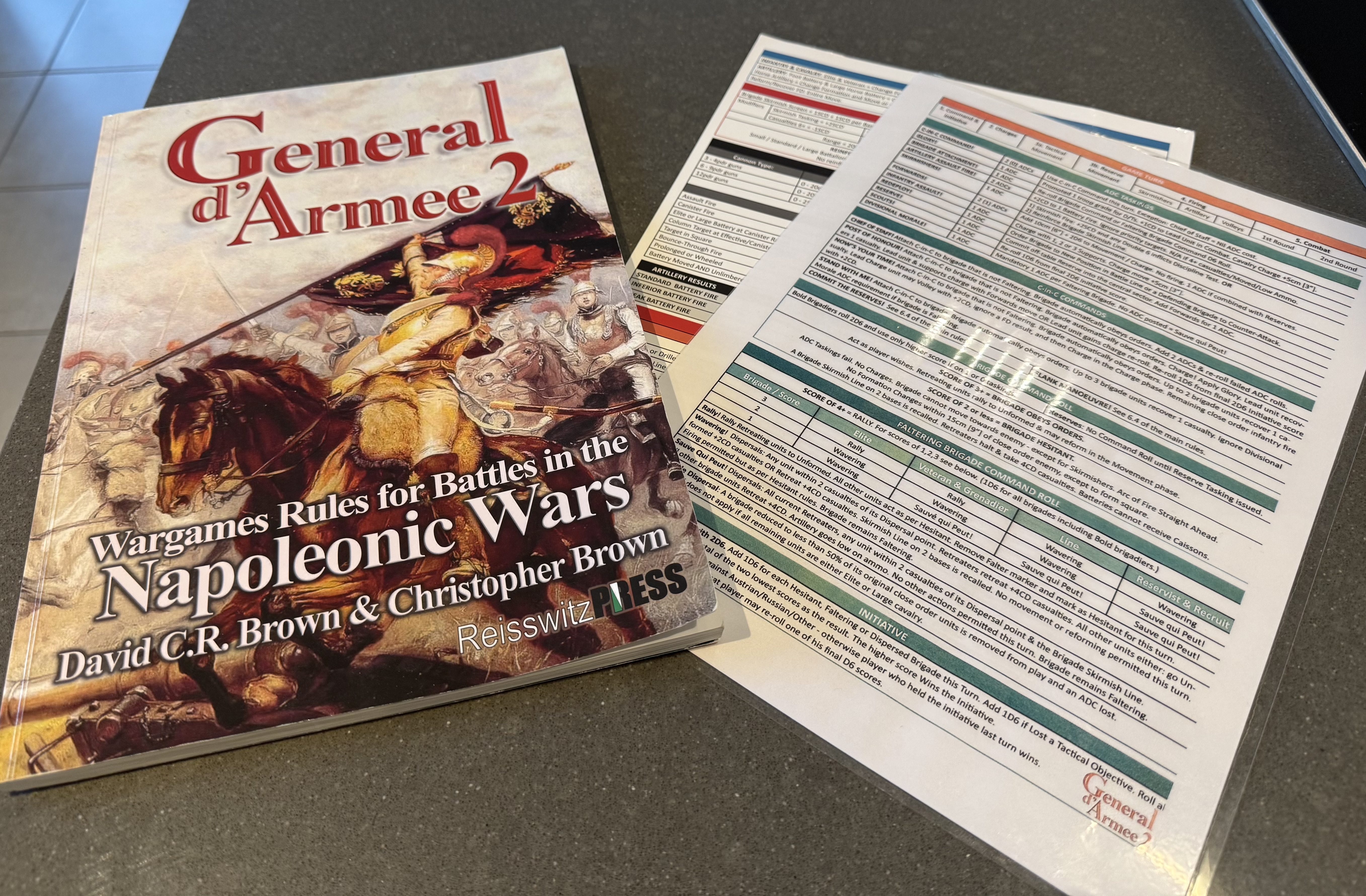
    The rulebook with QRS sheets

    In my last post I expressed a some frustration with GDA2 rules, which I have now been using for some time. This moves on to the question of house rules to improve the system. But the rules are widely used and are comprehensive. Messing around with them is not to be done lightly. So I am writing this piece to try and clarify my own thinking.

    What I like

    But first we need to get this into some perspective. Why do I like GDA2? I was previously using Sam Mustafa’s Lasalle 2 rules, which are in roughly the same game space. Each side has typically 5-6 brigades of 3 to four infantry battalions or 2-3 cavalry regiments, each typically consisting of four bases, with two bases for an artillery battery. For my 18mm miniatures they can be happily played out on 4ft by 6ft table. Each set has been thoroughly thought through and play-tested by the designers, who both have a deep understanding of Napoleonic warfare.

    But the period feel from GDA is so much better than it is for Lasalle. That comes at a considerable cost. Lasalle rules are simpler and so play faster; Sam has put a huge amount of thought into explaining the rules in the simplest possible way, giving them an exemplary clarity. But they are very abstracted and “gamified”. The role of commanders and skirmishers, for example, is abstracted almost out of existence. I, and my fellow gamers, much prefer GDA.

    How do the rules achieve this Napoleonic feel? Two things stand out for me. First is the system of “Taskings” and “CinC commands”. These confer specific powers or bonuses to the brigades to which they are awarded. If the rules were written by me I would not use the word “tasking”, which is not a widely used word in English (it means “taskwork” in my dictionary, which is “work done as a task, or by the job” – definitions that don’t really apply here). I would call them “orders” – though that isn’t quite right either. But whatever you call them they do give the feel of a Napoleonic commander directing his troops, without all the problems of doing so more literally on the tabletop. The CinC commands – which are limited to two per game – also reflect the more dramatic interventions that senior commanders sometimes made, and are referred to in battle accounts. The command mechanisms in Lasalle 2 are very clever, and to be fair are better at reflecting move-and-response dynamics, but they feel more like a game than battlefield engagement; they are also harder to adapt to a multi-player format.

    A second aspect that works really well is only allowing only one unit from each brigade to conduct a charge in the same move – which may be supported by other units in the brigade. This is the first time that I have seen it in wargames rules, and it really helps give a realistic feel. It stops the common wargame practice of two or more battalion columns bunching up and attacking a battalion deployed in line. This happened to devastating effect in one of my more recent games of Lasalle. It didn’t happen historically – one of those things that look simple on the tabletop that are impossible to accomplish in real life. This changes the dynamics of the battle in ways that give it a more authentic feel.

    There are other things. The system has found a way to represent skirmishers that is consequential but not too fiddly – another rare accomplishment. Brigade commanders are represented on the table and have a role. Rules for built-up areas achieve a realistic balance that few systems achieve (though Lasalle 2 isn’t too bad either, unlike its upscale cousin, Blücher).

    Minor quibbles

    Overall then, it’s an excellent system. I am not tempted to try and design my own system to replace it – which, alas, I often am with rules, though rarely successfully. But there are things I don’t like. Not so much on the detail – I think they are harsh on the firepower of columns, for example – but even there I know that things are the way they are for a reason, based on deep knowledge of the period and experience of game play.

    I would be tempted to redo the troop classification system, and change some of the names (e.g. grenadiers ranking below veterans). I would replace the six main categories with four: elite, professional (=veteran & grenadier), conscript (=line) and militia (= reservist & recruit). I would then add a number of special characteristics that could be overlaid (such as “drilled” already in the rules, which I might extend to rapid formation changes as well as firing). I haven’t completely got my head around to the many different sorts of cavalry classification, but I’m sure that could be simplified too. I would be tempted to give 8-gun batteries more resilience (or 6-gun ones less). But I won’t do any of this as it is sure to create more confusion amongst my fellow players, while not really changing anything much.

    Another issue I discussed in my previous post is the slow speed of movement of troops outside the immediate combat area. I was a little frustrated by my attempt to move cavalry from one flank to the other in the last game. Of course you might react that it served me right for posting them in the wrong place to start with! A more serious problem is bringing up reserves for an attacking side. The table edge can be a long way from where the troops need to be deployed. These are things that I think are worth fixing with house rules, but that is quite straightforward.

    Command system

    That leaves two more serious problems: command friction and rules layout. To take the second, the rules are quite detailed but they aren’t laid out very clearly. If you want to refer to a particular rule that you know you’ve read somewhere, it’s often hard to find it in the rulebook (though there is an index which helps enormously). There are four sides of quick-reference sheet on two separate laminated pieces of paper. When trying to find something it is common to pick up the wrong one first, and, especially when a bit tired, it takes much longer to find things there than it should. I am in the process of putting together my own version of the QR sheet, though whether that will work any better remains to be seen. I have already put together my own version of the main rules (but not including the tables in the QR sheets), which is much more compact than the original, which a number of my fellow gamers like, but I still find myself usually going to the main rule book to look things up. All this slows the game down, though as we get more familiar with the rules, this is less of a problem.

    Which brings me to the command system, which I discussed at length in my previous post. One issue I didn’t discuss is a problem with rules for bigger battles (of six brigades and more). There is a system for a corps battles, which I’ve read up, but never used. This involves a system of Corps Orders, which are quite detailed and not intuitive. In a big game this year I was asked to command the Austrians at Castaglione – which involved supervising three other players, each with their own GDA divisions. So I read up these rules to be ready – but I was relieved when the games master decided not to use them. It’s an added level complexity that could easily slow the game down. What the games master did instead was to reserve the CinC commands to the army commanders, including the limit of two per game. That worked fine, as it operated within the players’ rules knowledge.

    But this points to a curiosity. The typical larger game is played using the divisional game rules as if each side was a large division. That is how the scenarios in the GDA scenario books are set up (though that is based on GDA1 – I don’t know if the Corps game rules are in them). The armies actually consist of two or more divisions. That was the case for the Lützen scenario we played for the Prussians (Ziethen and Klüx)(the French divisions and brigades of the time were large; each brigade was split in two for the scenario, and the infantry all came from the same division). It is true that the typical corps of this period were bigger than this, though. Still, the officer coordinating the battle on each side would surely have been a corps commander, even if there had other troops not on the table to look after as well (Blücher in the case of the Prussian at Lützen). What is more, the CinC commands correspond quite well to the sorts of intervention this corps commander might make (as I pointed out in my previous post). The roles of divisional commander (who would typically have two brigades and a battery) is not represented separately – it is simply integrated with the brigade command roles.

    This represents a widespread game design problem. On the wargames table, with the players’ helicopter vision and compressed spaces, representing the full command hierarchy is often impractical. And it is the divisional layer that is usually skipped. But these feature historically important commanders. How to solve?

    The Napoleonic command system

    I think it is helpful first to reflect on the actual historical roles of generals in this era. Let’s start with the brigade. This was the basic unit of battlefield manoeuvre, consisting usually three or four infantry battalions, or two cavalry regiments. For the Austrians it was bigger: typically two infantry regiments, or six battalions. The Prussians in the later wars operated a more flexible system, with ad hoc groups of battalions being the main battlefield unit, and brigades being the equivalent of divisions in other armies (with 9 battalions and artillery). Earlier in 1813 (including Lützen), Prussian brigades look more typical, with often four battalions. But as reserve and landwehr regiments became incorporated, the brigades got larger.

    Brigades would typically be commanded by a Major General (Generalmajor in German) or Général de Brigade for the French (renamed Maréchal de Camp in 1815). Colonels were often brigade leaders too. The Prussians were short of senior officers, so we often find brigade level formations led by Lieutenant- Colonels or even Majors. This is also the case for Hanoverians and other German allied armies in 1815 – doubtless for similar reasons. Note the lack of the rank of Brigadier-General (let alone the 20th century one of Brigadier – a field officer rather than a general). It did exist in the British army at the time, but it was not widely in use in the field, for reasons that I don’t know. “Brigadier” more usually referred to a French NCO. It is interesting that wargamers usually ignore ranks. Of course rank in this era was hardly a guarantee of tactical savvy – but it did convey authority. I think that lower level Prussian tactical leadership was often a bit lacking in 1815 – and the relative lack of seniority of the officers does point that way. This is rarely reflected in wargames rules. Since rank is widely available information in orders of battle I think this is a lost opportunity.

    But I digress. The brigade (or perhaps the regiment where brigades comprise six battalions) was the critical tactical element in battlefield organisation, and wargames rules do a good job of reflecting this. A brigade commander would surely spend pretty much his entire time directing his battalions or squadrons. Overall I think GDA does a good job of representing command at this level. It does try to reflect quality of brigade commander (with provision for bold or poor ones) but in the games I have played we tend to ignore this. This is supposed to be determined at random at the start of a battle. The reason I don’t bother is a prosaic one. It’s an extra complication and I don’t have a good way of discreetly labelling it – my labels are typically printed a long way in advance of the game. There’s plenty of random friction in the command system anyway. It would be one way to reflect variations in command quality though – so perhaps Prussians in 1815 would have a high share of “poor” ones. However it would easier to do this by defaulting all an army’s brigade commanders: I haven’t had the courage to do this yet!

    Divisions were a major innovation of the Revolutionary-Napoleonic era. Their main role was as a manoeuvre element on campaign, consisting typically of two or three brigades and an artillery battery. It would usually be led by a Lieutenant-General or French Général de Division – but it wasn’t uncommon for the more junior ranks to act up. The Prussians used over-sized brigades instead, consisting, eventually, of three regiments (nine battalions), but typically commanded by a Generalmajor. The battalions were then organised into groups of two to four ad hoc task groups, with the different regiments usually mixed up. These should form the wargames brigades.

    A divisional general would typically have only a small staff, but operate in close proximity to his troops. His job was to receive and implement instructions from his superiors, and to communicate back to them. It would also be his job to maintain a wider situational awareness than would be the case for the brigade commanders. They would make direct interventions fairly frequently, often delivering orders in person.

    And then we have the corps d’armée, which consisted of a variable number of infantry divisions, together with cavalry support and reserve artillery. These would be commanded by a senior general, in the French case often a Marshal. This was meant to be able to operate as a self-contained army, if need be independently of the main army. There would usually be a substantial staff. The French were the first to adopt this system, but the Austrians, Russians and Prussians had caught on by the mid-war period. Indeed by 1813 their corps commanders were rather more effective than the French ones, in my view. The system never caught on in Wellington’s armies. In the Peninsula he did create what were effectively corps under Hill and Graham, but the main body remained under his direct control. There was a nominal corps system for Wellington’s army in 1815, but this was long way from proper grand-tactical system of other major power armies. On occasion the French dispensed with the corps system too: for example Marmont’s army in 1812, which was organised in a very similar way to Wellington’s.

    The problem for GDA is that games are typically bigger than a division but smaller than a corps. The solution is to pretend that the smaller ones are just large divisions, and to have a special corps superstructure for the bigger games. I don’t think this really works, and I want to try and imagine how this might work differently.

    GDA command system reimagined

    The starting point is that there would be no distinction between divisional and corps games. All games are corps games, though they may not represent a complete corps d’armée, but are played using the Divisional game as a basis. There is a CinC, who might be a corps commander, a divisional officer taking the lead, or even the army commander.

    We need to recognise the divisional role. Each side would be divided up into a number of divisions and independent brigades, following the historical order of battle. Divisions would have a divisional commander represented on the table. My inclination is that batteries would not be not treated as part of brigades but as separate parts of a division – unless assigned to support an independent brigade. This needs thinking through, though. Corps reserve batteries may be formed into their own independent brigades of up to two batteries, with a brigade commander.

    Start the turn like the Divisional Game. Throw a D6 for each allocated ADC across the whole army. The CinC player then allocates these to divisions and independent brigades, and decides whether to use one of his CinC commands. The Chief of Staff operates at Division level, but all others are brigade interventions.

    Players controlling the divisions then throw a D6 for their divisional commanders, unless the division or one its brigades is subject to a CinC command. A score of 3+ means that they may intervene. This means that they are committed to one brigade (or battery), which automatically obeys orders, unless Faltering. This counts as one ADC for Taskings, but no Brigade Attachment tasking is required. In the case of a Faltering brigade, add one to the Command roll die. It replaces the Divisional morale ADC. In this case a Brigade Attachment tasking is allowed (costing a further ADC), and this allows a re-throw.

    What is the ADC allocation? I think keep this at the current level, with a maximum of six (dependent on quality). This is clearly more generous than in the current game, as each divisional officer (there are likely to be two) becomes a super-ADC. However, I am proposing to treat batteries as a separate “brigades”. The maximum limit represents the fact that corps commanders could be stretched, and would struggle to manage more complex operations. There is a case for giving the attacker a bonus (or defender a penalty) at the start of the game – perhaps lasting until the move after the first time the defending side wins the initiative.

    What about officer quality? There are four grades for CinC, though I hate their names (Blusterer, Commissariat, Campaigner and Incomparable). It is not just personal ability that should reflect this grade: seniority, staff resources and off-table responsibilities (i.e. trying to manage a bigger battle than the one represented on the table) affect this too. Which category should be clear from the historical context. Perhaps rename the categories: Passive; Tentative; Active; Exceptional. I would be inclined to be a bit more generous with the CinC interventions (add one). Or perhaps allow a one ADC interventions to ensure that a particular divisional officer or brigade commander is under control.

    For brigades I think that leaders belonging to divisions should be rated as poor (i.e. capable of a single tasking only when left to themselves). Independent brigades would be standard, or bold if the historical context pointed that way. Occasionally they might be poor – perhaps a reluctant attachment from another formation.

    Which then leaves divisional leadership. It is doubtless a good idea to represent different levels of effectiveness – and easiest to copy the nomenclature for brigade commanders. Simplest is to vary the score required on the activation die. A poor leader activates on a 4, as they spend more time on dithering and in displacement activity. A bold divisional leader may be activated on a 2. Each of these categories should be quite rare

    Which leaves us with the question of initiative. There is no necessity to change the existing rules, which can be based on the number of Hesitant/Faltering brigades. However this is one of the aspects that annoy some gamers. What does it represent? I suppose an army with lots of hesitant brigades is less likely to seize the moment – but there’s an element of that old wargaming vice of double jeopardy there. Isn’t it enough that the brigades are hesitant? Besides some of those hesitant or active brigades may be quietly sitting in the rear or on an inactive flank on standby, not affecting the wider battle. A better idea (one of a number of suggestions from my friend Malc) is to base it on a single die throw based on the CinC rating. So this might be a D10 modified by quality rating (the system used in Age of Eagles, apparently). Or use different types of die depending on quality (a D10 for Active, D8 for Tentative, etc.). This might be modified upwards if the CinC is using Post of Honour, or Scouts and downwards for other CinC interventions (in these cases best to be a die modifier rather than move the quality rerating). Draws preserve the status quo, except Turn 1, which goes to the attacker.

    A lot to ponder there. I will let you know how it goes get on!
  • Making GDA2 play faster

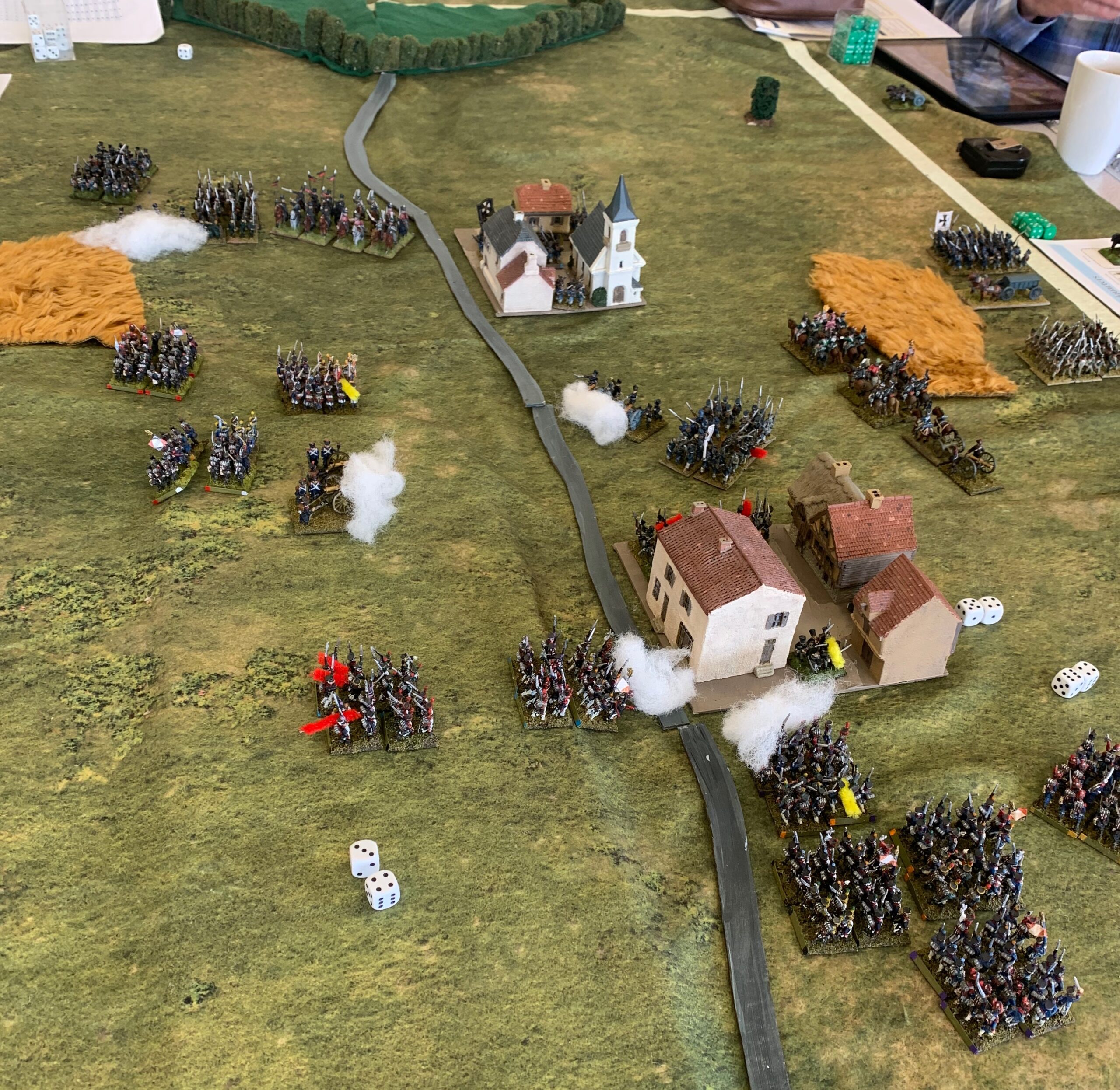
    Our Lutzen game at the club at lunchtime – turn 5 I think. Prussians on the left.

    Last weekend I got back to my club (Tunbridge Wells Wargaming Society) after a long break for a game of Général D’Armée 2 (GDA2). We attempted the shorter Lützen scanario in the GDA scenario book. We got as far as turn 7 after five hours of play of a supposedly 20 turn game. It was in fact clear by this point that the Prussians (played by me) weren’t going to win. Is it realistic to expect us to get through a scenario of this size in 6 hours – which I think is the effective maximum playing time for a club day? I need to know because this is not a big scenario by the standards of the GDA books.

    How the game went

    First a little bit of after action report. If you’ve been click-baited into this article by the title, then move on to the next heading. The French (played by regular club partner Malc)had four brigades of infantry, joined by a cavalry brigade in Turn 3. They had to defend four villages (three visible from the picture, and one off to the right) and an area of high ground (at the top of the picture). There objective was to ensure that no more than two of these fell into Prussian hands. He deployed one brigade each in and around each of the two forward villages, one in between and one as an off-table reserve.

    My Prussians had three infantry brigades and one of cavalry at the start, with a further brigade of infantry arriving on turn 4. Alas I was meant to have a further brigade of cavalry, but I left it at home (along with a foot battery on each side, meaning that we had to represent each battery with a single base). The missing cavalry was two units that were supposed to be there at the start. I did bring the second brigade of one unit and one horse battery – and I deployed this at the start rather than wait to turn 3. My plan was to refuse my right and send two brigades to the left to take the high ground and village on the left (Rahna), with the remaining brigade to pin down the French centre. The cavalry covered the right flank. This plan proved defective – and Malc had correctly anticipated it.

    On the left, my best brigade could not reach the high ground in time. Up popped the French cavalry reinforcements in that spot, pinning it down for the rest of the game. My cavalry was on the opposite flank and although I did redeploy it, it took too long to get it where it needed to be.

    On the right my brigade ran into the fire of two batteries. At this early stage the French had plenty of of spare ADCs and so could afford Artillery Assault taskings. In the first turn they scored a double six each. After that the French artillery managed two or three 11s! The centre brigade reached the Rahna, but with one unit ragged from artillery fire. Stupidly I led the attack on the village with this unit, and it got destroyed in the attempt (more artillery fire on the way in, including one of those 11s). A second attack took the village; helped by the fact that the French were hesitant and could not reinforce the combat. But they were able to retake it the following move, when it was my turn to be hesitant. I decided to use my reinforcing brigade to shore up the collapsing brigade on my right (having been severely mauled by artillery fire), and to keep pinning the French brigades of right and centre. It did this successfully, even attacking the village (Gross Gorschen) on one occasion, but with little prospect of being able to take and hold the village.

    And so we came to Turn 7. Malc had one entirely fresh brigade. All of my brigades were looking battered, with one on the edge of destruction. A final humiliation was the loss of one of my batteries (see below). The French brigade defending Rahna was getting a bit battered by now, but the others looked in reasonable shape, and I still hadn’t unpinned the brigade from the French cavalry, which was slowly being destroyed by the horse artillery. I had used both my CinC commands in a desperate attempt to keep the attack on track. I decided to throw in the towel. A throughly deserved French victory.

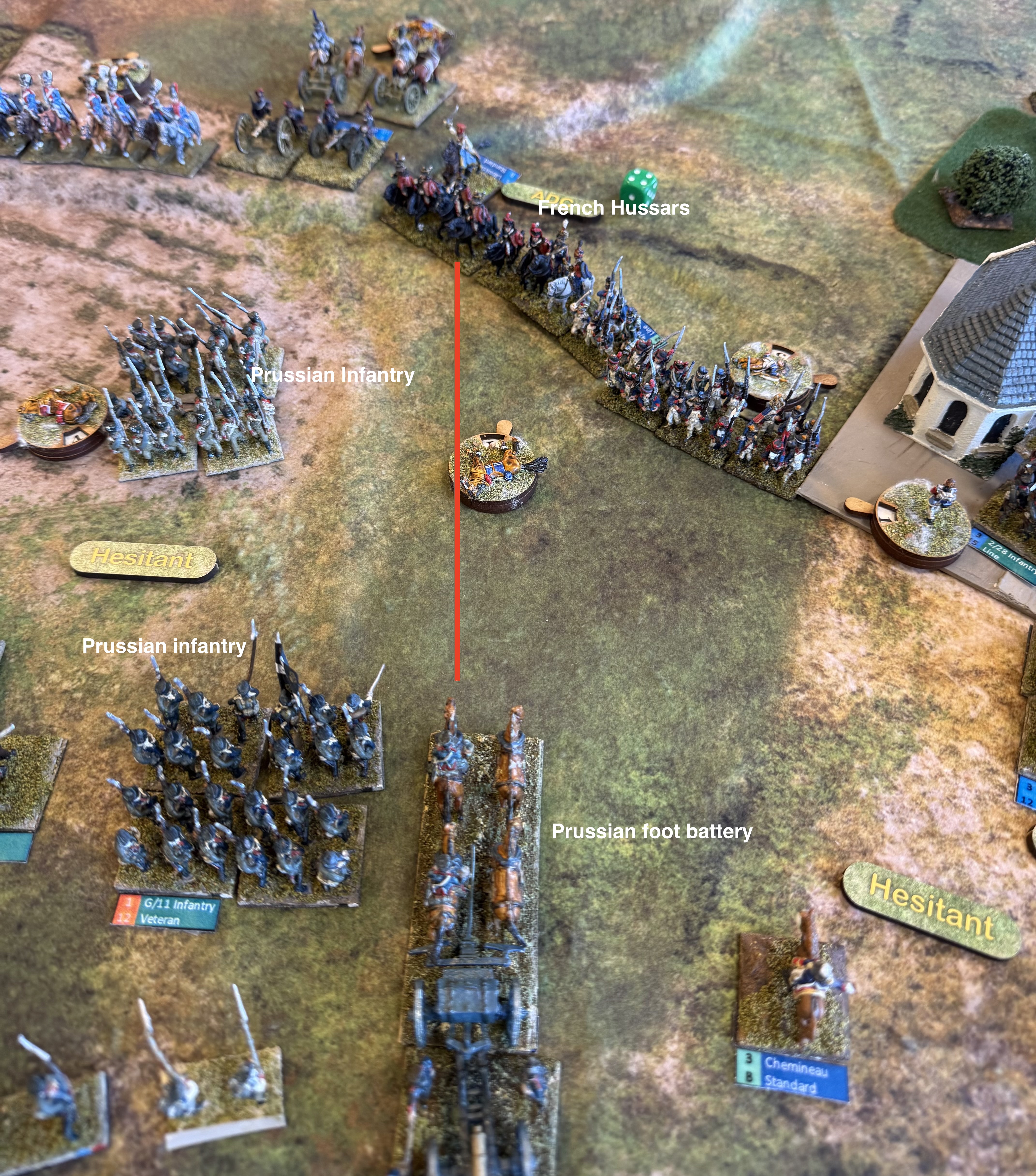
    One item of interest, which I raised on the GDA Facebook group, is worth mentioning here. On turn 6 the French Hussar unit pictured below decided to attack the artillery battery I had brought up to assist the pinned brigade, but which hadn’t unlimbered. That was nasty because attacking an unlimbered foot battery means automatic dispersal. The cavalry went on to attack the Prussian column next to it, but this was beaten off with losses to both sides.

    I decided this was legal, even though it meant brushing past a Prussian infantry unit in square at closer than 5cm. I thought that the rules said this could be done in a charge move – but I hadn’t read them closely enough. The only time units can get closer than 5cm to the enemy is in the final step of a charge, after reaching the 5cm point when the charge process is resolved. Thanks to FB group for setting me right! The FB group also suggested that the hussar unit could not legally manoeuvre past the infantry unit to its left. But I’m pretty liberal on such things, as I think there is more flexibility in practice – especially for cavalry which manoeuvred by squadron.

    Making the game faster

    This scenario is by no means large by the standards of both the 1813 and 1815 scenario books. So if I want to run these at club days we are going to have to get through them much quicker. A 20 move game needs to be do-able. First of all I will cover things that don’t involve modifying the rules.

    One thing to do is have more players. We had originally planned to have a third member of our group, Rod. He would have taken charge of the Prussians, while I did the game mastering, perhaps assisting the Prussians a bit. We could easily have had two players a side with an additional game master. But I’m not sure how much faster this would have made things. At the start of turn everything focuses on the overall commander of each side; and the turn is structured into a number of phases which apply across the whole table, which means there would be quite a bit of waiting for players to finish. And more players ,more chat! But it would help.

    Secondly, is to spend less time referring to the rules. I’m afraid that I’m a bit of a rules lawyer, and I really like to get things right. Many players prefer to keep things moving even if it means getting things wrong. And GDA2 is difficult to master in detail. I have written a summarised version of the rules to speed things up, but this isn’t all that helpful (though an excellent introduction to the rules). The things that I need to look up tend to be in the main book – and I found myself turning to this first. The index is a godsend. Still we were checking rules much less than in earlier games, now that I’m much more familiar with the rules. The FB group is a help here. I read the rule queries coming through there, and try to answer the ones if somebody else hasn’t got there first. And I do try to make decisions quickly at the risk of being wrong – as I was about the attack on the battery. I will think about doing my own version of the quick reference sheets (4 sides) which are notoriously hard for finding the bits you are looking for. But as a game master I need to focus on keeping things moving.

    Another idea we actually implemented is to make the table a bit smaller. The scenario recommends that if possible the games should be played on a table 5ft deep and 6-8ft wide. We played on my standard battle mat which 4ft by 6ft (actually a little over). It helps that my bases are only 25-30mm wide, with four to a standard battalion. That means a standard battalion is 10-12cm frontage in line rather than the recommended 15cm. The game table wasn’t overcrowded. Since no adjustment was made to the move distances or ranges, this means things should happen a bit more quickly. And I think that was so – by move 7 it was quite clear how things were heading. That would justify knocking a few turns of the game length.

    After that I’m running out of ideas. Movement sabots for columns might speed up pushing the metal around the table. I could do this relative discreetly since my bases have magnetic bottoms, so this could be done with a relatively thin piece of metallic card. Still I think bases are thick enough as they are, and sabots are usually a bit unsightly.

    Fiddling with the rules

    Now to consider moving beyond the pale to think about any house rules that might might things happen a bit more quickly. David Brown, the author, has done a lot of this for version 2 of GDA, and I think the combat mechanisms should be left alone. the troop quality system it could be simplified a bit, that is likely to be more trouble than it is worth. We’re getting used to the existing system fast.

    Instead I want to think about making things happen more quickly at the command level, and in movement outside the combat area. I’ll tackle the second issue first. Both of these should reduce dead time and help battles get resolved in fewer turns – they won’t make the turns any quicker to resolve.

    Moving reserves into combat can take quite a few moves, soaking up ADCs as you try to avoid the risk of hesitancy. This applies especially to attackers bringing in off-table reserves after having advanced deep into enemy territory. There is also an issue in moving uncommitted troops from one flank to the other, as I tried to do. I don’t think either of these was particularly difficult historically, and it’s a well known wargames design conundrum that troops more quickly outside the combat area than when you approach the enemy. At 2 mph troops could be expected to cover 30cm on the tabletop for the minimum turn length of 5 minutes; the column move distance is 15cm. When following an order to reposition, outside a combat zone, things should happen much more quickly.

    My current thought experiment on this works for the Redeploy and Reserve taskings. Outside the combat zone (perhaps defined as 20cm from the nearest enemy troops, perhaps 30cm) troops with these taskings should be able to move faster – perhaps using the Forwards move rate, or simply double standard, or a fixed bonus of 20cm, say, provided units are in column or limbered. I think a road bonus could be added – to reflect their use as a navigation aid as they are too narrow to handle combat formations. The tasking is not removed at the end of the turn provided the unit is outside the combat zone. However it would still be subject to brigade command rolls, and would be lost if the brigade became hesitant. (This is actually similar to the current rule for Redeploy – though I’m not sure about losing the tasking if hesitant).

    If reserves are deployed far from the front line, and the Reserve tasking or is lost because of hesitancy, then this can be replaced with a Redeploy tasking.

    An alternative house rule is to allow reserves to be deployed anywhere on the table where there is a clear line of march outside the combat zone from the entry point. Where troops are forced to deploy in the combat zone, then they can do so deployed. But there would be no reserve movement. On reflection, this may be a better way of handling the reserve tasking as it is altogether quicker.

    Command rules

    Changes to non-combat movement amount to tweaks of the existing system. I next want to consider something much bigger, which will be beyond what most players of GDA2 will want to contemplate. But not all: because I know some people who have done this already. Iain from my old club, South London Warlords, explained this to me when we were involved in a big reconstruction of Castaglione played using GDA2 – though I’ve forgotten what he said his replacement system was! But it went to the point that I am now going to make.

    The issue is the brigade command roll: this has a one-third chance of failing, reduced to one-ninth if you invest in a Brigade Attachment tasking for that brigade. This is often severely disruptive. In many cases it is entirely realistic. The brigade commander (incidentally I think the use of the word “brigadier” in this context is an anachronism – I suspect the word more usually referred to an NCO at this time, and certainly for the French, where it still does) might well get confused, or orders might get lost. But this is unlikely under the nose of his superior officer, and certainly not for more than one move in a row (a not infrequent occurrence in GDA). If the brigade was the divisional/corps commander’s focus of the time, then the brigade was very likely to do as wished. But Commander interventions are limited to two in the whole game. The rules don’t reflect this commander focus well. In any case hesitancy would be pretty obvious to the CinC in the relatively small battles in scope of GDA.

    Let me digress a little at this point. The Napoleonic (and Revolutionary Wars) era was a period of command transition. In the earlier 18th century command was focused on the commander, who would array his army in one or more lines. Junior officers were expected to hold their place in the line until ordered to move by the commander. The commander would take himself to the main locus of the action and take control there. The classic pattern was Frederick the great’s “oblique order”. The commander would start on one flank and progress towards the centre as the battle unfolded. Nothing much would happen on the opposite flank unless the enemy was able to seize the initiative there. The best Napoleonic example of this was Wellington at Salamanca. Wellington’s command model was very much in this 18th century mode, though he adapted it with an intermediate divisional command instead of the inflexible lines of battle.

    Roll on to Bismarck’s wars of the later 19th Century (and maybe the American Civil War or the same era – but I’m less family with this). Here the battlefields were vast and a delegated model of command was in operation. The role of the battlefield commander during the battle was limited. His main contribution was to plan of battle the night before and issue orders to his subordinates. Battles could get very muddled. We can see this devolved model developing in the Napoleonic era. Napoleon’s marshals had wide discretion when Napoleon was not breathing down their necks. In my view the most developed example was the Allied armies of 1813/14 (especially Schwarzenberg’s Army of Bohemia) – battles often turned on intermediate commanders using their initiative, while central command looked distant.

    In wargames terms the best way to reflect the old model is Phil Barker’s PIP system – players get a variable allocation of PIP points which they allocate to junior commands, with those further from the commander model being harder to allocate to. No PIP, no movement. The new model is best reflected by the Fire and Fury system developed for the American Civil War, and used in Chris Pringle’s Bloody Big Battles for Bismarck’s Wars, where junior commands are subject to activation throws (called movement throws) to see if they move, and the commander has little influence over this. GDA uses elements of both: ADCs are its version of PIPs, but the brigade command roll is like the Fire and Fury movement throw.

    But GDA2 games (in spite of their name) reflect smaller battles between extended divisions – so their model should be closer to the commander-centred one – which in any case was far from dead in bigger battles. So how might the rules be tilted to reflect this?

    My thinking revolves around a more active Commander. The commander model can be placed with any brigade, which automatically then operates under orders, and may take on one or two taskings (two would cost an ADC). Perhaps there would be a distance restriction for moving the model around between brigades at the start of the move. ADCs and taskings would be issued to other brigades as usual. But the very powerful CinC commands would disappear. That would be a pity as these add a lovely touch of drama. They might be used to represent the intervention of a more senior commander on the field – but if so they would not be under the complete of the player. Also something on the Destiny table should knock out the CinC figure for one or more moves.

    This needs more thought. One idea might be to use an event card system – cards drawn at the start of the turn might allow a senior officer intervention (i.e. CinC command), take the CinC out to deal with staff, comms or intelligence tasks, and perhaps other events. There also needs to be some mechanism for allowing for the difference between more active and passive generals.

    This all needs a lot more thought – but I thought I’d put it out there!

  • GDA2 – lessons from first game

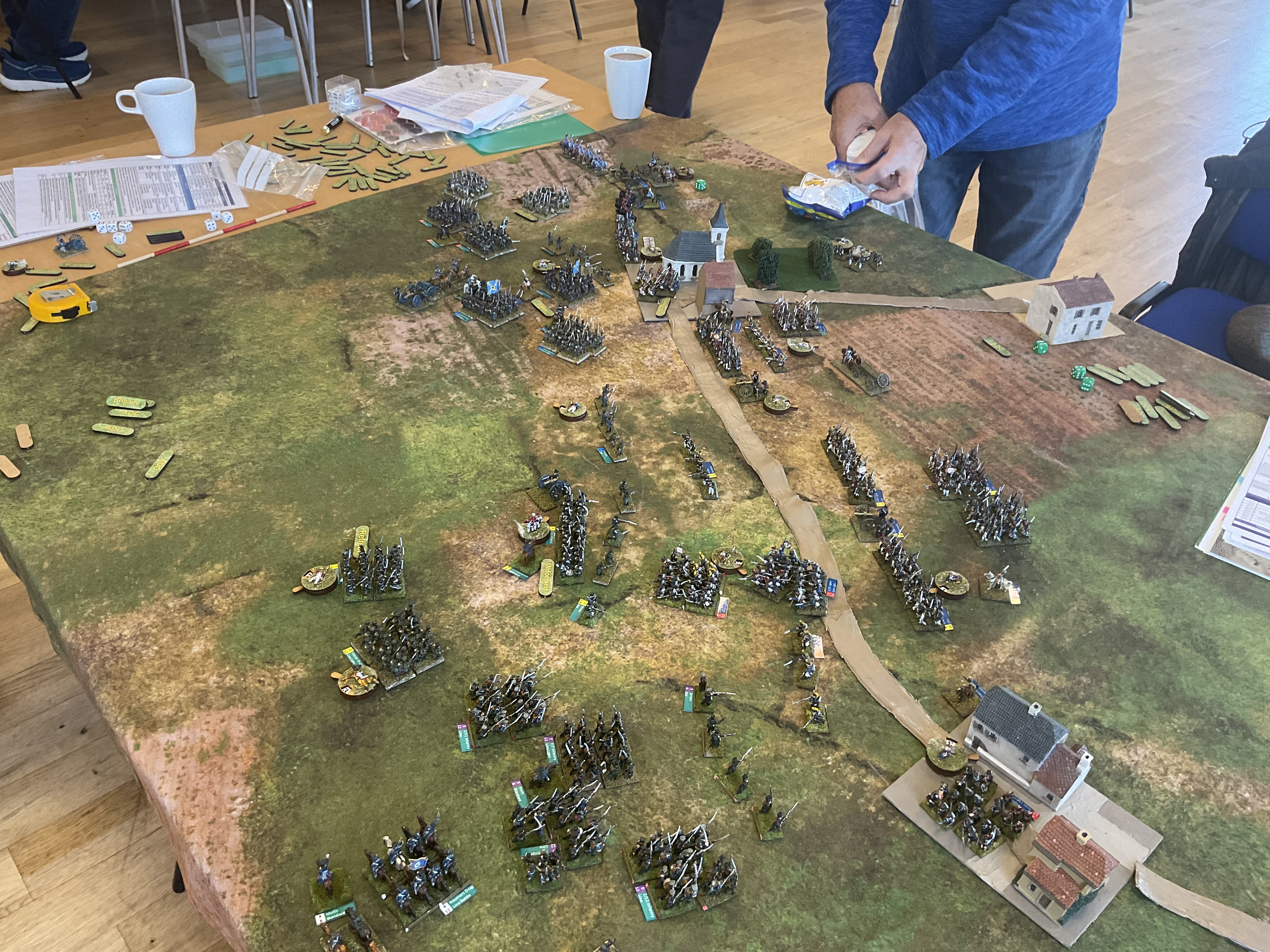
    Our game not far from when we finished. At the top right the French cavalry’s flank attack is in progress

    My hobby year started off with real momentum. But this crashed to halt in early April, and I’ve made little progress since. A combination of holiday trips, a family crisis and gardening conspired to divert me. I can’t see myself getting back to the hobby room for a few weeks yet. The one bright spot is that I have kept the games going, with my two regular monthly groups, and I have had time to explore new set of rules: Général d’Armée 2 (the published rules don’t bother with the accents: I’m just being nerdy) – known hereon in as GDA2. I have already posted my first reactions. At the start of the month I played my first game with a couple of people at the club.

    For this game I went for a similar scenario to my first club game of Lasalle 2, a very different game system, but in a similar space in terms of the scaling. A Prussian brigade of 9 battalions plus two cavalry regiments and two batteries attacks a French division of 10 smaller battalions and two cavalry regiments and two batteries. We used my normal Napoleonics, on 25mm bases, with four bases to a standard unit, and six for a large one (the Prussian infantry were in large units). Because of this small base size, we used the 28mm distances, but in centimetres rather than inches. We played on the same field size I have used for Lasalle 2 – 40in by 60 in, rather than the full 4 ft by 6 ft. Following my concerns about the complexity of the game, we decided to leave some of the rules out, notably the menu of ADC tastings, including the C-in-C commands. My fellow players provided the tokens, including a set of casualty trackers using rotating number devices (which can be seen in the picture – adorned with casualty figures).

    The game itself proved a bit lacklustre. The Prussians moved to an infantry attack, but this took too long to develop. The French decided to send their cavalry round their left flank. This again took time, but they were able to deliver a devastating attack on the Prussian cavalry, catching it in the flank, and driving it from the field, causing complete disarray on the Prussian side. At this point we ran out of time. Subsequently we realised that this flank attack should have been kicked off with a Redeploy tasking, which the French player forgot to do – as the cavalry started off in the centre rear. that wouldn’t have been too hard, though.

    Clearly the learning curve meant that we were slow. In a learning game it is worth taking time to refer back to the rules a lot. We decided that my attempts to simplify the game didn’t really work – and especially that the CinC intervention rules were critical to the balance of play. We also felt that the scaling didn’t work, as it was taking too long for the combat to develop – even after I allowed the attacking side to deploy much further in than the rulebook suggested. We decided next time to use the full rulebook, and the standard 15mm scaling, though using a 6ft by 4 ft playing area. The unit sizes would need to be kept the same, though, as I don’t have enough miniatures for the six-base standard battalions that you should really have for this scaling.

    For all the frustrations we decided that the rule system has an excellent Napoleonic feel, and that this would be our standard Napoleonic system for club games.

    It is also clear is that the game’s name is a misnomer. “Général de Division” would give a more realistic idea of the scope. Though the rules do provide for the use of an army corps, this would still need a very large playing area – or smaller scale miniatures. In the latter case, though, our experience is that there is a danger of things being too slow – though I do see Facebook reports of it being done successfully. I will resume development of my own big battle rules.

    Alas, I am going to miss the next club day at the beginning of July. However, I have promised to lead a game at my other regular venue, which should entail two players a side. I plan to use the Gilly scenario from the 100 Days book (although this is not a historically accurate reflection of that encounter, on the evening before Ligny). I’m hoping that some of the other players will have some experience of the game – and I will certainly bone up on the rules – as we need to keep it reasonably brisk to get through ten moves.

  • General D’Armée 2 – first impressions

    I have been using Lasalle 2 for my club wargames, gradually working through the scenarios in the rule book. But I’m tiring of it. It is far too abstracted and too gamey – by which I mean the players is more concerned with the operation of game mechanisms than things that a historical commander might consider. Many important features of a Napoleonic battlefield (such as generals and skirmishers) are abstracted away. In my last game I found myself pushing my cavalry towards a random patch of earth because it represented a victory point. This allowed me to snatch a draw from a losing game – and it felt like a lot of nonsense. It’s always possible to rationalise explanations when odd things happen, but I prefer it when tabletop events look more historically plausible. At the same meeting, one of the other club members raved about the General d’Armée 2nd edition rules. I have also seen being praised by some members of my last club – so I thought it was time to investigate.

    Now I had heard about GDA and GDA2 before – but because they were designed around divisional or corps-sized games, I had not investigated further. My main focus is bigger battles – and I thought that the well-written Lasalle 2 rules would suffice for club games. But if these rules were gaining popularity at my club, then they were surely worth a look. So I went to the Reisswitz Press section of the Too Fat Lardies website and ordered the pdf and hard copy package. I wasn’t disappointed.

    I discovered that they covered remarkably similar space to Lasalle 2 – the typical two-player encounter would be between forces of four to six brigades – being a reinforced division. The basic unit is a battalion for both with typically four bases (this uniform in Lasalle 2 but there is variation in GDA2), allowing only the most basic of formations to be represented: line, column and square – with the column representing all manner of different column types. They are both carefully written. GDA2 covers some 90 pages of A4; Lasalle 2 has some 120 pages of smaller 7in by 10in paper. But GDA2 feels much weightier. More space is given to diagrams in Lasalle 2, and the writing is more spaced out. And Lasalle 2 is split between basic rules (100 pages) and advanced rules. There is no basic game in GDA2 – you plunge straight into the advanced game equivalent. Its quick reference sheets are a full four sides of closely packed A4, with many more tables and categories than Lasalle 2 (whose QR is much briefer but leaves too much out).

    My most recent club game of Lasalle 2. My French are attacking the Prussians from the right. You can see my cavalry passing the cornfield on the right centre and heading for that lone tree in the distance – which marks a victory point. I am in the process of overwhelming the village in the foreground. But in the distance on the left Rod’s combined arms attack is about to cause some serious havoc. Great game but it doesn’t feel historical – a problem GDA2 should fix.

    Quite a lot is abstracted away in GDA2, of course. But it feels much less. The generals are represented on the table and issue what amount to orders. There are skirmish bases rather than an off-table system. You need a dozen or so hits to destroy a unit in GDA2, rather than the typical seven in Lasalle 2. There are more unit statuses; in Lasalle 2 units are fresh, shaken or broken (though their effectiveness diminishes with each hit); in GDA units can be unformed, brigades can be hesitant, and so on. Somehow GDA2 feels much more serious and detailed.

    Write-ups for GDA2 suggest that its the critical innovation in game design is the allocation of Aides-de-Campe (ADCs) from the commander to the brigades. This is a bit oversold. The ADC system is really a variation on the old idea of command points or command capacity. They only superficially represent the role of real ADCs. I have had the idea of using ADC figures to represent command points for allocation each turn in my own rule systems. It is a good idea though – contemporary prints of battles often show individual horseman charging around the field, as well as skirmishers, and these prints should be an inspiration for the tabletop, as they operate under similar constraints. What is much more interesting are the stylised orders that these ADCs transmit, which operate at brigade level – they are called “Taskings”, terminology that I dislike: surely “orders” would be better. They are supplemented by “C-in-C Commands” to represent the impact of the commander taking personal control, which can only happen a limited number of times. Brigades can’t do very much without these orders. This system achieves the same thing as MO in Lasalle 2, but it is less abstracted. It is much easier to understand what is actually supposed to be going on on the field.

    One interesting aspect of the brigade order system is that only one unit in a brigade can charge per turn. Amongst other things this stops the wargames tactic of two or more columns ganging up on a unit deployed in line (which happened in my last game but one of Lasalle 2), which is totally unhistorical – a function of how different a wargames tabletop is from a real battlefield. This is an arbitrary rule but a very sound idea.

    The turn itself follows a fairly classic Igo-Ugo format, with different phases for command, charges, movement, firing and close combat, each played alternately. This has the big advantage of making multi-player games easier to run – though only one player can allocate the ADCs. The more complex card-driven or other systems so fashionable in modern wargames systems can produce interesting game situations, but are harder to rationalise. They are more suited to skirmish games than one where each commander dominates the whole field of play – as was the case in Napoleonic battles at this level – though perhaps less so for big multi-corps situations. The need to manage multiplayer games without players from the same side having to wait for each other all the time is still the best reason for the traditional alternate move system – and it’s an important consideration for me. It’s the big weakness of Lasalle 2, though the author does make suggestions as to how to run multiplayer games.

    There will always be things in a rule system to quibble over from somebody that has been into wargaming and Napoleonic history as long as I have. From a gaming point of view my biggest one is that I would have much preferred a simplified basic game, to which more complexities can be added as people get the hang of it. It’s not hard to see how that might be done. The basic game would focus solely on divisional encounters (the rules do cater for corps games too), with a reduced menu of ADC Taskings (leave out CinC Command, Skirmishers, Artillery Assault, Scouts and Reserve) – and the CinC Commands altogether. No reserves, scouting, simplified troops types, no light infantry skirmish deployment or reinforcing skirmish screens (or you could leave out the skirmish screen altogether), and simplify the troops types a bit (no drilled or enthusiastic) and do away with small (and perhaps large) units. I’m tempted to create such a basic version myself, but currently I have bigger priorities for my limited hobby time. As it is taking on my first game with my usual club partner is going to be a bit daunting.

    Other quibbles are pretty minor. I don’t buy the logic that six and eight gun batteries are the same at this level (“If simply having more guns guaranteed superior firepower, then surely every nation would have deployed 12 gun batteries,” the author asks. Then why didn’t everybody use six-gun ones?). It wouldn’t have be too hard to build a bit more depth to the larger batteries, even if there is no firepower distinction. The author isn’t familiar with later Prussian command doctrine, whereby commands at “brigade” level (i.e. the game brigade – the actual Prussian Brigade is a game division) were task-oriented, and it was usual for them to be composed of battalions from two or three different regiments. I would like to see the ability to form converged howitzer batteries. I’m a little less than convinced by the skirmish rules, especially what the deployment of light battalions into full skirmish actually means. It would be pretty much impossible to deploy a whole battalion into skirmish order and to maintain any meaningful control of it – it would disperse over a very wide area. This presumably actually means some combination of a dense screen and formed reserves. And I don’t think this happened much (or at all?) in the Empire era. Commanders often reinforced skirmish screens by drawing off companies/third ranks from formed units – but the rules provide for this already. And yet this is all grumpy old man territory – the issues are either easy to fix or don’t really matter.

    The important thing is that these rules are steeped in a Napoleonic feel. Achieving this with relatively simple game mechanisms is quite a feat. Incidentally, I don’t think they would work that well for either Seven Years War, or the mid-19th Century ones. I really want to give these rules a go!

    Which leaves the question of how I adapt my Napoleonic armies to the system. I have 18mm men on bases 25mm square (with some on 30mm squares) – six infantry or two cavalry per base. Artillery are on 35-45mm bases. I also have skirmisher bases which are 25mm by 15mm deep, with a pair of figures. The rules say that a standard battalion should have a frontage of about the same as musket range. On the standard scale for 15mm troops (1mm to a yard), this would mean 15cm. That’s six bases (or five if they are 30mm) – with say 8 bases for a large unit (which would be normal for my 1815 Prussians). This is a lot of metal: 36 miniatures for a standard battalion, though it would doubtless be visually impressive. I would prefer to use the basing I already use for Lasalle 2 – four bases to a standard unit, six bases for a large one (using house rules). That would mean using the recommended distance scale for 10mm miniatures – where musket range is 9cm. That’s a bit tight, but it roughly equates to what I’ve been using for Lasalle 2 in terms of distances (musket range is four base-widths). The distances in GDA2 are all (almost) in units of 50 yards – which is 5cm for 15mm, 3in for 28mm, and 3cm for 10mm. So I could try 4cm for 50 yards. – but then all the QRFs etc would have to be redone. Batteries would be two bases, as per Lasalle 2.

    In breaking news, I have already agreed to have my first game this coming weekend at the club. And somebody is bringing a set of status markers – which you are encouraged to buy separately, as there are no printable sheets, but which are out of stock. We still have to mark casualties somehow. I think I might stick to pipe cleaners with yellow/white being singles and red being 5s. I will try and simplify the rules (i.e. leave bits of the standard game out).

    My aim is to try this system out for club games with generally non-historical scenarios – in place of Lasalle 2 (perhaps using Lasalle scenarios). For big, historical battles, like Ligny, I still want to develop a different system. The authors suggest that GDA2 can be “bathtubbed” for bigger battles, with each unit representing a brigade, and so on up. That’s not a bad idea, but I prefer systems developed specifically for the scale. Anyway, watch this space!