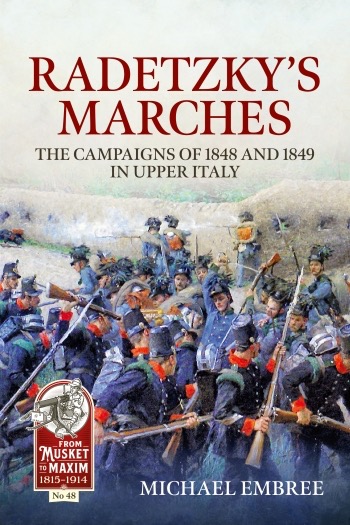
I have recently read Michael Embree’s Radetzky’s Marches – the campaigns of 1848 and 1849 in Upper Italy. I bought it at last year’s Salute show – the hard back version, a limited edition and signed, bought for the same price as the current paperback edition (£35). I finally got around to reading it last month. It proved to be an interesting read – will it open up a new period for me?
This book piqued my attention for three reasons. First, Radetzky is a familiar name from the Napoleonic wars, but his achievements in the 1848/49 were what made him famous – inspiring the Radetsky March from Johann Strauss the Elder, his most famous work; I wanted to know more. I am increasingly interested in the Italian wars of unification, with plans to refight the second (1859) and third (1866) wars: what about the first? As a regular visitor to Italy on holiday, I’d like to know more. And finally I am interested in the evolution of warfare in the 19th Century. I know a lot about Napoleonics, and I’m gathering more knowledge of the wars from 1859-1866 (encompassing the American Civil War). The wars of 1848-49 (also including the Hungarian uprising) are a way marker in that evolution.
I found the book itself a bit on the dry side. There is all the detail you would want as a wargamer, with the forces involved in each engagement, right down to many minor skirmishes, listed meticulously, with casualties as far as they were known. In this it recalls George Nafziger’s works. The detail of what happened in each battle is a little vaguer: he follows the popular route of using verbatim quotations from eye witnesses to do quite a bit of heavy lifting. For historians to attempt more than this requires an enormous amount of work though: this is as good as it usually gets. What’s missing is atmosphere, and descriptions of the personalities and how many of the decisions were taken – and especially from the Austrian side. I have no better feel for Radetzky’s personality that I started with. There is almost nothing on the political background, especially from the Austrian side. I also missed a narrative on the balance of forces through the various phases of the campaign, or rather campaigns – the actions of 1848 and 1859 were separated by an armistice, and the rise and fall of the Venetian rebellion is separate again. This is in complete contrast to Lieven’s book on the Russians in 1812-1814 – and its strong grasp of the strategic and personalities. Still, it clear why people have suggested that Radetzky’s grasp resembled that of Napoleon in the same theatre in 1795-97.
What about the wargaming possibilities? By this I mean refighting the battles – rather than strategic conflict, which would be very promising for a boardgame or kriegsspiel. There are four biggish battles, but none are particularly easy to wargame. The battles of Santa Lucia and Goito were a bit tentative, without a clear objective for either side – though they could be turned into more decisive scenarios. The critical battle of Custoza is a three-day sprawling affair with none of each day’s actions being lop-sided (first day to Austria, second to Italy; last day to Austria); the grand-tactical level is interesting enough, but this plays out over too big an area for a wargames table, and the whole point is that each side doesn’t know where the other is or where it is moving. Of course, scenarios where one side is badly outnumbered and making the best of things can work, but this is not classic wargames play. The final large battle, Novarra, in 1849 is maybe more promising. The Austrians are outnumbered but have substantial reinforcements on the way – but the difficult terrain could pose a challenge. Overall, if restricted to historical battles, the 1859 and 1866 wars are better. There are lots of skirmish level possibilities though, which this books documents thoroughly.
What about the evolution of warfare? Technologically, this is very close to the Napoleonic period. The muskets were fitted with percussion locks rather than flint locks, which would make them more reliable. The Austrians made extensive use of rockets (which also make an appearance in 1859, but not 1866 as far as I know). Napoleonic rulesets don’t take rockets very seriously and would need attention. The main point of them, as far as I can see, is that they were lightweight and much more mobile than conventional artillery – but much less lethal, although they had their moments.
Tactics seem to be strongly Napoleonic, but the regular forces would be better drilled than was usual in Napoleonic times, and I suspect tactical doctrines a bit more rigid. Both sides made use of specialist light troops, unlike French Napoleonics, though line troops could skirmish if required. There were quite a few irregulars on the Italian side, which were often given light infantry tasks. On the Austrian side, Grenz infantry were still used as light troops alongside the jagers. The quality of the Austrian troops is generally good, including their commanders – these are not the Bruce Quarrie Austrians! The Piedmontese regulars were generally good too in 1848, but seem less well-led, and perhaps cracked under pressure a bit earlier. In 1849 their quality was diluted by massive conscription, and doubtless the confidence of their leaders had been dented.
One striking feature, though, is that casualties seem quite low, when compared both to many of the Napoleonic bloodbaths, or many of the battles of 1859 (Solferino led to the founding of the Red Cross). The casualties in 1866 were also high, but aggressive Austrian tactics can explain that. The terrain was generally quite cluttered, and probably the tactical leadership more conservative when it came to exposing their men. There weren’t many glorious artillery targets, as there were at Waterloo, Borodino, etc., or classic volley moments against dense targets.
After an initial bout of enthusiasm, I don’t think I will be pursuing this. At a pinch I could reuse many miniatures from 1859/66 or even Napoleonics (for the Austrians – though the shakos wouldn’t be right). And terrain pieces would be reusable too. But I have to many other irons in the fire!
However, for a detailed understanding of this interesting and historically consequential campaign, I recommend Mr Embree’s book, though you might want to skip through some of the lists of units and leaders.
Leave a Reply