Alas another slow month, with little hobby progress. The cold that I mentioned in my November update developed into a rather vicious virus that took weeks to shake off. I was banned from going to the studio to paint my little men, and I had to pull out of two games. I did do lots of reading though!
I’ve also had some email issues. The notification from my last post (on d’Erlon’s attack at Waterloo) had a large number of bounces. This was due to a change to the WordPress software. I’ve had to upgrade my mailing application, taking me into technically dark territory – but I hope I’ve solved the problem. While I was at it I noticed that scores of dummy names had been added to my mailing list, and I’ve deleted the obvious ones.
Reading
The first new book I read was Graeme Callister’s book Waterloo – the Attack of I Corps. I have already posted on this, together with the reflections it provoked on that battle.
Next up is Michael Embree’s Radetzky’s Marches: the Campaigns of 1848 and 1849 in Upper Italy. Another period! But I had always been a bit curious about this famous campaign (which caused the Strauss senior’s Radetsky March to be written) about which so little has been written in English. When I saw this book second-hand at Salute I could not resist the urge to buy it. Since I have visited Italy a few times over the years, I have become more curious about Italian history, and I’m slowly being drawn into the Risorgimento – and the series of wars through which the modern state of Italy was formed. Custoza 1866, my main current project, is almost the last of these wars (there was some unfinished business in the Papal States afterwards). These 1848-49 campaigns were fought over largely the same ground as 1866, including another battle of Custoza. And after this year’s holiday to Lake Garda, I now have a much clearer idea of the geography. I am also curious about how warfare evolved from the Napoleonic period to 1870 and beyond. The 1848 wars are an interesting link.
More on this when I finish the book. Will I be drawn into wargaming this war? I could re-use some of the terrain. I might, but I would need to reuse my 1866 armies, which won’t look quite right. The Austrian uniforms were closer to the Napoleonic era. Too many other projects come first before I indulge in building yet another army!
Gaming
Alas I had to cancel two games due to my virus. A game with 17th Century sailing vessels in the Caribbean with my friends in Beckenham, and a Général d’Armée 2 game I was setting up at Tunbridge Wells.
On the subject of GDA2, Iain Fuller, from South London Warlords, kindly shared with me the modifications to the GDA2 command system that he and this friends use. These are quite radical. I want to try out some of these ideas, along with others I have. To that end I have drafted some house rules for use in my next game at Tunbridge Wells. More on that after the game.
Painting

I finally got back to the studio last week. Some of the paint on my wet palette was still usable, but a layer of mould made using it unappealing. I set up a new wet palette, recovering some of the paint. I have had two sessions on my remaining 10mm Custoza Italians – cavalry, artillery and generals. The cavalry are now nearly there – just the flags and finishing (base decoration and wash). It shouldn’t take too many more to finish. Meanwhile the figures I need to finish the Austrians arrived from Pendraken. The 10mm figures are proving reasonably quick to paint – helped quite simple uniforms for the period. This scale is much closer to 6mm in style than 18mm. Still there’s a lot to do! After the Italians my plan is to switch to 18mm late Napoleonic French.
While I’m here, with a short post, it’s worth saying a little about my wet palette. Ken Reilly, the Yarkshire Gamer, hates them almost as much as round dice. A wet palette consists of a sheet of greaseproof paper, sitting on a sheet of blotting paper, enclosed in a shallow box with a tightly fitting lid (but not so tight it’s a challenge to lift it!). You soak the blotting paper with water, and put your paint on the greaseproof paper. After your session you put the lid on and it should be ready for you to resume your painting where you left off. How long the paints last depends on things like temperature – it can be weeks in winter, if the mould is kept at bay. You can buy these from artists’ suppliers (the one I use is from Rowney), and the usual hobby sharks have their own versions. They are also easy to make yourself at a lot less cost, though you need to find a suitable container.
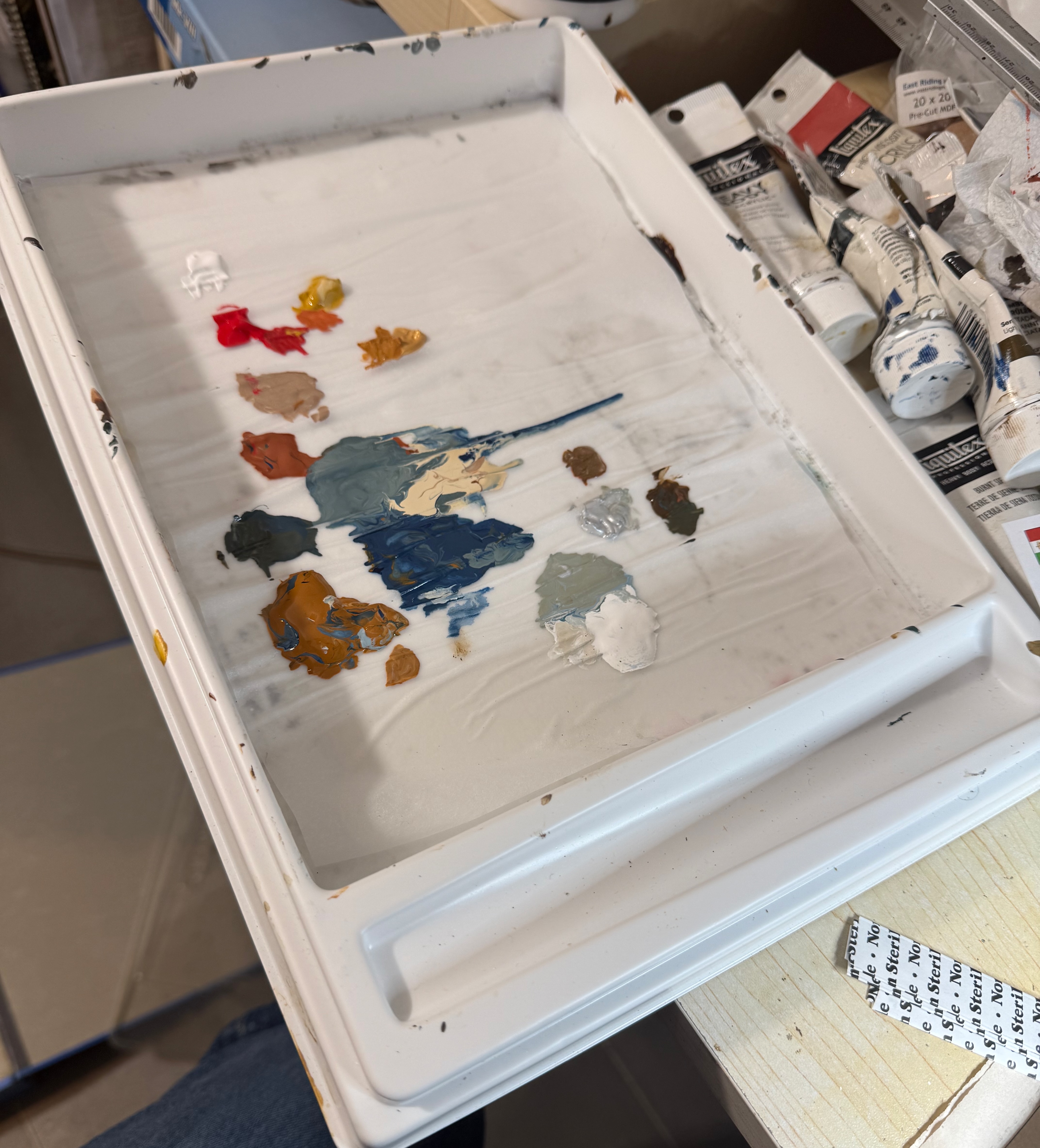
The reason I use one is that I use artists’ acrylics rather than hobby paints (e.g. those from Vallejo). Hobby paints are more liquid and come ready mixed in a huge variety of colours. Artist paints come out of tubes, are quite thick and are generally pigment-based. Almost every colour you use on the miniatures is mixed – that’s the fun! So it helps to preserve your mixes for multiple sessions. And the stiffer consistency means that the paint behaves well on a wet palette – usually. Every so often the pigment runs a bit – presumably when the blotting paper reservoir is too wet. I’ve read that poorer quality pigments (usually sold as student grade) have a greater tendency to do this – though it’s not something I have particularly noticed. I tend to use student grade paints for terrain.
And so Happy Christmas to all my readers. Over the festive period I hope to catch up a bit on the painting, and get started on that French infantry. But theatre’s a lot to do in the garden too – as I wasn’t well enough for that either!
Leave a Reply