Tag: ACW

  • Hobby update – August 2026

    August was dominated by heatwaves here in Sussex, in the south of England. This made going up to my studio over the garage an uninviting prospect. On top of that the wooden staircase up to it is deteriorating, leading to some spousal pressure about the dangers of using it. You have be especially careful descending; the banisters aren’t safe and wouldn’t stop you if you tripped. So no painting in August. But I did get a game and I spent quite a bit of time on rules design. This included a first look at the new ACW rules.

    Back to Carolus Rex

    The game was at the club (Tunbridge Wells). I was hosting the game as usual, and I wanted to ring the changes from my Napoleonic French and Prussians, using Général d’Armée 2, so I thought it was time to bring out my 6mm Great Northern War Swedes and Russians. I have devised my own rules for this (published in this website), which I have named Carolus Rex. I last used them in a multi-player game – and concluded that the activation system (divisions moved in a sequence determined by a card draw) worked less well in that context. But this time there would only be Hugh and Rod – so that wouldn’t be a problem. I also had a scenario in my mind – very loosely based on Holowczyn (pronounced hoh-wof-chin) in 1708.

    In this scenario the Swedes under Charles XII are attacking a Russian division over a river. This division is separated from two divisions of reinforcements – while not all the Swedish forces are there at the start either. In solo play this proved a tense game with all manner of grand tactical options for the players.
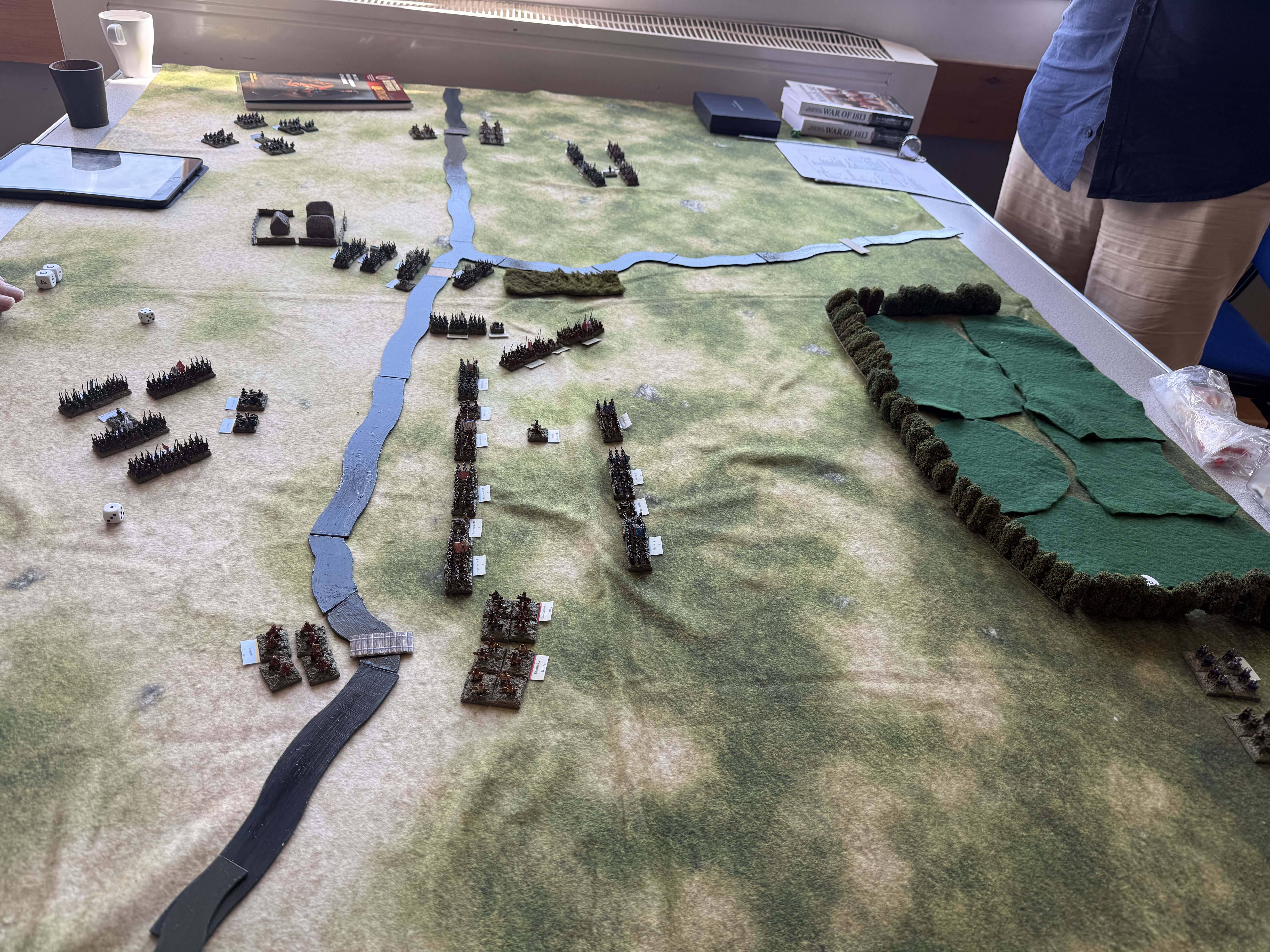
    The game after the first turn. The central Russian force (under Repnin) is to the right of the river. Golitz’s cavalry is lurking in the bottom right, mostly out of frame – but an advance guard of Cossacks has reach the bridge, and is facing off against some Vallachs. in the distance is Sheremetev’s division. The leading Swedish division has started to cross the river in the centre of the table, while more infantry is approaching the Russians frontally. On the top right the Swedish cavalry is starting to get going.

    The game went pretty well. The players liked the way that there was plenty of space on the table for manoeuvre – and a scenario where that made use of this. They also liked the card-driven activation system, which spiced things up. The Russians were in the event able to concentrate their forces faster than I expected. This wasn’t enough though – they needed some good dice-throwing to beat the better-quality and better-led Swedes, and didn’t get it.
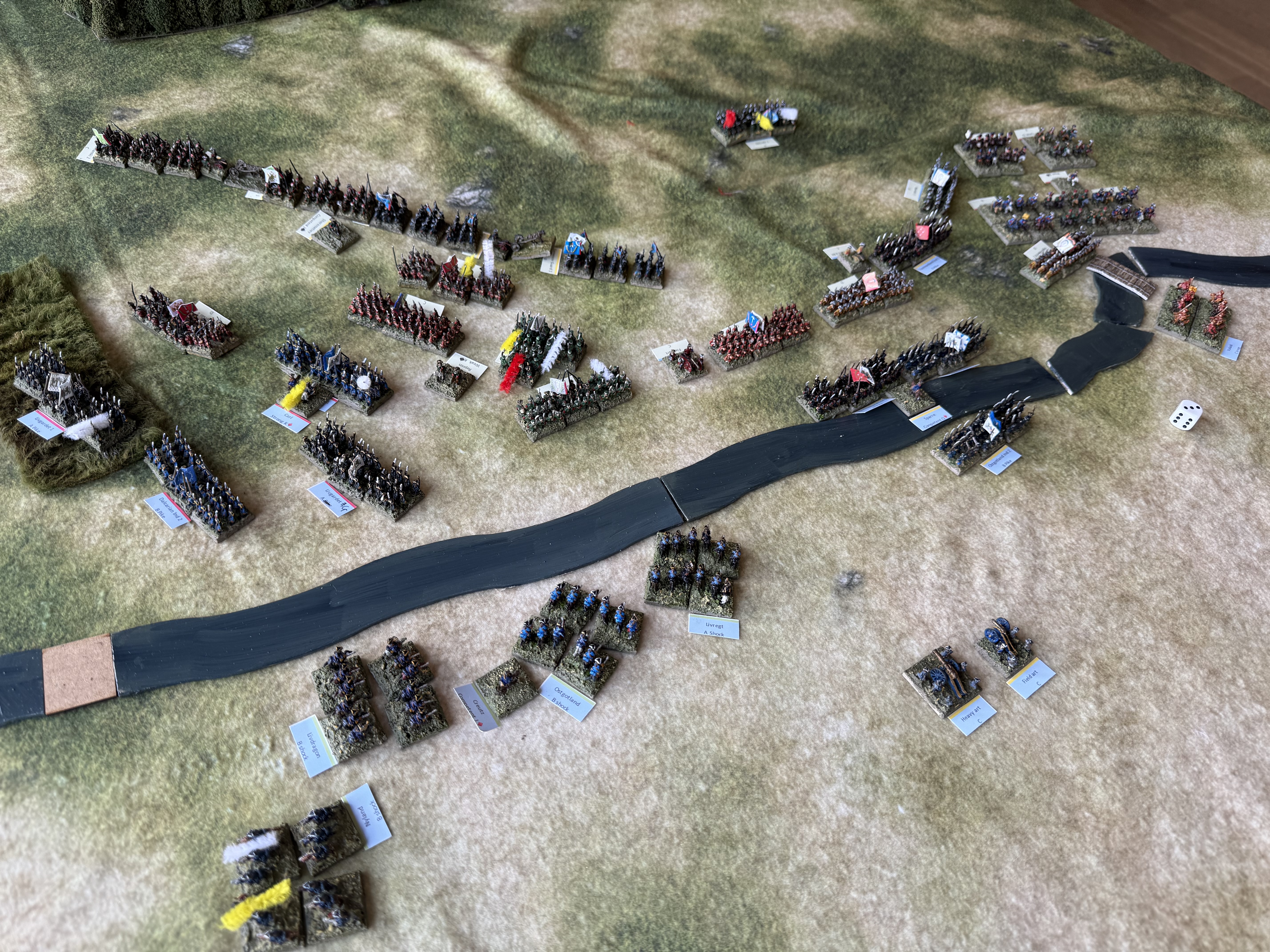
    Lunchtime as the battle reaches crisis. Repnin is weathering the Swedish assault, but slowly losing units – two have routed. But Sheremetev’s infantry have arrived (to the rear in column of march), including two battalions of Guards. The Swedish cavalry in the foreground haven’t got stuck in yet, though the unit on the left is the worse for wear after being taken in the rear by some cossacks.

    I inevitably reflected on the rules. They are too loaded in favour of the better-quality Swedes, whose forces were still nearly intact at the end – the rules don’t really do gradual attrition. They are also a bit cumbersome and the processes could do with a bit of streamlining. So I have now drafted a Version 2, ready for a play test. I am leaving the card activation system in, though. In multiplayer games it has been suggested that we deal the whole sequence at the start of the turn, freeing gamers to move in parallel in different parts of the field. The scenario also needs more work – it has a lot of potential.

    ACW rules
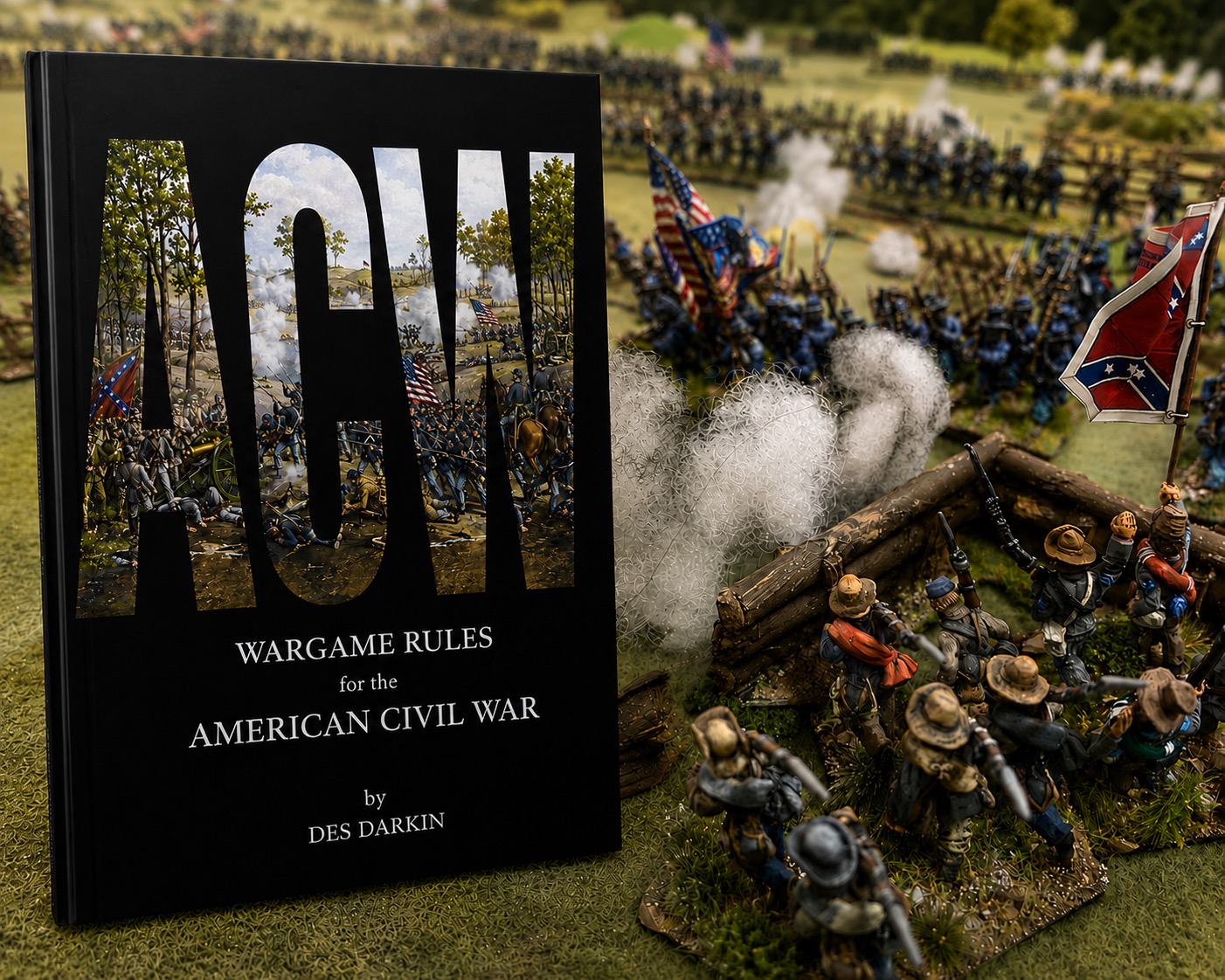
    Photo from Des Darkin’s website: shedowargames.co.uk

    Another source of hobby interest, apart from my diversion into Great Northern War, was that my friend from South London Warlords days, Des Darkin, has published a set of rules for the American Civil War – called ACW. It is the first set of rules he has published, and they are a treat.

    Des is part of a group of friends who play regularly at the Warlords in Dulwich, and also at Des’s “Shed o’ War”, and include Iain Fuller whose ideas on GDA2 I have discussed here. They care deeply about historicity, and getting play mechanisms that correctly reflect the pressures of command. These rules are packed with ideas culled from different rule systems, with a few that are doubtless their own invention (like Iain’s Command Clock – which I have used in one of my GDA2 games). That’s the same as most wargames rules (including all the ones I have written) – but these have been integrated into a properly thought-through and properly tested whole.

    The result is what I would call a “serious” system – one with quite a bit of detail and nuance in the rules. The rules themselves take up 45 pages, including a number of pictures, examples and explanations. This is still half the length of GDA2, another serious system. This is partly because the Napoleonic era is more complicated, partly because ACW is written more compactly – but also because the system itself is better engineered (or so it looks without having actually played them).This contrasts with slimline systems where the focus is more on playability – these include Lasalle 2 and Valour & Fortitude in the Napoleonic context. These can be written in a dozen pages or less. Much less in the case of V+F; the Lasalle system covers 90 pages for the basic game, but these are smaller pages, and Sam Mustafa spends much more text explaining the rules and ironing potential misunderstandings. Of course these slimline systems are pretty serious in their own way – and are easily the best option if you are putting on big games, especially involving people not familiar with the rules. But the experiences between these approaches is different.

    The turn system closely follows that for GDA2, as does the scale and scope. It even uses “staff officers” instead of “ADCs” as the name for its command points (though you need counters rather than models to represent them), with “assignments” instead of “taskings”. The number of hits required to knock a unit out is similar too (11 for a regular unit). Thereafter the differences grow. It feels like what you would get if you started with a GDA-like system (Picket’s Charge perhaps) and kept changing the bits that you found irritating, until you ended up with something that is very different.

    These rules will take a bit of getting into – but Des is producing explanatory videos and deals with queries on his Facebook page. ACW is not my period, though, so at the moment these rules are mainly a source of inspiration. I think I will try them out once I have enough Bismarck-era Austrians and Italians on hand. A setting in the 1859 Second Italian War of Independence would be a good place to start – this is the European war that most closely resembles the ACW. The 1866 war is more complicated, because of Austrian Stosstaktik , which will need some special rules. ACW looks to be a highly absorbing game, strongly grounded in history. IYou can order a copy from the website.

    Command & Discipline

    All of which has inspired me to return to my slimline Napoleonic rules, Command & Discipline. The first version proved unsatisfactory in a number of ways. I need a radically different command and sequence system. I will borrow some ideas from ACW, although given the slimline scope, the opportunities will be limited.

    September will not be a big hobby month. I am away on holiday for a large chunk of it. I am unlikely to get a game.
  • Back to BBB: American Civil War

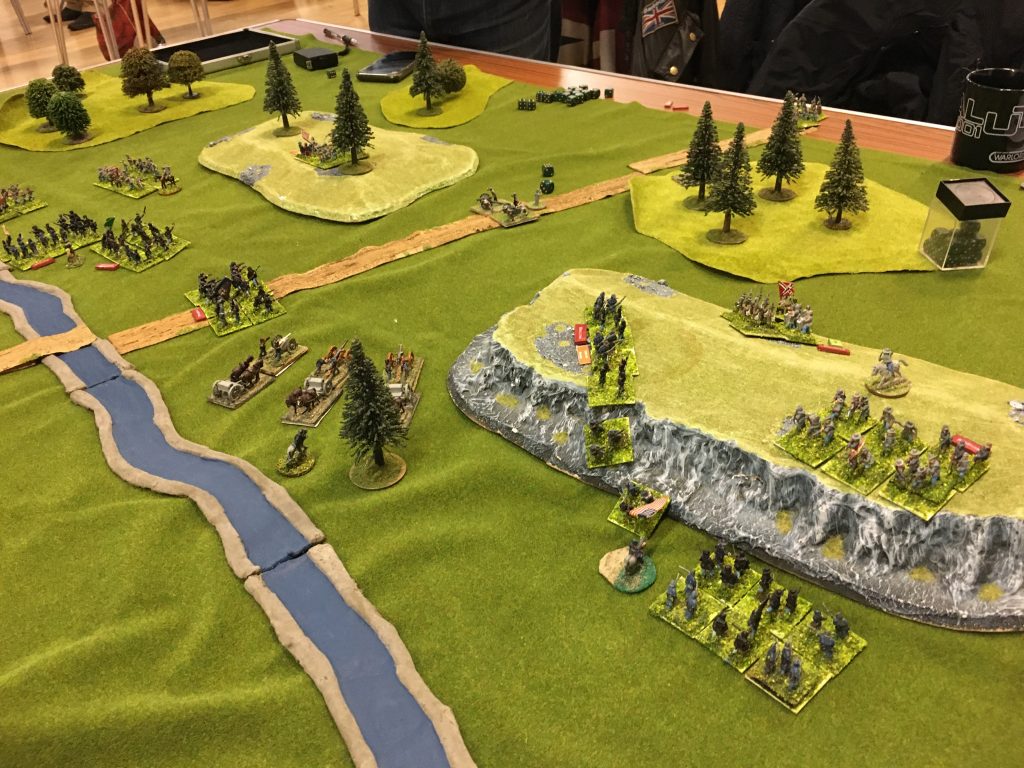
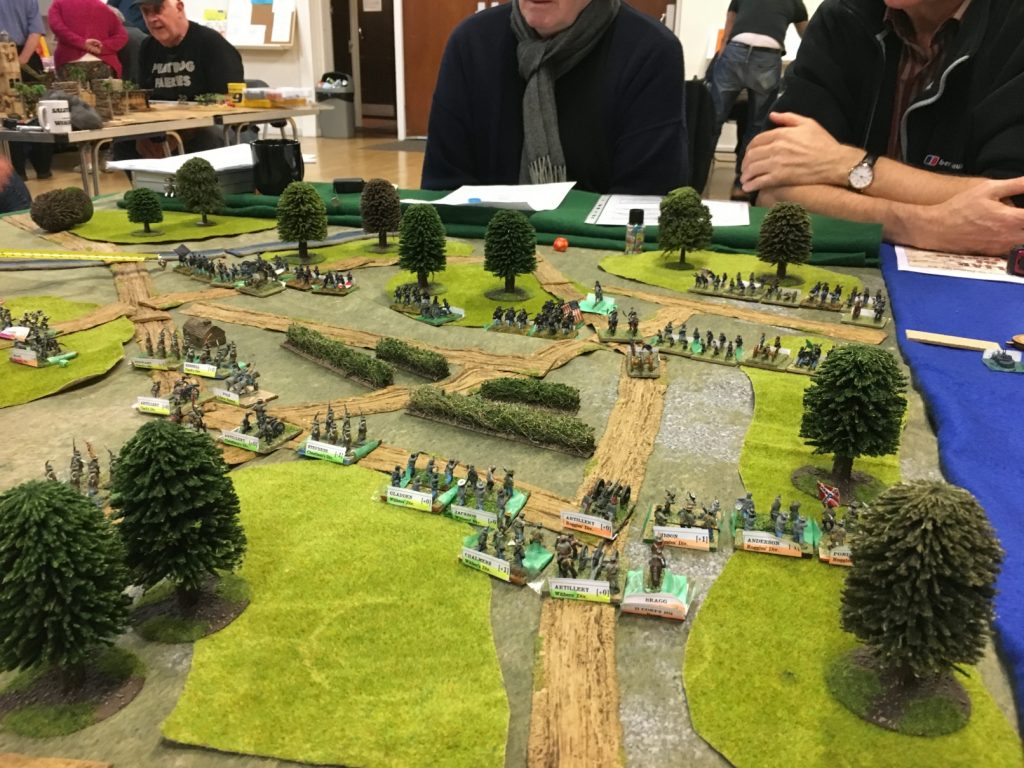
    Last night at the club we played a game put on my regular club colleague Terry, using his American Civil War figures, and based loosely on the battle of Peachtree Creek. We went back to the original, unmodified Bloody Big Battles rules. This is interesting since I’ve spent so much energy rewriting these rules for the Napoleonic era, so that they are now far distant from the original.

    The game confirmed my contention that BBB is fine for the era it was designed for (the second half of the 19th Century) but flawed for earlier battles. The game played very well. There were four of us with half a dozen infantry units a side, plus artillery. We easily accomplished five moves, at which point it was clear that the Confederate attack had failed, in spite of relative unfamiliarity with this version of the rules.

    What is so different about this era? First is that firing is much more important. Infantry weapons are more lethal because the are effective over a much longer range: 9in rather than 3in, reflecting the use of rifled muskets. We represented two Union units as having early breech-loaders, which gave them extra lethality at short range. This extra range meant there was much more firing, featuring occasional base losses. Artillery was more effective too, especially rifled guns. There was more of it too – in original BBB each base represents twice as many guns as in our Napoleonic rules. One Confederate division was wiped out by artillery fire alone.

    We were left with one of our frustrations with these rules: inflicting a disruption on a unit has no effect if it is already disrupted, rendering much fire ineffective. But in context that seemed to matter less. One aspect of the rules was striking though: the effect of the “out of ammo” provision, which happens when units throw an 11 or 12 in firing. In our rules we have replaced this with a disruption, which is not far from mimicking its effect on artillery. But for infantry the effect is halve its firepower and it is very hard to shake: the unit must spend a move out of range of the enemy. This is nearly impossible in such a closely-fought game with such long weapons ranges. It is not a bad way of representing the progressive fatigue of troops, when the other method, base loss, is more drastic. Both units of breech-loaders suffered this, though not before some serious damage had been done to their opponents. This was quite neat example of play balance: not allowing an advantage and lucky throwing to get out of hand.

    The game itself revolves around lots of dice throws, whose effects can be dramatic: movement throws, firing and melee. However over time these tend to balance out, and the rules overall do feel well constructed and balanced. It is interesting that when applying them to a slightly different era that this balance seemed to fall apart, especially when we tried to adapt them to the rather different role played by cavalry, and the effect of cavalry on infantry.

    The small arms ranges used in this game are interesting. Nine inches is about 1,350m, or over three-quarters of a mile. Rifled small arms were technically effective at these ranges, but I doubt that such long range fire was important, and the ranges have been extended for games purposes. They doubtless represent a rather more dispersed use of forces than represented by the bases on the table. On that basis the Napoleonic ranges could be extended to six inches – and yet that would run counter to the feel of the era. Napoleonic battles were largely about tightly managed masses of infantry (and cavalry) engaging at relatively close ranges. Skirmishers were used extensively, but the three inch range (450m) captures this, as the actual effective range was under one inch.

    Our conclusion is that we will use original BBB for future ACW games. If we ever get into the Bismarck Wars, we can use them there too. I did try them in a solo game for an 1866 encounter between Prussians and Austrians, and they were similarly entertaining then. But we’ll use our new rules for Napoleonics: we plan another game of these next week.

  • Altar of Freedom ACW rules

    First an apology to my email followers. The email system broke down due to a technical issue, which is now fixed. So my most recent post a couple of weeks ago on our latest game of BBB didn’t go out on email.

    For the last two weeks we have been trying the Altar of Freedom American Civil War rules. This started from a suggestion made as a comment to this blog, as the rules combine a very interesting command and movement system with simple movement and combat mechanics.

    Last week we tried a scenario I devised based on the first day of Gettysburg. My fellow players liked the mechanics, by and large, but the game didn’t work that well. Partly that was to do with the way the game was set up. Our brigade units were made up of pairs of bases of 15mm figures that were put together on the night, using folded paper labels. These would not stand on the club’s sculpted hills. Also as an encounter battle there was a lot of manoeuvring and very little combat, as the Union side decided to pull off a withdrawal rather than try to defend the Seminary area.

    Given the this failure, this week we tried the Shiloh scenario from the rule book, described as “small” for 2-3 players (we had 5…). It is of a similar size, but this time there were no hills, and the units were pre-based and labelled. We still only got through about five moves, and only in the last was there a major combat. The Confederates found it slow going amid the forests, and the Union side once again pulled back to defend a more cohesive defensive position.

    The main point of interest in AoF is the command and bidding system. Each side gets a number of priority points (PPs) based on their leaders. These are allocated to divisions, to controlling the “turn clock” or to end of turn adjustments. Controlling the turn clock gives you the initiative and some control over how long the turn lasts. Each turn is effectively divided up into a number of moves depending on the number of PPs allocated to divisions. So, for example, all those with PPs of five would move first, then any with four, and so on. Their may be as few as two moves in a turn, or as many (theoretically, in the Shiloh scenario) as 12; more likely three or four. So if you allocate just one or two PPs to a division, it is quite likely that the turn ends before you reach it. This is all very interesting; players need to consider their bidding strategies very carefully – and there is also a lot of scope to vary different command structures for different armies. One of AoF’s design principles is to focus on these differences in command rather than different troop or weapon types. In the Shiloh game, the Union side is one combined army under Grant who has a single block of 20 PPs to allocate as the player chooses; the Confederates have 22 points but split between an army general and four corps commanders, each of which had further restrictions from leadership characteristics. That, and given the more passive Union stance in the earlier phases of the battle, meant that it was easy for the Union side to control the turn clock, and the Confederates soon gave up trying.

    The movement and combat systems are, on the other hand, very simple. That caused some grumbles amongst players who expected some rules to work in ways that they didn’t – in particular that firing and close combat were alternatives, when players expect a fire first and close combat later system (such as in the Fire and Fury/Bloody Big Battles system). But it is one of the things that makes the rules playable, once you are over how they work and stop arguing that such-and-such looks wrong.

    The verdict? Too early to tell. The command system is intriguing, but a bit gamey. Allocating your PPs and the various strategies needed to outwit your opponents in the bidding do not correspond closely to anything in actual warfare. It was quite slow going to build up forces for the attack. The combat did not play out to be quick and decisive, as billed. A lot of this is learning curve. Perhaps the Confederates needed to push forwards with a smaller number of divisions, and bring the rest up later once the path had been cleared. Because of the way the PPs were distributed between the corps commanders, it wasn’t so easy to refuse one flank and concentrate on the other. And the combat could be more decisive once we’ve worked out how to play to best advantage.

    Another problem is that the representation of the battlefield was not very accurate, as we had to set it up quickly using whatever terrain pieces the club had. Perhaps there were more ways through without having to plough through forest… though the forest was very much a feature of the historical battle.

    So far it looks as if we’ll appropriate the game as a club regular, once we’ve learned how to speed up, and represent the often rather complex terrain – based on actual battles. I’m less sure that I’ll be copying the mechanics for my Napoleonic venture. But the rules are a lesson in good game design.