Another quiet month, hobby-wise. Alas no games – I was unavailable for both the club game and the Beckenham group one. Most of my hobby time was spent on the secret aircraft modelling project that I will not report on yet! This isn’t quite finished.
My second project has been to develop some hex-based fast-play rules for Napoleonic games. The first draft is pretty much there – but they need a solo play test before I move onto a more robust playlets with other gamers. I’m call them Command and Discipline – a riff on Valour and Fortitude, the system on which they are largely based. In the absence of much else solid to report on, I will take this opportunity to offer some thoughts on the VF system – with the huge caveat that I haven’t tried it in action.
We also visited Egypt during the month. It was a seven-day crash tour, including four nights on a river cruise boat. Nothing much of hobby significance to report, but I was blown away be this exhibit in the new Grand Egyptian Museum:
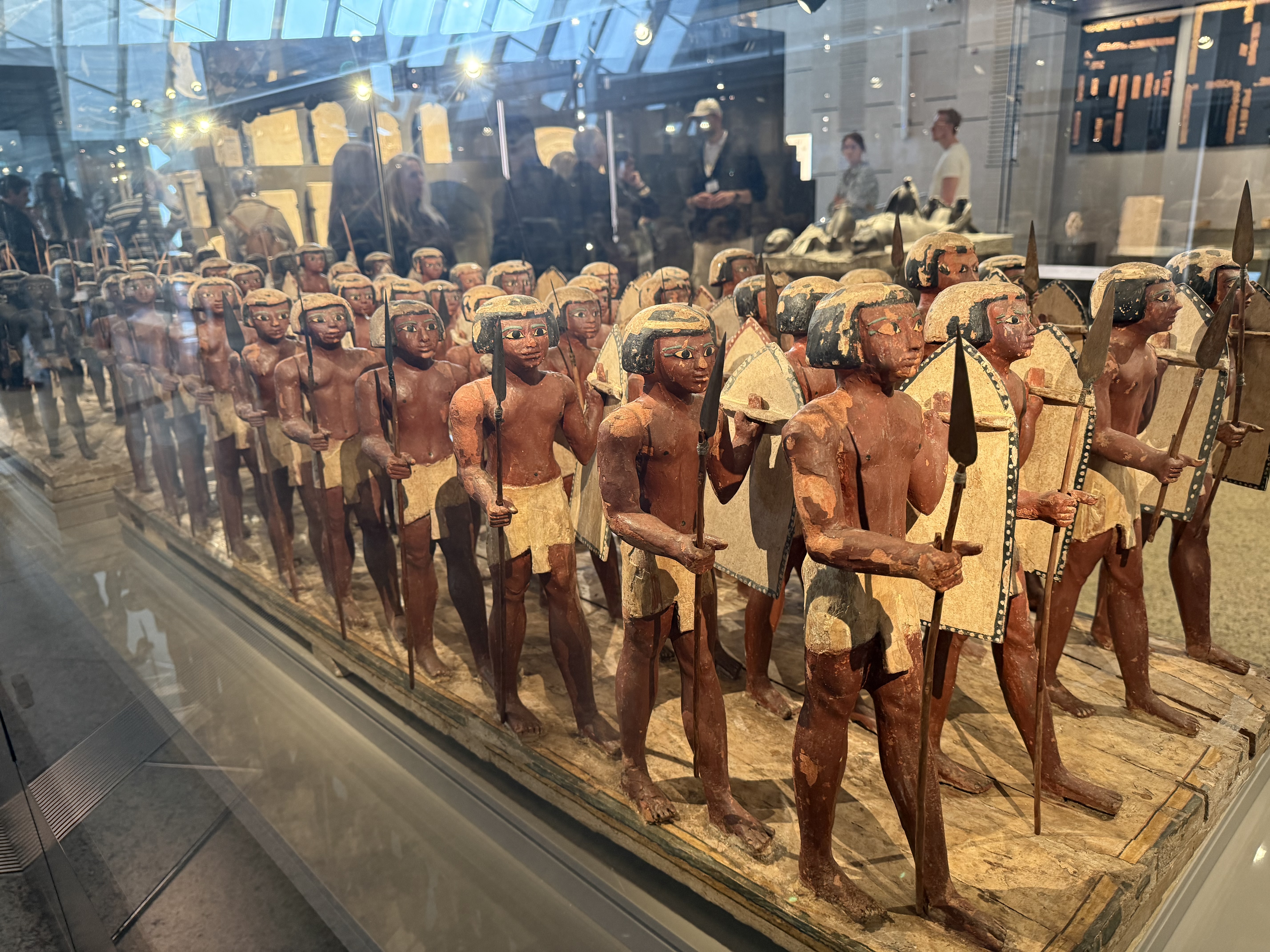
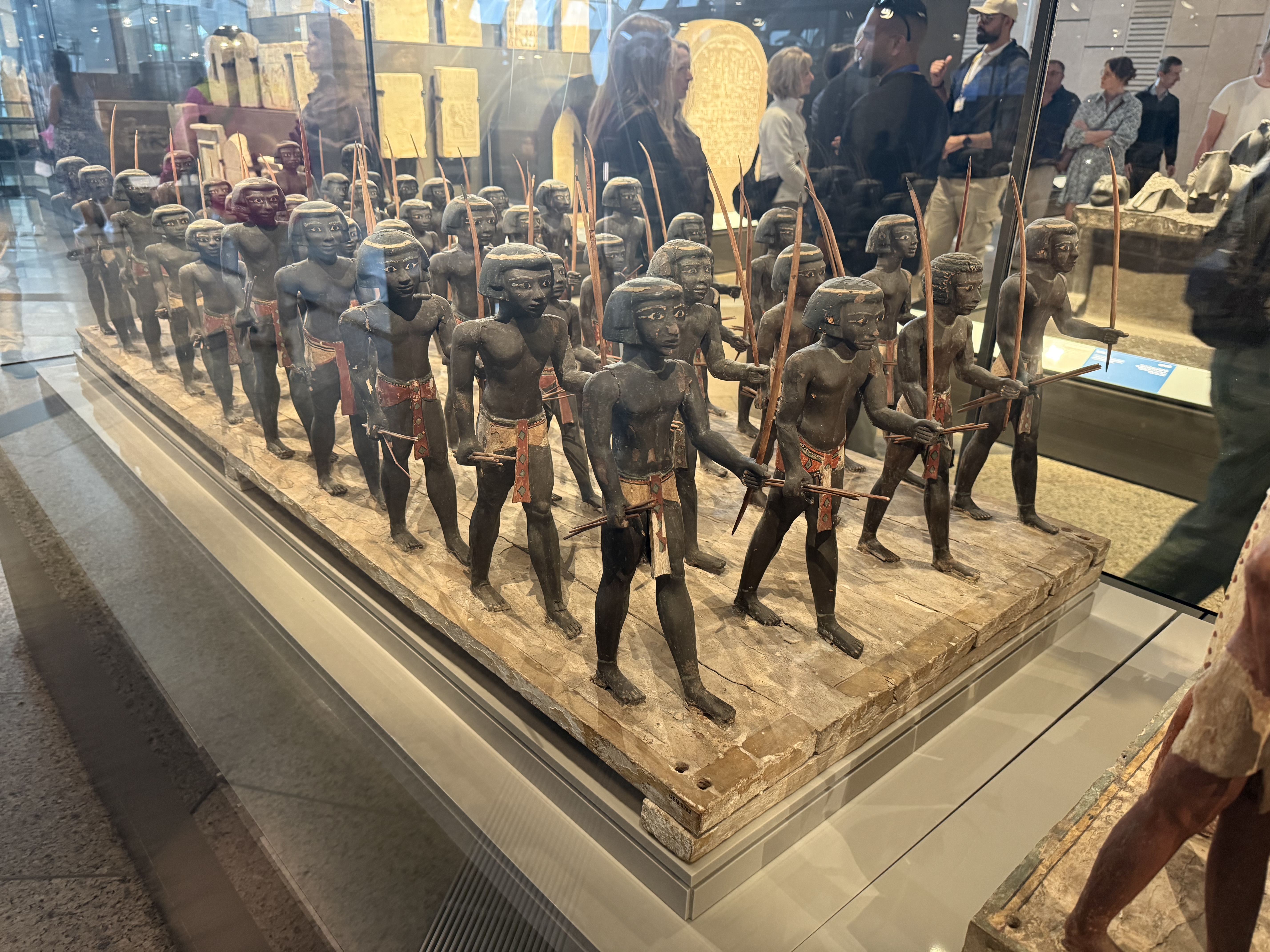
The first picture shows Egyptian infantry, the second Nubian archers. They come from a Middle Kingdom tomb dated about 1900BC. It is more than rare that we have such a full colour contemporary representation of how soldiers looked from ancient history. It was notable that the figures are of different heights – but they are all marching in step. It is a wonderful combination of individuality and uniformity (the shield patterns on the spearmen are all individual, seemingly representing cattle skin). It almost made me want to go out and paint up an army featuring these troops – options are available in 15mm and 28mm. Alas this army is tactically not very interesting – their opponents (the Hyskos) had chariots and composite bows. One of the reasons the Middle Kingdom fell. The later New Kingdom is understandably more popular with wargamers.
Valour and Fortitude
I have mentioned these rules before. They are published by the Perry brothers, and they were written by Jervis Johnson, with the Perry twins also credited – and can be downloaded for free. They are designed with Perry miniatures in mind. The photos and videos published alongside feature gloriously painted 28mm miniatures on sumptuously dressed tables. In fact they look easy to adapt to any scale. Their scope is all of the horse and musket period (the Perry range is extensive!), though they started life with Napoleonics. There is a four-page set of core rules. Each period is covered by two-page army sheets, which give both period-specific rules (e.g. for Napoleonic squares) and army-specific ones (e.g. one for French élan). This compact writing is a welcome contrast to the tend to much longer rules – where it can be hard to find specific rules, and where sometimes the rules a re pad out with chat. The dense writing can be a little hard to understand sometimes, though.
The game structure is an old-school I-go U-go system, with separate phases for firing, movement and mêlée. This is doubtless to ease multi-player format games, though each phase is structured highly sequentially between units (you fire with one unit it, then move on to the next, etc.) – this is no great obstacle to parallel activity in different parts of the table. There a lot of single D6 tests – a bit like the old Wargames Research Group horse and musket rules.There are more modern features too. There is a “Fate card” system, where each side draws a card at the start of their turn from a set of 13 specific to their army (using conventional playing cards), which can then be played later in the game to boost your own side or thwart the enemy. Movement rules are also highly flexible – without the careful wheeling and oblique movement of traditional rules. The system for losses and morale rather resembles Sam Mustafa’s Disruptions in Lasalle (both versions), rather than old-school casualty removal and morale tests.
But there is a very old-school feel, overall. These rules seem to be in a “Grand Manner” tradition, dating back to huge games played of old at the Wargames Holiday Centre, which inspired so many. This comes up in some of the details the rules choose to pick up on – that French élan for example, and cavalry skirmishing with carbines. Not having played any Grand Manner games (I do have a copy of the rules, but I never used them), I might be wrong on this. It just comes over from the look and feel of the games in the pictures. Rules on command friction are very limited – the Grand Manner tradition is that the players generate plenty of command friction without any help. It is also reflected in the language – “valour” and “fortitude” being examples of an attempt to create period feel with period language.
This boils down to a different conception of Napoleonic warfare from Général d’Armée, the system that I am currently using It seems a bit old-school: in which the French do well in charges, and the British in musketry. The example play video (featuring a French attack on a British brigade), while instructive, did not inspire any confidence about historical authenticity. Strangely, though, skirmishers are abstracted away, except certain light infantry units adopting open order. GdA2 comes across as being more serious, with a stronger historical base – but much more complicated.
My current project is to translate VF into a hex-based game, that I can use with my Beckenham friends, for whom the complexity of GDA2 is a disadvantage, but where we usually play two to three a side. At least that was the original idea. In fact, in a topic that I am so deeply marinated in, Napoleonic wargames, this is impossible. I can’t help fiddling with it to fit my own ideas of Napoleonic warfare and game play. The Fate cards are out – players should be playing their troops and not a hand of cards in my view (though you can do very interesting things with cards). In its place I have put a basic command system, where players must decide what to do with their command figure – whether to intervene directly in events or stand back. I have also introduced a Discipline test for troops undertake certain actions in close proximity to the enemy. I have brought in a system of brigade skirmishers (I think these are important to the visual feel of a Napoleonic battle, if nothing else). Hence my new name: Command and Discipline. Alas I fear that I have added complexity – though my basic rules (which include period specific rules for Napoleonics) run to just seven pages so far, and the quick reference sheet is comfortably contained within a page and a half (compare four pages for GDA2).
The hex system can be used to sort out a lot of traditional tabletop nonsense, however. This includes columns ganging up on lines (the explanatory video suggests this could be an issue for VF). It’s will be interesting to see how well all this works under tabletop conditions!
Looking ahead
I will miss the next club game, which is on Easter Sunday. That would never have been on for me, even if we weren’t visiting friends and family. I should get a Beckenham game, though. My secret modelling project should be done by next week. That will allow me to get on with my 10mm Austrians for 1866, which are now ready for basing. And Command and discipline will get a solo tabletop excursion. Unfortunately, the garden is pressing for attention too…
Leave a Reply