Tag: Napoleonic

  • Nafziger’s 1813 trilogy: a useful resource but a poor history

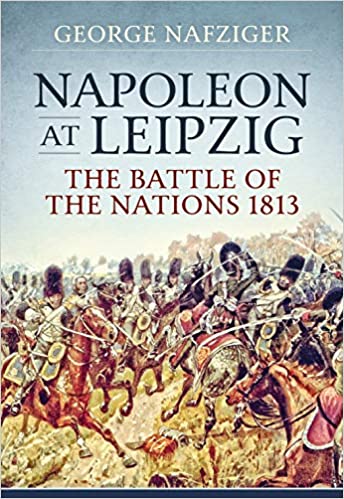
    Back to this blog’s original focus: Napoleonics! My reading about this era has focused mainly on the Waterloo campaign, the Peninsula War (1808 to 1813) and the Austrian campaign of 1809. I have dabbled in other campaigns: Napoleon in Italy 1796/7, Suvarov’s campaign 1799, Marengo 1800, Austerlitz 1805, and Russia 1812. That left a huge gap: the epic Central European campaigns of 1813 (and to a lesser extent the battles in France in 1814). I thought I needed to do something about this, saw an offer on George Nafziger’s three books on the subject, and bought them.

    I started the first book, on Lutzen and Bautzen, last year, read the second, centring on the battle of Dresden, during lockdown, and have now finished the third, centring on Leipzig. I have very mixed feelings about the whole experience.

    Captain Nafziger is well-known amongst wargamers for his intricate research whose main output is orders of battle for many encounters in Napoleonic and other wars, where he went much deeper than the usual British and French sources. He has also ventured into wider military history, with an account of the 1812 campaign, which I have, and others which I haven’t). Unfortunately his ability to ferret out and absorb multiple sources does not make him a great historian, and this series of books doesn’t show him at his best. His prose is leaden. His editorial choices are rather strange. No detail about which unit was to the left or right of another unit is too small for him to note down, but swathes of more strategic information get left out. His accounts include strings of place names, many of which do not appear on the (usually) sparse maps, and little geographical context is offered. It really is very hard to understand what is going on. The result is that I’m still pretty confused about how the earlier campaign, resulting in the battles of Lutzen and Bautzen, unfolded and why things happened as they did. The other books are generally a bit better, but still very hard going. Occasionally there do seem to errors. I found one case of what looked like the same episode being repeated. There are almost no eye-witness quotations to provide context and atmosphere (though in some ways this is a relief: some modern historians give too many undigested eye-witness accounts, and not enough interpretation).

    Occasionally Captain Nafziger’s method works. His account of the prelude to Liepzig, the battle of Liebertwolkwitz, is much clearer than the two versions I had previously read (one by Digby Smith). but mostly it is thoroughly confusing. How accurate is all of this? I suspect him of giving too much credence to French accounts of their own prowess, though he does try to be objective. At Bautzen he describes dreadful execution done by French batteries firing across the river. And yet it was very hard to tally these with what he describes as happening to the Allied troops at the other end (which has a single horse battery being forced to retreat, if I remember correctly). There were other cases where praise for the conduct of French commanders is made for achievements that look quite modest. Where French sources are the main ones available, such as for many of the sieges a the end of the book, the accounts are very lopsided.

    There is a lack of strategic commentary. Where he provides it, it reads more like thinking aloud than properly-developed argument. Overall there is a very 19th century feel to his commentary. In this era commentators (including military theorists) felt that Napoleon’s early campaigns (from 1796 to 1805 in particular), with their rapid manoeuvre and decisive battles were the epitome of good generalship, and the standard to which all military leaders should aspire. So they are continually critical of Napoleon’s more “lethargic” later campaigns, and have a good laugh at the floundering grand tactical leadership of the Allies. But war was changing, with massed armies, deficient training and stretched officer cadres. You had to fight wars differently. I suspect many of Napoleon’s “errors” can be explained by such considerations, which, for example, did not allow him to expose the logistical centre of Dresden. And, there is a plausible interpretation of the the Allies’ second campaign, masterminded by the Austrian Prince Schwartzenberg, as being one of the most brilliant of the era. There is a more modern flavour to these campaigns, compared to the more 18th Century earlier campaigns. It reminds me rather of the classic comparison of the generalship of Lee and grant in the American Civil War: one seems to look forward and the other back.

    What are the takeaways? First I was right about 1813: this is in many ways the pinnacle of the Napoleonic Wars. In a wargamers’ terms (let’s dance lightly over the pain and suffering) this is very rich source of action – with the two sides remarkably well-matched. The sheer scale of it is clearly one of the big problems the author faced in his account. I might very well like to compare this work unfavourably with such masterpieces as Rory Muir’s book on Salamanca, or Eric Gill’s trilogy on the 1809 campaign – but these were much smaller affairs. It is very strange that these epic battles in 1813 are so weakly covered by English-language historians. Captain Nafziger is to be congratulated on taking such a challenge on. The level of detail in this book will make it a useful resource. But I badly need to read a more strategic account to get a clearer idea of what was happening (there are a couple around).

    Incidentally, something rather interesting does emerge from wading through the mass of detail: it is how well the Austrians performed, right up to leadership level. I would go as far as to suggest that they were the most aggressive of the troops in the alliance in the second campaign (they were the freshest of the combatants, so this should to be too surprising). This is a far cry from the standard English language account which suggests that they performed poorly because their heart wasn’t in it. Indeed Austrian and Prussian leadership at corps level seems to be every bit as good as that of Napoleon’s veterans, and often better.

    There are some mysteries to me that these books throw up, and which my further reading will address. The first is to get some kind of coherent narrative around the first campaign. I don’t buy the standard account that Napoleon outwitted the Allies and had them on the ropes when the armistice was agreed. After all, why then did Napoleon agree to the armistice? There is surely a strategic narrative that tells a rather different tale. Second is why did the Allies accept battle at Dresden when they realised that Napoleon was there in strength, especially when their deployment was so flawed? Third, was Napoleon really so close to crushing the Army of Bohemia after the Allied calamity of Dresden? And finally how close was Napoleon really to achieving victory against the Army of Bohemia on the first day of Leipzig?

    That last needs to be explored in a wargame. I really don’t understand why this part of the battle isn’t attempted more often by wargamers. It’s big, but so is Borodino. And it has everything – Guard units and cuirassiers aplenty on both sides, and lots of drama. There are lots and lots of other wargames ideas to be found in these books (though I in many cases these will require the finding of much better maps). There are a couple of very interesting smaller battles that caught my eye too.

    Conclusion. 1813 is where I need to be directing my future energies on Napoleonic wargames, following the realisation of my Ligny project for 1815.

    PS George Nafziger has contributed a comment, below. August 2024
  • Albuera 1811: refight for BNB

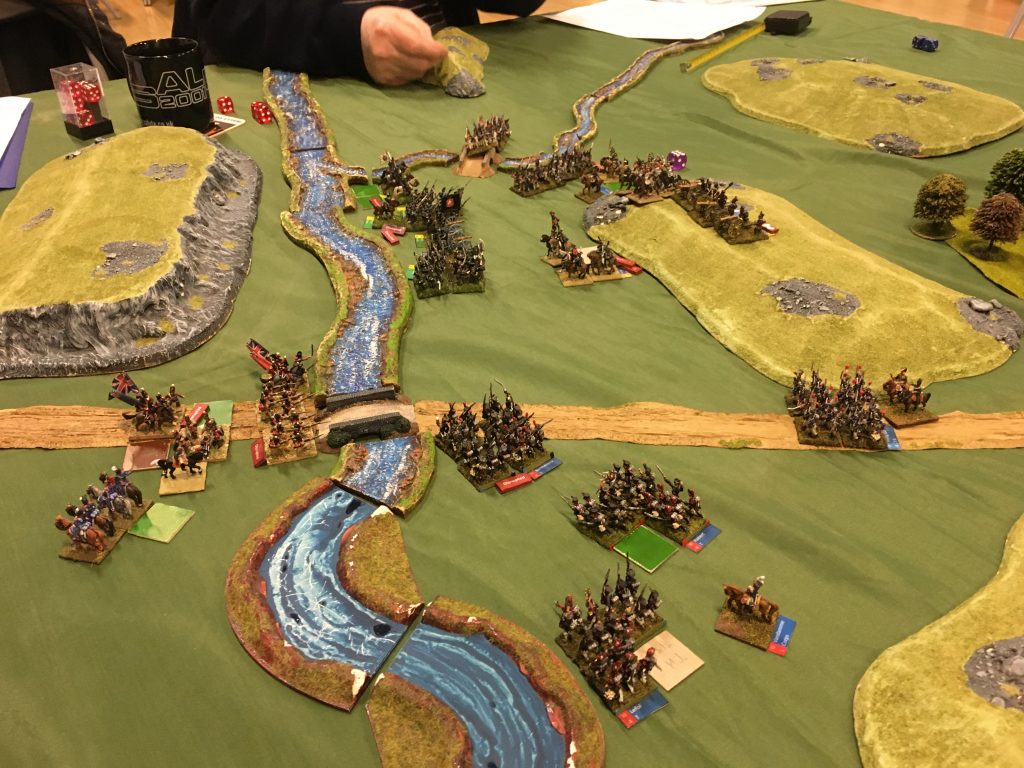
    Another week , another outing for my Big Napoleonic Battles rules at the club. This time I wanted to try something historical. I had already worked out a scenario for the epic Pensinsular battle of Albuera in 1811, so I dusted it down. Unfortunately I brought the wrong box of French, so the French army looked very scrappy, including some ancient Minifigs Old Guard and Union ACW troops in skirmish order. So no pictures.

    The scenario was quite stylised. I am avoiding close adherence to the historical terrain and orders of battle. This makes the games quicker to set up and play. The terrain is simplified to essentials, and the units mostly of standard size. However the overall number of bases was close to historical for each side. Apart from the French infantry (using my usual four bases) the unit sizes were smaller than I have used for 1815: three bases. The figure ratio was set at 1,000 infantry per base, less than the 1,250 I am using for 1815, but this reflects the toll the Peninsula took on grand tactical formations. Each of the two British divisions were represented by two units (allowing the Portuguese to be separated in Cole’s division). There was one four-base Spanish unit: Zayas’s division. Not too much distortion was needed with these unit sizes. The French got an extra unit, attributed to the reserves. Alten’s KGL light infantry was merged with Collins’s independent Portuguese brigade.

    All the British and French infantry was classed as Veteran, including the KGL/Portuguese unit, and the British (but not the merged unit) were also classed as Aggressive. The two Portuguese units and Zayas were classed as Trained. The other Spanish units were Raw and Fragile, along with the Spanish and Portuguese cavalry. The British cavalry unit was Trained and Aggressive. The French light cavalry units were classed as Veteran, with one (the Polish lancers and 2nd Hussars) also as Aggressive. The two French dragoon units were classed as Trained – the French dragoon arm seems to have had problems in 1811/12 in the Pensinsula. To mimic the command problems on the Allied side, they were given no generals, and the Spanish were additionally classed as Passive. The French had two generals.

    As with the original battle the French pushed most of their infantry into a left flank attack, with the lead unit feinting on Albuera village in the centre. Unlike the day the main French attack the Allies had more time to respond, notwithstanding command issues, so the flank was not fully turned, and all the cavalry was thrown into the attack in the centre. This succeeded drawing in British infantry to the centre, where the French held their own, though the sight of two French cavalry units scrapping for the village jarred a bit (the village wasn’t treated as a dense built-up area, so cavalry could operate in it). The Spanish were left holding off the main French onslaught, but were helped by cavalry superiority. By the time we called it a day, the Spanish were holding on, though the fight had lasted only two moves: a longer battle would have been uglier for the Spanish. The French had started to relocate some of their cavalry from the centre to counter the Allied cavalry superiority.

    So how did the rules do? Such historical refights need to be judged on three aspects. Scenario design, player performance and the rules themselves. The scenario had one major weakness: it allowed the Allies to react to the French battle plan at least one move earlier than they did historically. Their ability to react needs to be constrained. Also I think Coles’s division is available too early. I was playing closer attention to the French, and their their use of generals and the veteran status meant that the army didn’t suffer too much friction in the early stages. The Allies suffered more, but I’m not sure if it was enough to reflect the historical situation. Perhaps they should all be Passive (with maybe a British general to compensate). I am broadly happy with the troop classifications: if the Spanish were too effective that is a rules problem, as they had nearly the lowest grade possible. On terrain I think it was broadly OK except I don’t think the hills on the Allied side were right, and could do with another look – but the restraint is using club terrain, which does not allow relief to be represented exactly right. I think some way of showing a watershed on the table might be worth considering.

    And the players? You can bring a horse to water, but you cannot make it drink. If wargamers behave unhistorically on the tabletop there nothing much that rules and scenarios can do about it except nudge them in the right direction. The first unhistorical thing was the way the French threw their cavalry into the centre, leaving the left unsupported against three Allied cavalry units. This followed the way I split the commands, giving both the advance guard and the cavalry to one player, and the rest of the infantry to the other. Each player then focused on their own personal battle rather than the battle as a whole. Historically the French had a strong overall commander, Marshal Soult, and this strong unified command showed in a coherent battle plan. A second issue was that the French threw all their infantry in at once on the left, leaving no reserve. Soult left a substantial reserve which he threw in at the critical point once the initial attack got bogged down. This is a classic wargames issue, exacerbated by the fact it was an evening game with a maximum of five moves. The Allies were no better. A further wargamer issue is that the players are much more aggressive with cavalry than historically. On the Allied side this meant moving units far out to each flank in the hope of taking the attacking units in the rear. This isn’t historical, though the natural response – for the attacker to cover flanks with cavalry certainly is historical, and this would be an effective way of neutralising the tactic. I have noticed the very aggressive cavalry before and I’m not sure what, if anything, to do about it.

    And the rules themselves? In terms of the broad sweep my chief concern is that battles don’t evolve quickly enough: each turn is meant to represent an hour, and the battle seems to develop more slowly. In this case I don’t think it was because the players were hesitant. There are two possible culprits: slow movement and combat mechanisms. The move distances are already uncomfortably long for the simplest moves, especially where roads are involved. Of course terrain and command friction can slow things down a lot, but that wasn’t the issue in this game. The big infantry battles perhaps take too many moves to resolve. But given that they are already very dice-heavy you need to resolve in several rounds to the dice a chance to balance out. In an earlier incarnation I added to the losses on both sides in close combats – that might be worth looking at again, so that units are worn down faster (allowing multiple combat rounds may be the best way of doing this). The jury remains out. It is hard to draw out where the rules are at fault rather than the scenarios or players. A key learning from Chris Pringle (author of Bloody Big Battles) is not to rush in to fiddle with the rules to fix every problem.

    There are some lesser points that I will add to my list of ongoing issues and modifications. The cavalry had it too easy in the village – and indeed I worry a bit about the way “open villages” work. I think they need to be disadvantaged in this type of terrain (and open woods too). Also what happens when two cavalry units hit an infantry unit? Simultaneous combat , as the rules imply, or sequential, which I think makes more sense? The second unit would benefit form disruption in the infantry (+2), but it will be in square (-2). A more radical thought on combat is to make all multiple attacks sequential – this might help make combats more decisive, but creates problems if units are of different sizes (three and six bases for example). That’s much too radical for now, of course.

    Life away from the hobby is going through a busy patch, so I will have limited opportunity to develop further scenarios. But I’m keen to get going. Something that helps is that I have bought some lovely British infantry from another club member, which means that doing Pensinsula scenarios is a more realistic proposition. It is much easier to use Prussians as a stand-in for Portuguese and Spanish rather than British redcoats.

  • Big Napoleonic Battles – prototype rules published

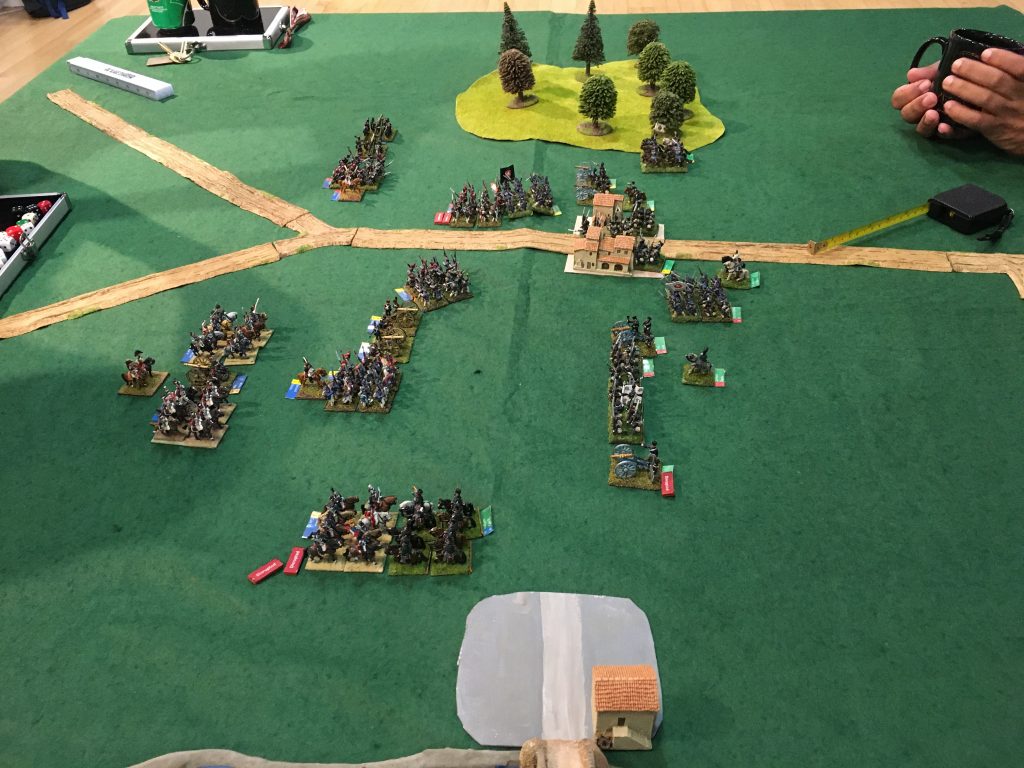
    Our latest game reaches its climax.

    Since my last report we have played two more short games at the club with my new rules, Big Napoleonic Battles (loosely based on Bloody Big Battles). They have settled down enough for me to publish them on the Rules page of this website in pdf.

    These rules are a working prototype, which I am calling V0. They should be all you need to play, but there are no pictures or diagrams, and very few examples. While these rules will never be published in the mainstream way, with lots of eye-candy and glossy paper, I might aspire to something with more explanation and perhaps even some scenarios. The model here is again Bloody Big Battles, though I can’t see that I will ever get the rules actually printed and sold for money.

    Instead of updating these rules as I think of changes, which I have done a couple of times already, I propose to publish a separate sheet of updates and clarifications, which I can update regularly. That will make things easier for people who have printed the current version, as some of my club colleagues have. These will be consolidated into V1 in due course. At that point I will attempt examples and diagrams.

    These rules are by no means perfect, but they give a good club game. My fellow gamers like them – something I take as a considerable complement: we often let go of rules that we find don’t quite work. That has happened with Fistful of TOWs, Battlefront, Rapid Fire and Iron Cross for WW2/Modern, and Altar of Freedom ACW. My next project indeed will be to develop something for my WW2 models! Foe us the rules have to play quickly in a multi-player format, and conform to some degree with how they expect wargames to work.

    How realistic are they? I get fed up with claims made by rules promoters that are both simple to pick up and realistic, when they obviously have not been tested against historical reality. The original BBB has been extensively used for historical refights, though typically for battles later in the 19th Century, so it has a fair claim to realism. I can’t yet make the same claim for BNB, as the sort of quick scenarios we can do on club night are rarely historical. I might try out an Albuera game next week, though.

    What I can say, as I said last time, there is high variability based on dice throws, making outcomes very unpredictable. I don’t think that is unrealistic, given the vast number of factors that have been abstracted away, but it will irritate some players just as it entertains others.

    Do try them out and let me know how you get on!

  • Big Napoleonic Battles – nearly there!

    Our club game on Monday night

    A couple of weeks ago I reported I had taken the radical step of creating a set of standalone Napoleonic rules, based on our house rules for Bloody Big Battles. For the time being I have christened these rules as Big Napoleonic Battles, until I can think of something better. At our club game this week we used the next iteration of these rules. And the verdict from my club colleagues is that they are nearly there. After the next series of tweaks I will post a copy here.

    The scenario was one I put together in a hurry, and wasn’t helped by being caught in a horrendous traffic jam on the South Circular on the way. With five players (including one brand new one), each with two or three units plus artillery, we completed five moves, which was the limit I placed on the scenario. I am understanding how to design games that can be completed comfortably on a club evening, where we are limited to two and a half hours. The multiplayer aspect doesn’t speed things up as much as it might, since there is still a tendency for players on the same side to wait for each other. It also helped that I limited unit size to four bases. I hope that can I increase to four units per player, so that we can get bigger games, but the five move limit feels right. It is meant to represent 5 hours of real time, which in 1815 was the length of both Ligny and Quatre Bras – as well as the Prussian involvement in Waterloo.

    Now that I have a game that my colleagues like, I am going to put my Napoleonic rule-writing on hold. Doubtless I will want to make small tweaks to BNB, or write some special rules to cover particular situations, such as strongholds (i.e. farmhouses, churches, etc turned into defensive structures). Perhaps extra rules on generals would add appeal. But my more ambitious thoughts on a new turn and movement mechanism will wait. I will switch my rule-writing to another era: WW2 probably.

    The scenario had two Prussian corps, each one regular infantry, one landwehr and one cavalry unit and two artillery bases, defending a town, in a position with flanks anchored by a river and village on one side and a dense wood on the other. Attacking them where two French corps, each with two infantry units and two artillery bases, one with a cavalry unit. In addition there was a reserve cavalry corps with one unit of cuirassiers and one of dragoons, both classed as veteran (all other French were trained) and the cuirassiers classed as aggressive. The objective was to take the town in five moves.

    The Prussians took a bit of a battering but held out pretty well. The town changed hands several times. I was a bit worried that French cavalry superiority would dominate, and indeed gave the Prussians their second cavalry unit at the last minute in order balance things better. But the cuirassiers performed poorly, in spite of having a +2 advantage on close combat. The Prussian artillery kept stopping them, and they threw badly in combat. The extra Prussian cavalry unit, on the other flank, contributed very little except as an artillery target.

    The main rule feature on trial were rules on town combat. Each town block can only be occupied by a single infantry unit (and only attackable by one infantry unit at a time), and any loss on close combat would result in the attacker capturing it. The town provided good cover against fire, but only -1 in close combat. Though some details need to be tweaked, this worked very well. It changed hands on most attacks, with the attackers only to be turned out by an immediate counterattack. This is pretty realistic – historically this would only be complicated by the presence of a strongpoint. But rules to cater for such things would not be simple, and I am leaving it until later.

    I have still have questions over the treatment of elite formations. The +2 for the cuirassiers looked a bit rich. That isn’t a problem with the rules as much as one of scenario design. In fact the indifferent performance of that unit showed that I may be worrying too much.

    Which leads to the observation that there’s no getting away from the fact that these rules are very dice-heavy, even though they don’t take the fistful of dice approach (you never throw more than two at a time). The same scenario is likely to play very differently if repeated. Personally I don’t mind this: historians are too quick to suggest that historical outcomes are inevitable. Surprising events often happened. But tastes vary. Some of my colleagues loved it when their cunning plan failed because they threw a double one; others were frustrated when a blast on canister fire completely failed to register.

    The game went so well that my friends asked for another game next week. I can’t ask for a stronger endorsement that that!