Author: admin

  • French artillery in 1/100: Part 6 – the 6in howitzers

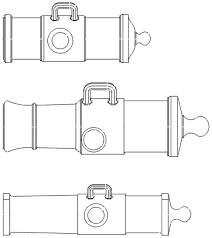
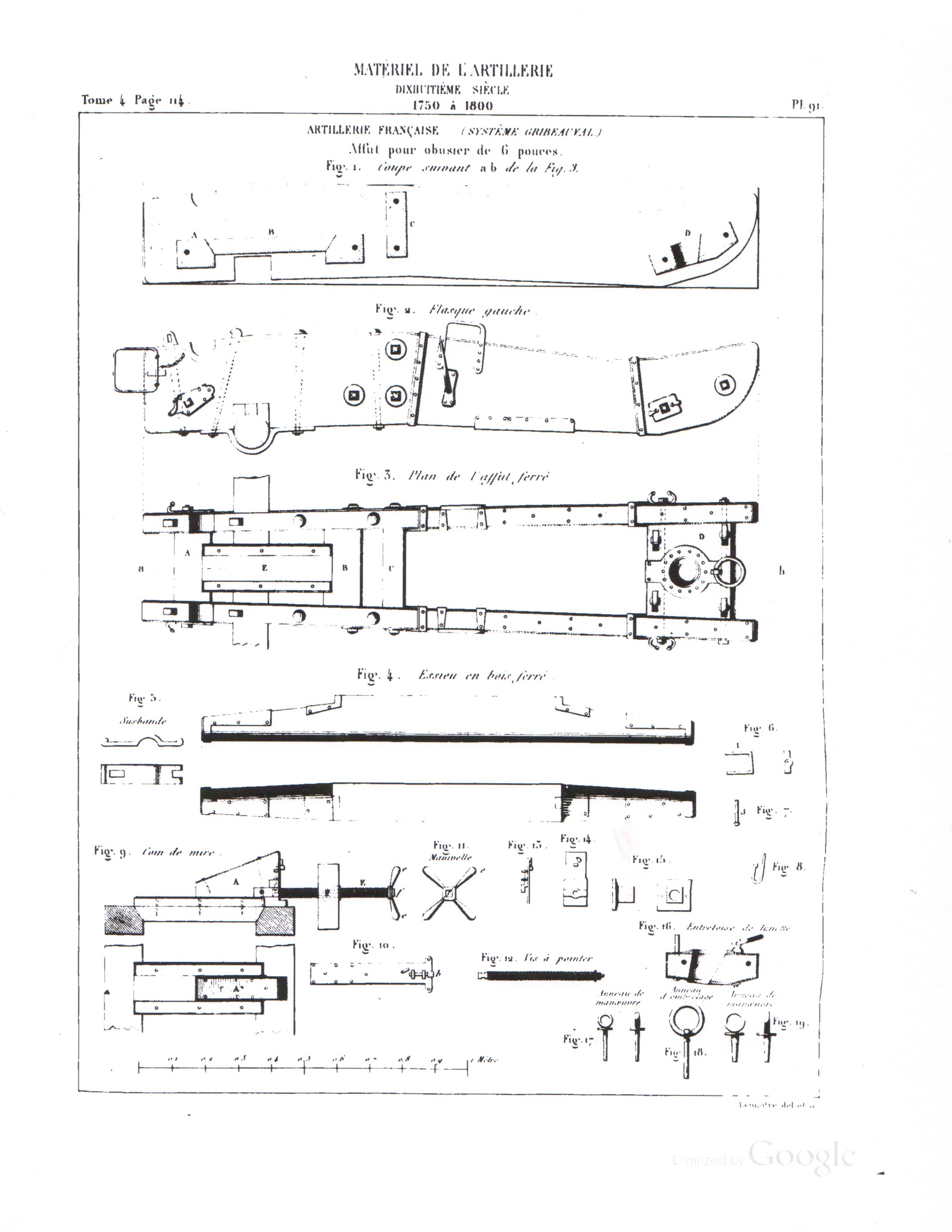
    An so we come to the howitzers. Howitzers are often ignored by wargamers, as they usuallyFrench howitzers only comprised one section of two  in each battery – so there is only a call for them if you are representing pairs of guns. My games are grand tactical where each tabletop piece represents one or two complete batteries. And yet I have always had a soft spot for the type, and found ways of including one or two on the tabletop. And when it came to this project the howitzers caused me more research problems than any other aspect – and so has the modelling. Confusion reigns from start to finish. Let’s begin by considering the diagram to the right, which shows a drawing of each of the three howitzer types that the French used in the field, alongside captured weapons. Each of them is usually referred to as a 6 inch howitzer. In addition to these three RC in his Osprey offers some pictures of an earlier “Gribeauval” howitzer that was not in use in our era, so far as I know.

    The one at the top is the “real” 6 pouce ( = thumb = inch) howitzer, that was cast in the 1790s, and dominates all illustrations of French howitzers. Its calibre is exactly six French inches, which were slightly longer than the ones in modern use in Britain and the US. I will call this the 6 pouce. The second is the heavy howitzer, based on the Prussian 10pdr howitzer. It was never produced in large numbers but it accompanied French 12pdr batteries right up to Waterloo. I will call this the 10pdr. These two I will deal with in this post. The third is the An XI howitzer, more properly called the 24pdr, or sometimes the 5 pouce 6 or 7 lignes (12 lignes = 1 pouce). It is nearly six English (and modern) inches in calibre, and is thus it is usually called a 6in howitzer by British observers. Perhaps disliking the alternative nomenclature, the French also seemed to have used this name very often too. It is much the most important of the three militarily, and also the most challenging to model, so it gets a post all to itself. I will call it the 24pdr. Incidentally DDS uses modern inches to distinguish the three (6.4, 6.8 and 5.9 respectively), but I don’t think this helps – if you must impose modern nomenclature, then surely the metric system is preferable and transparent.

    So first to the 6 pouce. This is the 8pdr of the howitzers. From the literature and illustrations you might think it was the only howitzer the French had in service. And yet it was not all that widely used – though it is hard to tell for sure because when orders of battle refer to 6in or 6p howitzers they may be referring to any of the three designs, and possibly some captured 7pdr howitzers too. A number of barrels pop up in illustrations; all were cast in the 1790s, and I don’t think any were cast later. RC says that more were cast between 1804 and 1813, but I am sure he is confusing it with the 10pdr. The 6in howitzers captured at Waterloo and in the Royal Armouries, when not referring to the 24pdrs, refer to two 10pdrs, one cast in 1795 and the other 1813 (the entry for the latter was shown in my previous post). The 6 pouce was regarded as inaccurate and its carriage had a tendency to shatter (according to RC). Still, a number were used well into the Imperial era. There is an example in Les Invalides mounted on an An XI carriage, clearly from later on. And the official documentation seems to keep mentioning it. Whether it was used in Spain, like the Gribeauval guns, I cannot tell. All the howitzers described in both French (as published by Nafziger) and English (the report of artillery captured at Vitoria) sources refer to all the field howitzers as 6in. The surviving example from Vitoria in Lisbon is a beautiful 24pdr, showing that the French, as well as the British, referred to the 24pdr as “6 inch”. The Spanish government may not have used this design, unlike the Gribeauval guns – and these were the main source of artillery for the French in Spain, apparently.

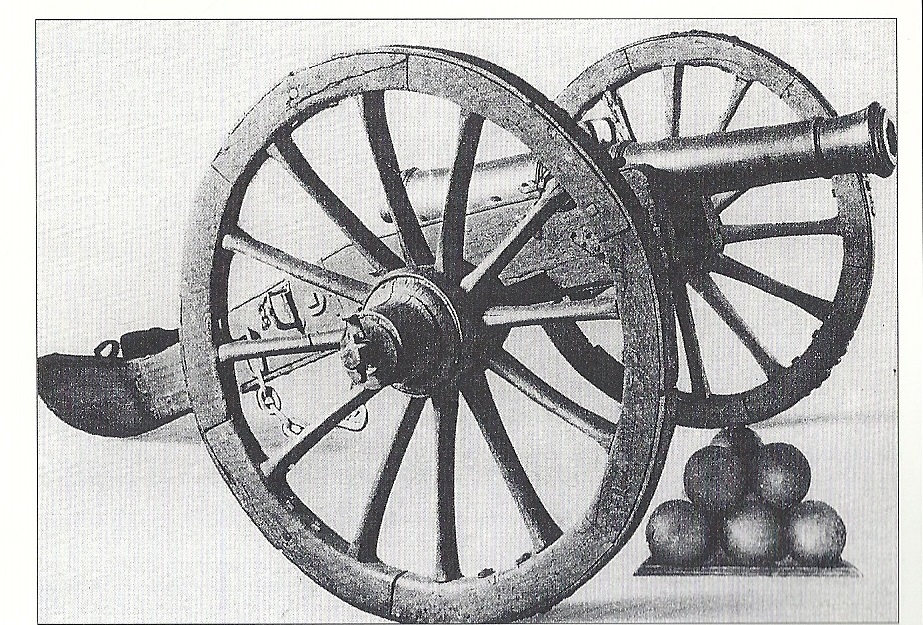
    Be that as it may, unlike the other howitzers, there are some lovely drawings of it and its original carriage. Some of these originate with designs sent by the French to the United States. One (after de Scheel 1800) is reproduced in part in DDS, and shows the original elevating mechanism – with a triangle of wood moved by a screw to the rear. Here is another version of this drawing:

    img981

    This is the source of a nice picture in RC – though this elevating mechanism (quite unlike the Gribeauval one) was replaced in 1792 according to DDS (the elevating screw came from below the barrel). Artists and historians seem attracted to these drawings and have quickly appropriated them to represent all French howitzers. It is used, for example in Mark Adkins’s book on Waterloo, in spite of the fact that it was almost certainly not used in the 1815 campaign. The visual appearance is certainly striking. You can see from the above drawing that the barrel is very stubby; there is not much barrel in front of the trunnions and it barely projects from the carriage. But it is also very chunky. as is the carriage, which, apart from the elevating mechanism, seems to have a family resemblance to Gribeauval pattern (though the cheeks do look a bit chunkier, they have that characteristic bend) The wheels are the same as the 8pdr and 12pdr, but the trails are shorter, though longer than for the 4pdr. One remarkable picture in DDS shows this carriage mounting a 24pdr from about 1822 – including the triangle of bolts relating to the obsolete elevating mechanism. This may be an attempt to render an 8pdr carriage, which we are told was in use at the time, but it clearly refers to the obsolete 6 pouce carriage.

    There is a bit of problem with the drawings though. The barrel seems to be subject to different drawings from the carriage, and the scales get wonky. According to the above drawing the length of the trail is 187cm; according to the picture in DDS it 298cm. According to a table of dimensions in RC (which looks authoritative, though the metric conversion can be shaky) it is 268cm – which is the version I take as accurate. The DDS scale appears to be accurate for the barrel, but not the carriage. The colour illustration in RC seems to have overcome these problems, though, to produce a very nice picture, albeit with the out of date elevating mechanism.

    How to model the 6 pouce? Unsurprisingly, it is the only French howitzer that any of the manufacturers has attempted. But they haven’t given it much attention. Battle Honours gave us a barrel, but supplied it with their “light” gun carriage, which I have used for the 4pdr. Old Glory and Fantassin/Warmodelling give us a tiny barrel to plant on a standard 8pdr carriage. Minifigs produce quite a nice model, but under scale for my purposes. AB get the closest. The overall dimensions and topography are correct on my models, bought over 10 years ago, and it even gets the elevating mechanism right, but apart from the wheels it just looks a bit weedy. The barrel, in particular, is much too thin – it should rival the 12pdr in girth (the calibre is larger after all (166mm to 121mm). The model may have changed, though. The picture in the link on the Fighting 15s site seems to show an 8pdr style carriage, not unlike the one used for the 6pdr. The recent Blue Moon offering is nothing less than a disaster. The carriage is hopelessly over scale (33mm long, or 330cm in scale). The barrel is on a more accurate scale, but lacks heft, though it is better than the AB attempt. The wheels are fine though!

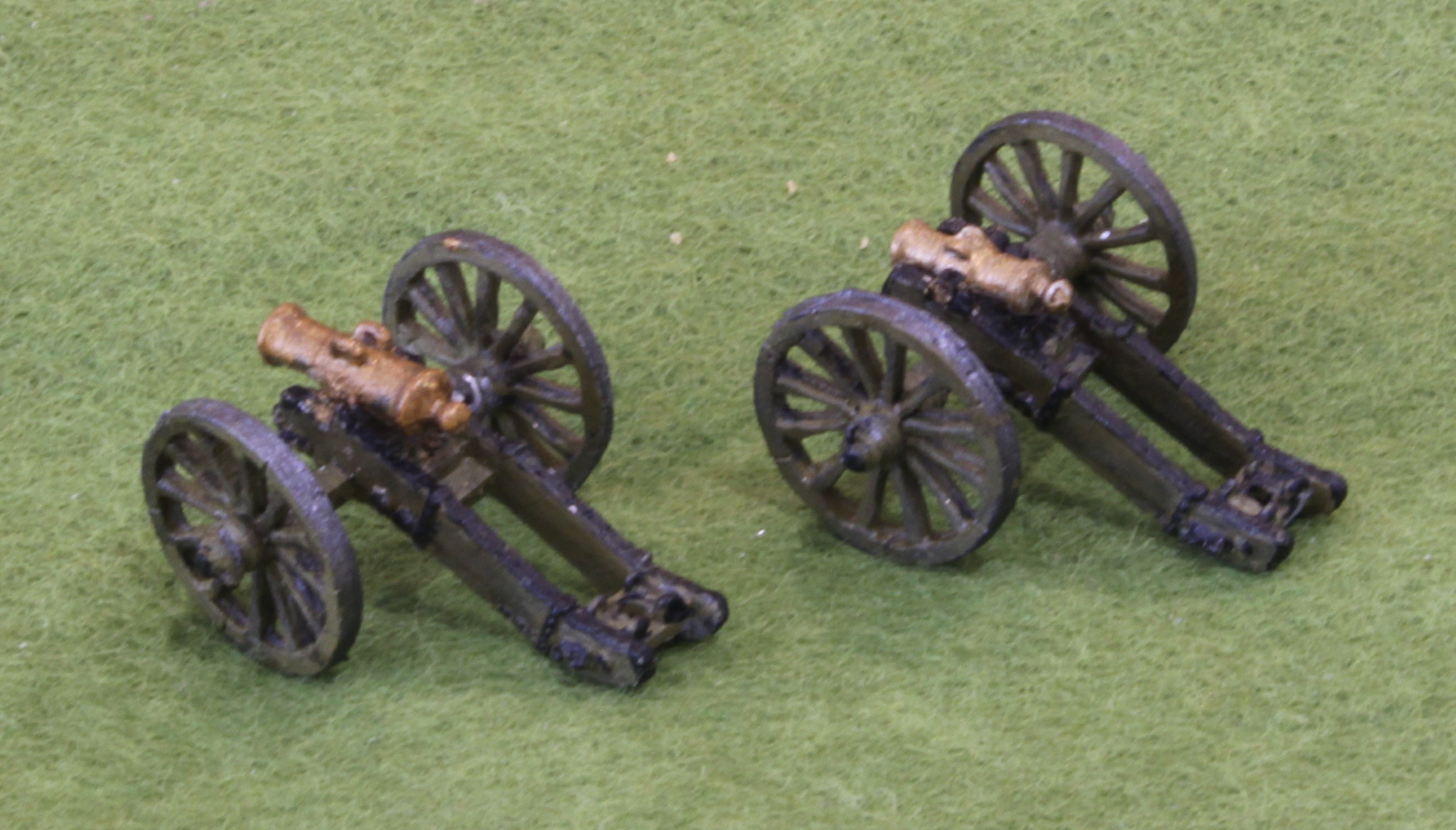
    So what to do? I used the BM barrel on the AB carriage. I already had three of the ABs, and I used two for this purpose. Some of the BM carriages I converted to 12pdrs, and I have used all the wheels – so I have managed to get something form £12 purchase of six. If you are starting from scratch I can only suggest you use the AB version and grit your teeth – unless you fancy scratch building the barrel yourself – it has quite a simple shape after all. I remain a bit disappointed with the carriage though. And if they have changed it to the 8pdr type, then this is something of a blank. The closest I can get is the Minifigs Prussian 10pdr, but the wheels are too small, the carriage a bit too broad, and the barrel nothing like right. It may be easier to model it on the AnXI carriage – see my next article. The barrel will still be an issue!

    And now for the 10pdr. During the 1790s, apparently, the French were impressed with the Prussian 10pdr howitzer. So much so they produced a copy for their own use in 1795. I’m not entirely clear why. Perhaps problems with the 6 pouce howitzer led them to look on foreign weapons more kindly. But its more obvious competitor was the 7pdr howitzer, and Austrian 7pdr howitzer was certainly well regarded. DDS mentions the use of captured Prussian and Austrian ammunition. Perhaps the French just wanted something hefty to join their 12pdr batteries. And this piece was hefty at some 670/680Kg. That was twice as heavy as the 6 pouce, and heavier than the 8pdr gun – and only 100Kg lighter than the 12pdr. And it wasn’t a particularly new design – the original dated from 1743 according to DDS, and I have seen a picture of the barrel of the Prussian version complete with antique dolphins, representing mythical sea creatures, not the simple handles of the Napoleonic era. Still, it continued in use throughout the era, with additional pieces cast in 1813. Two were taken away by the British at Waterloo and are now in the Royal Armouries, one dated 1795, the other 1813.

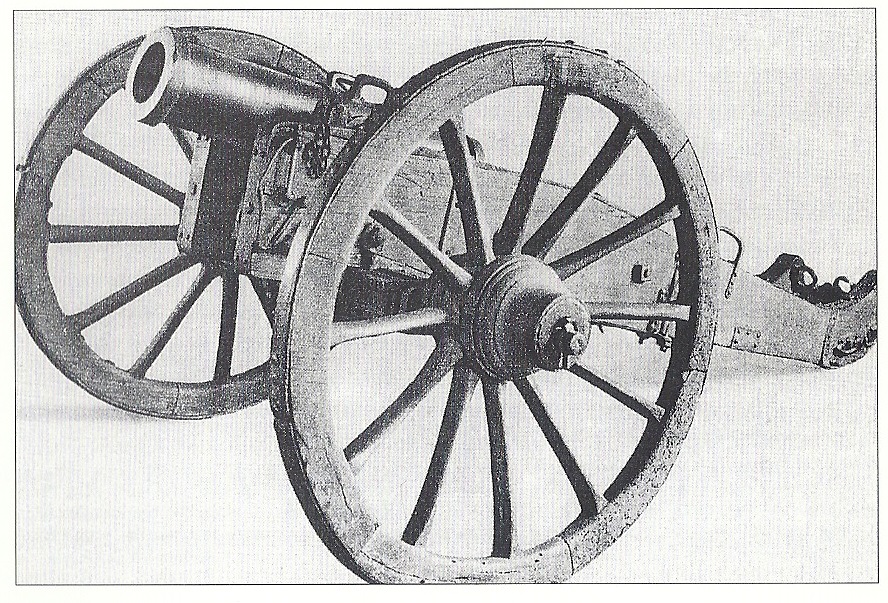
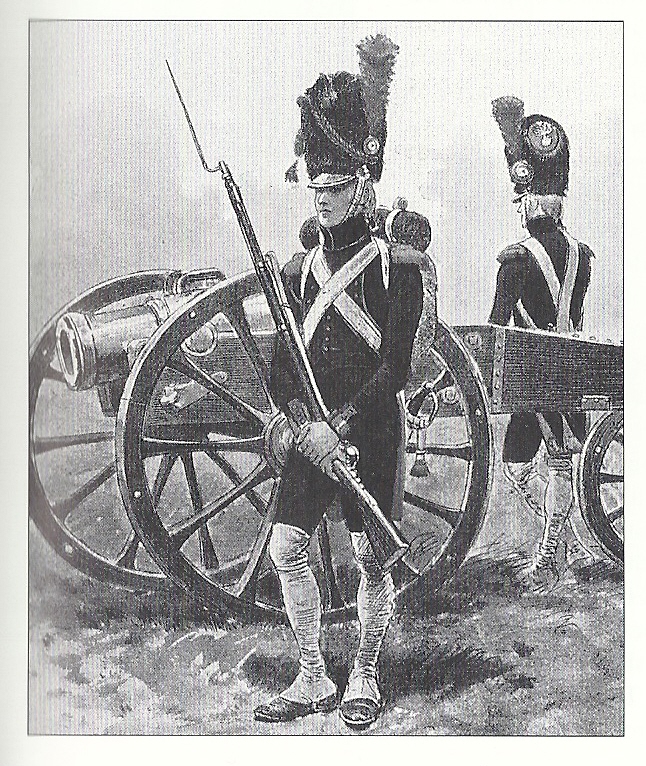
    What of its carriage? Here I have practically nothing to go on. DDS declares that the commonly depicted 6 pouce carriage was the Prussian original for this (in the caption to the drawing of the 6 pouce carriage, which shows a very clear drawing of the 6 pouce barrel alongside). I don’t believe this – the design is surely more modern and takes features from the Gribeauval design. But in the absence of any better data, I have decided that ithis carriage was used for both designs. The trail would no doubt have to be widened a bit to take a significantly broader barrel, but I expect that was standard stuff in those days before precision manufacturing. My basis for this (apart from assuming that there might be something in the DDS reference) is a picture in RC showing a Guard artilleryman in front of a howitzer (see below); this is clearly the 6 pouce carraige, but the barrel is a bit ambiguous (a bit too long-nosed for the 6 pouce, without looking like a 10pdr). This picture seems to date fromGuard howitzer late 19th Century, and is thin evidence indeed. But if in doubt I often take a lead from artists confronted by the same problem; the 10pdr was surely the howitzer used by the Guard foot batteries.

    Whether this carriage was really robust enough for this brute is another question. Later in the era tangential references in DDS suggest that it may have been mounted on on a modified An XI carriage with an elevating plate. But there are no illustrations of this piece, apart from the barrel, that I have seen anywhere, so this amounts to guesswork. One thing can be said about its appearance though, apart from being very bulky: the trunnions are towards the bottom of the barrel (like many pieces of heavy artillery). This means that it would look as if the barrel was perched on top of the carriage, compared to how other weapons look.

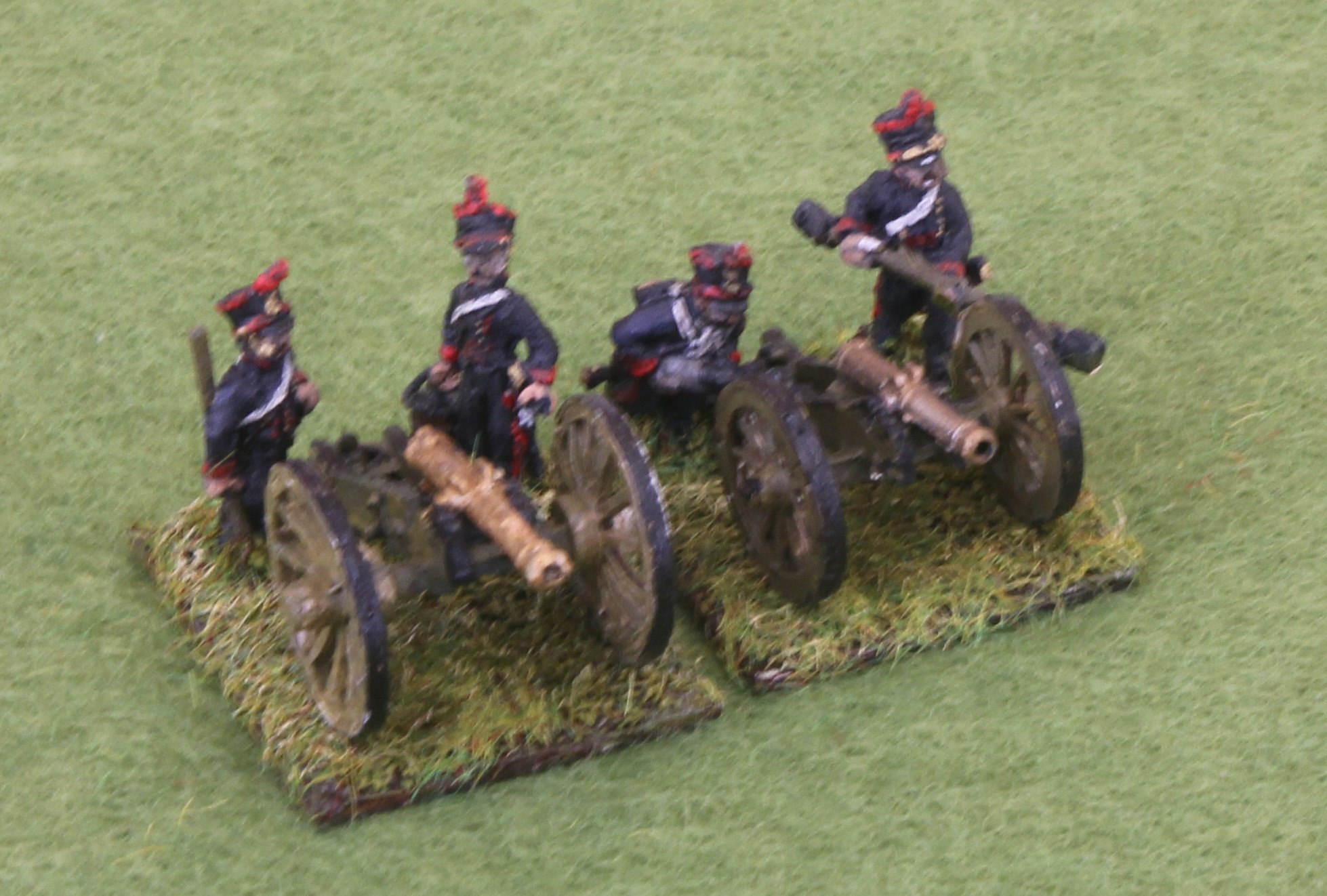
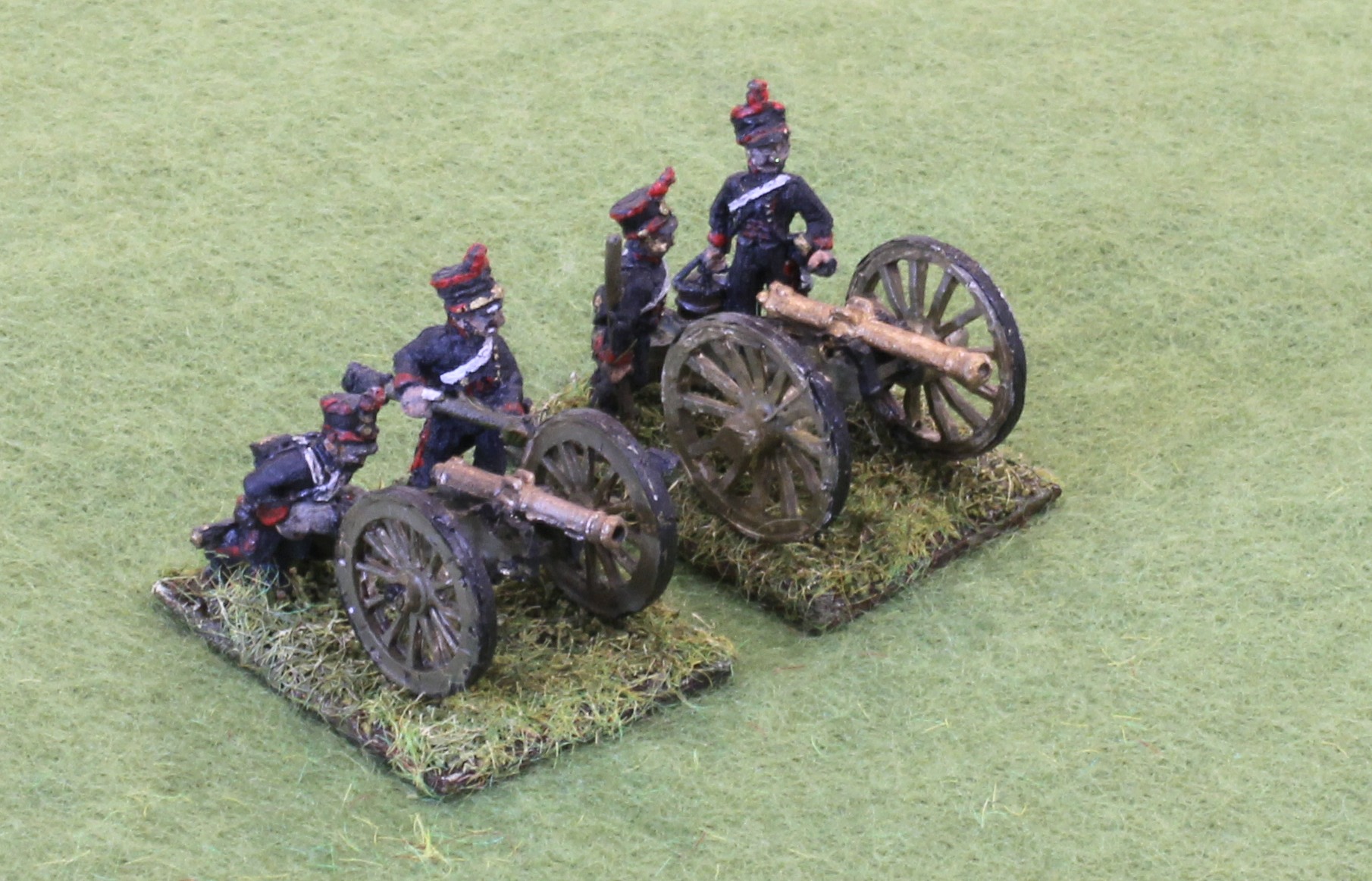
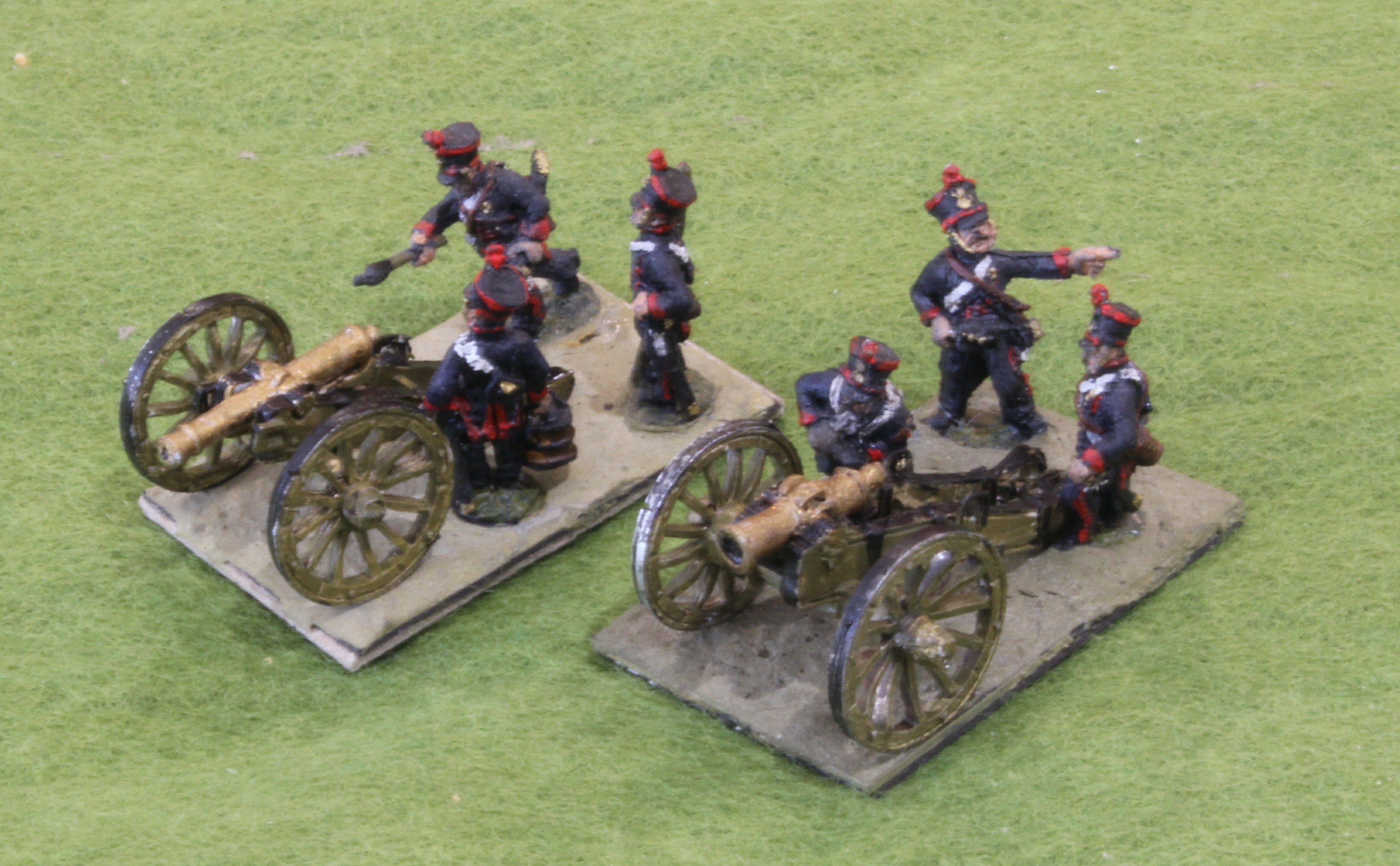
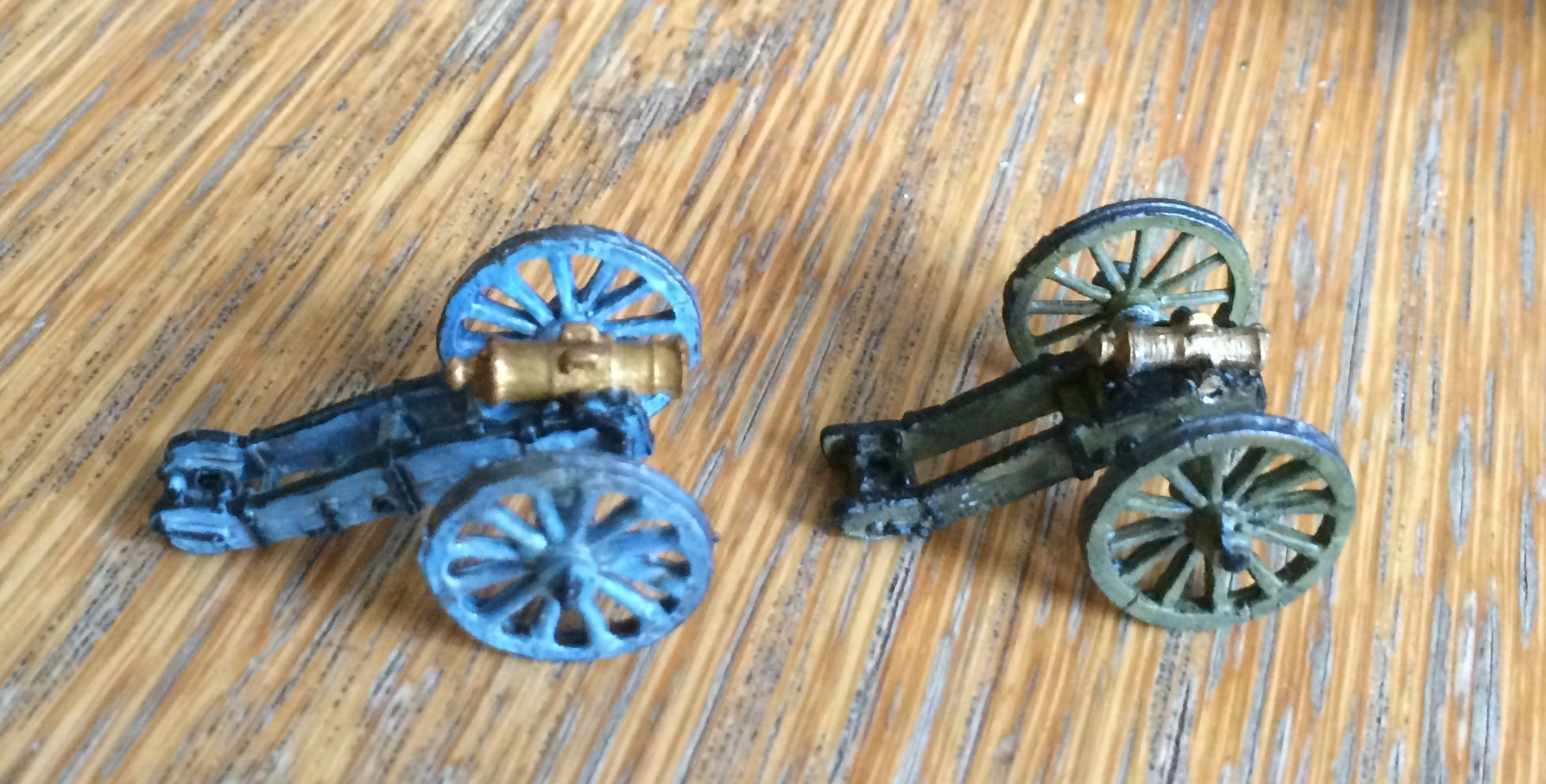
    Modelling this piece, almost invisible to history, might seem a hopeless task. But not so. I had bought the AB Prussian 7 pdr howitzer to support my slowly developing 1815 Prussian army – but it looked wrong. The barrel looked far to big, and it perched on top of the carriage. As I became aware of the 10pdr, the penny finally dropped. This represented a 10pdr howitzer, not the 7pdr! The dimensions measured up too – though since my French artillery barrels have a slight tendency to be oversized, it might not look quite right in comparison – though fine next to the 6 pouce, as it happens. I used this barrel on the AB French howitzer carriage. I had to add trunnions to it (the AB model moulds these to the carriage not the barrel) from a plastic rod – quite hard for my clumsy fingers, though. I simply borrowed a barrel from one of my many old Battle Honours Austrian howitzers to put on the original Prussian carriage, to give quite decent looking 7pdr. If you don’t want to do this, simply convert the Prussian carriage to a French one. In essence the Prussians copied of the French An XI carriage design for their later ordnance, so it makes quite a plausible carriage for French service. Just cut out the retaining bars for the ammunition box underneath rear end of the trail, and add some trail handles if you feel up to it (bend and cut some fuse wire or ordinary stationery staples and glue on). If you have the patience (I did not on my Prussian conversions) you can also cut off/file down the rings on the right of the rear transom.

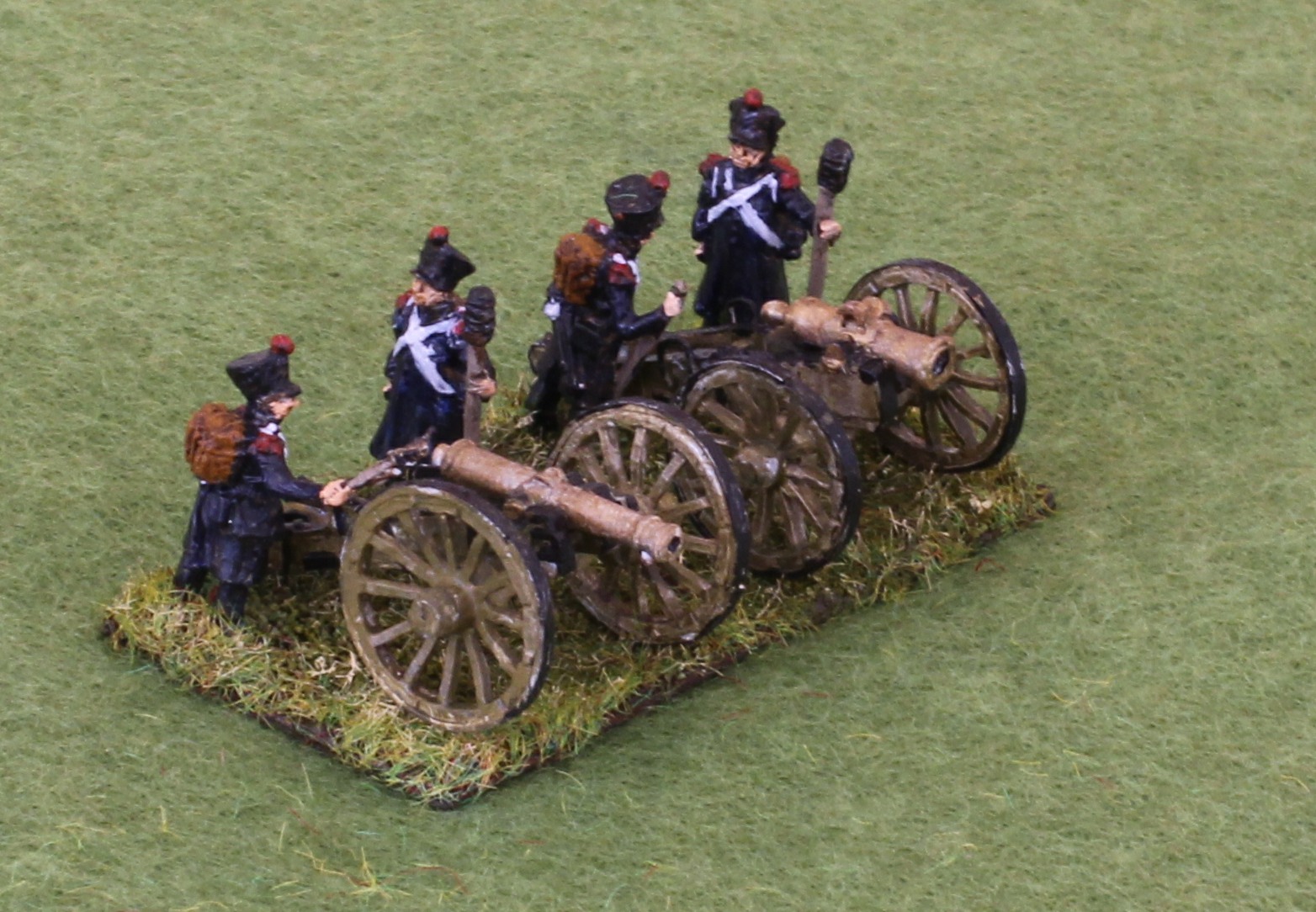
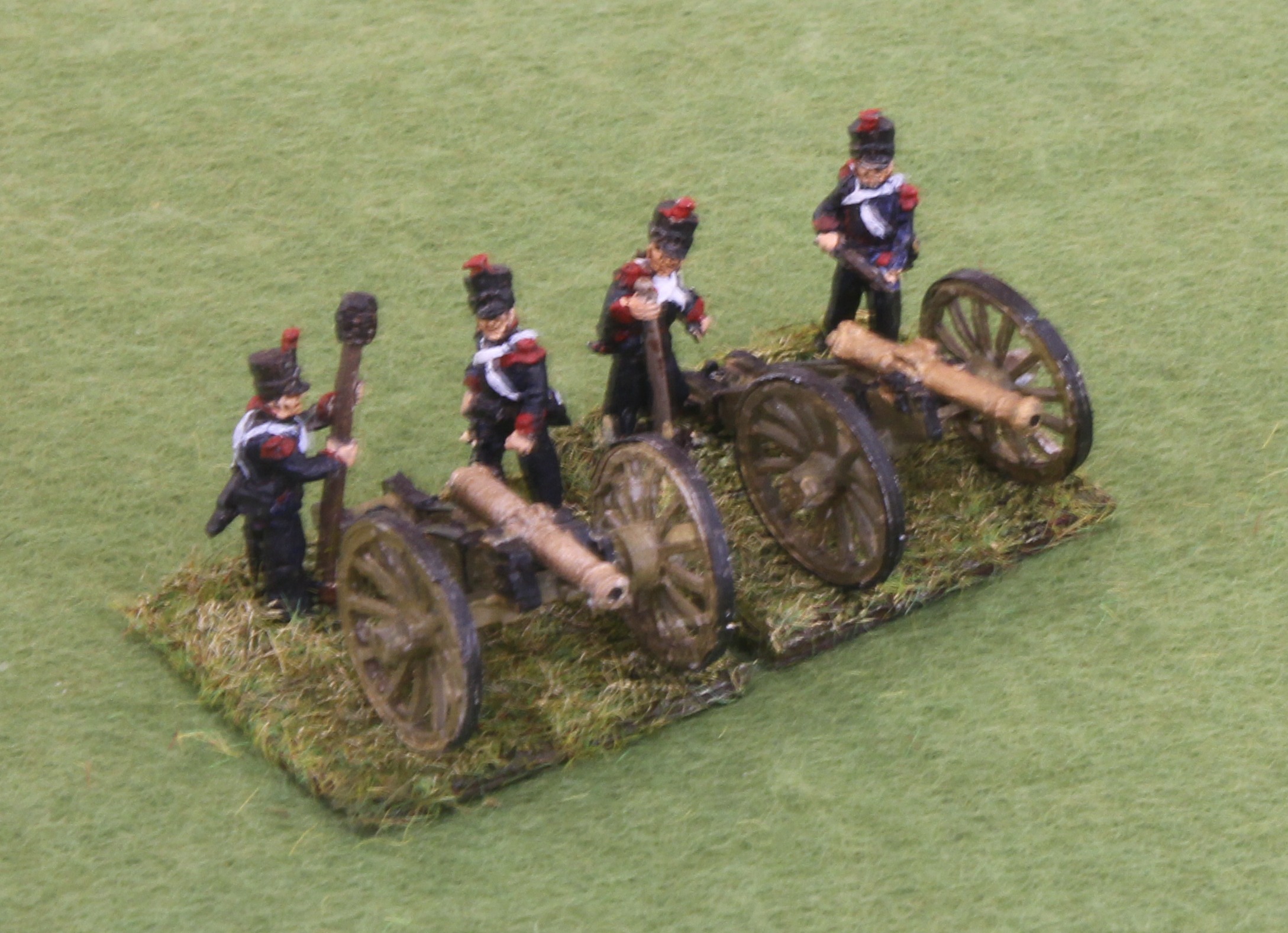
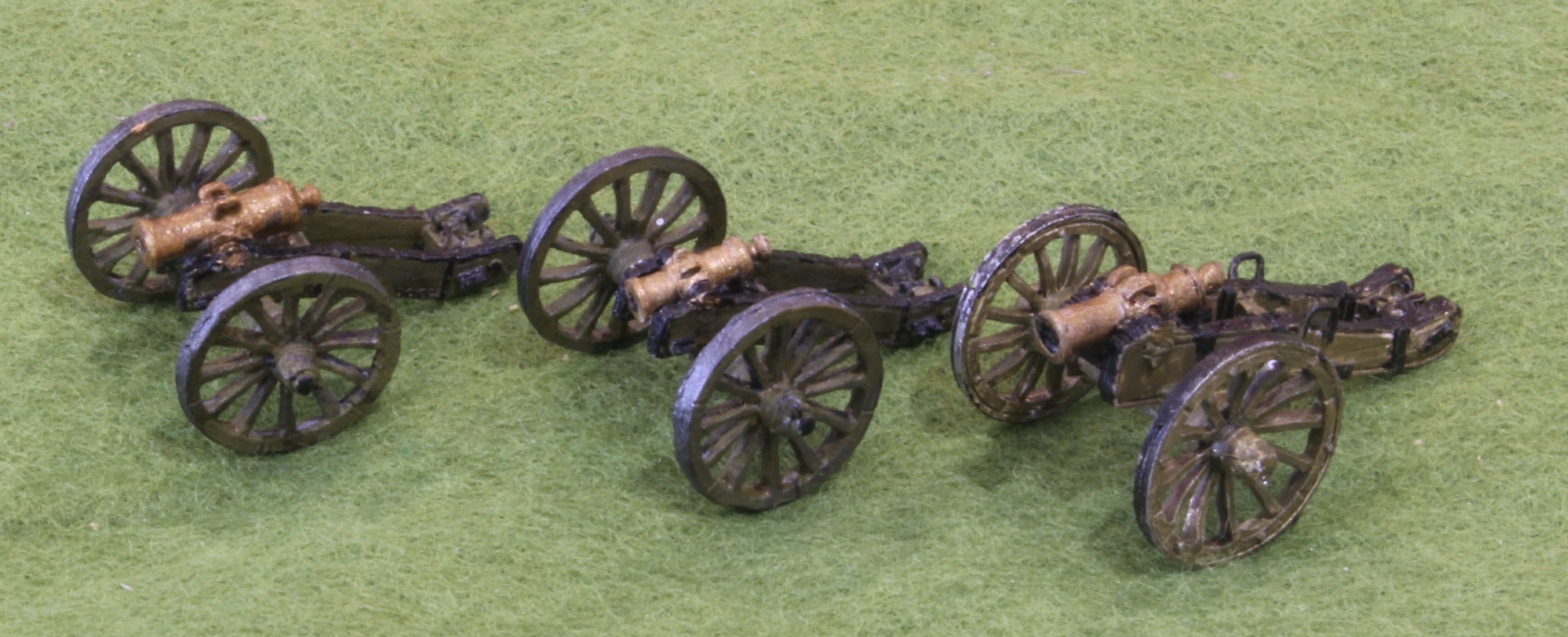
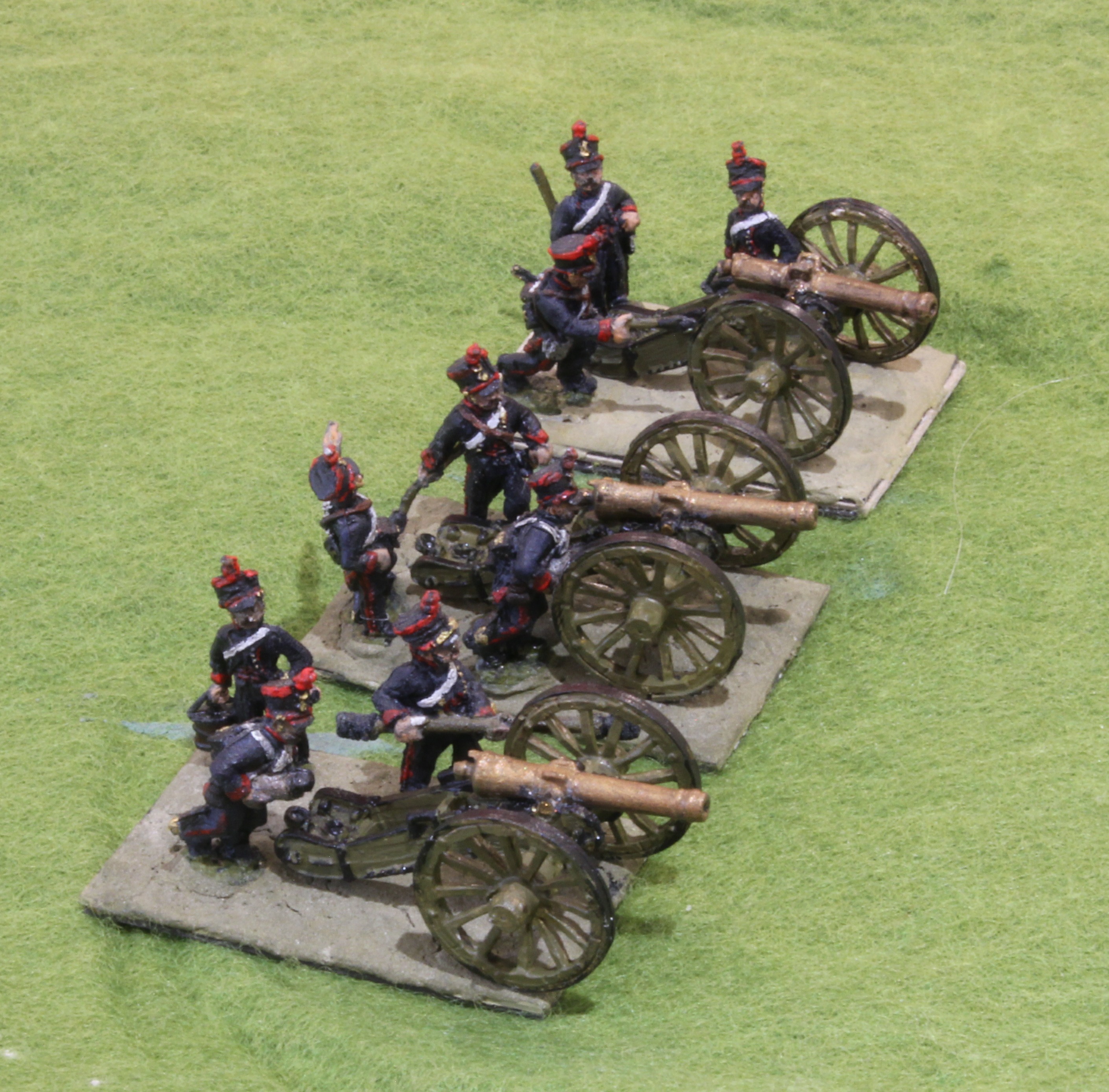
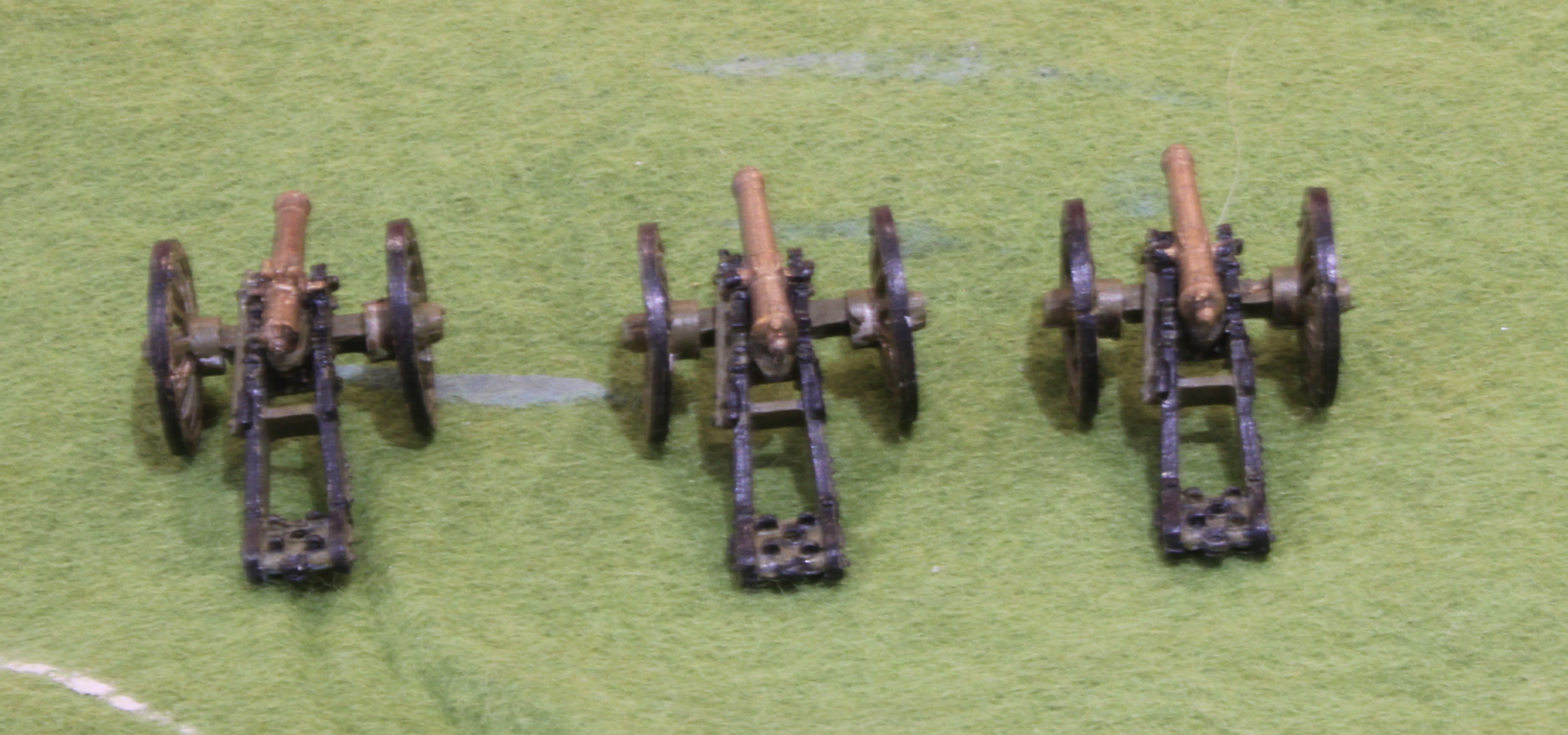
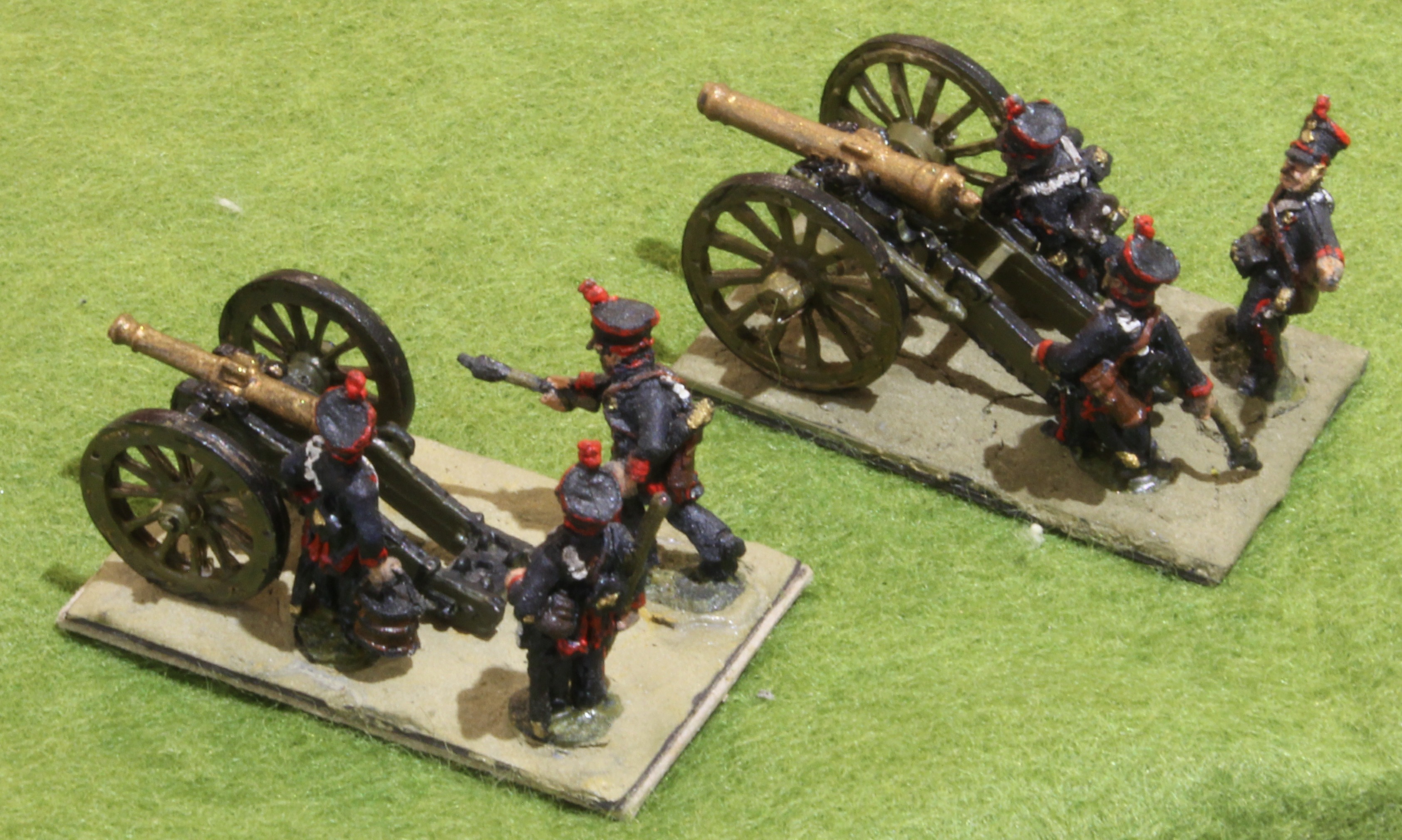
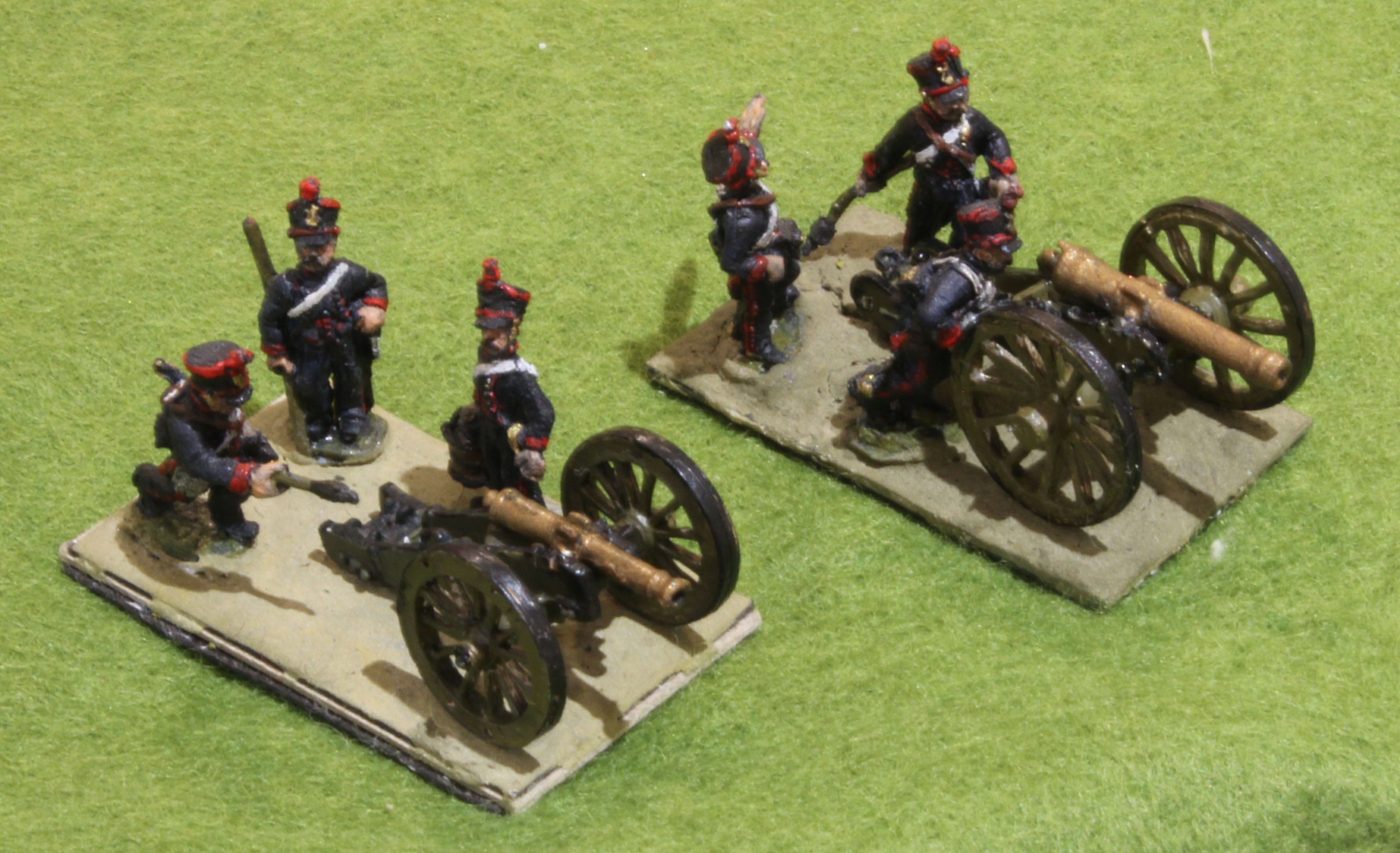
    So here are my models. The 10pdr is on the left, the 6 pouce to the right.:

    6in hows 2

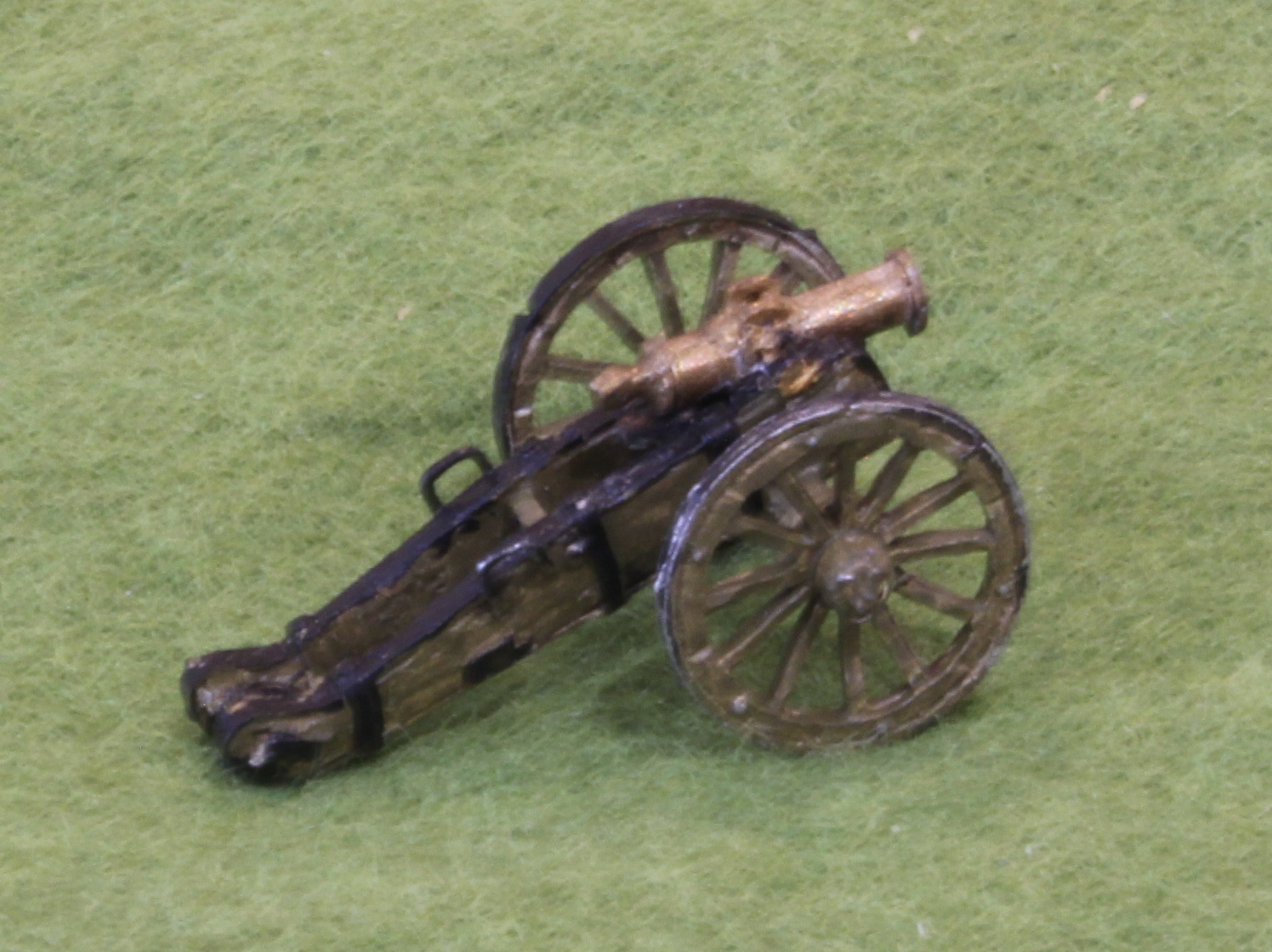
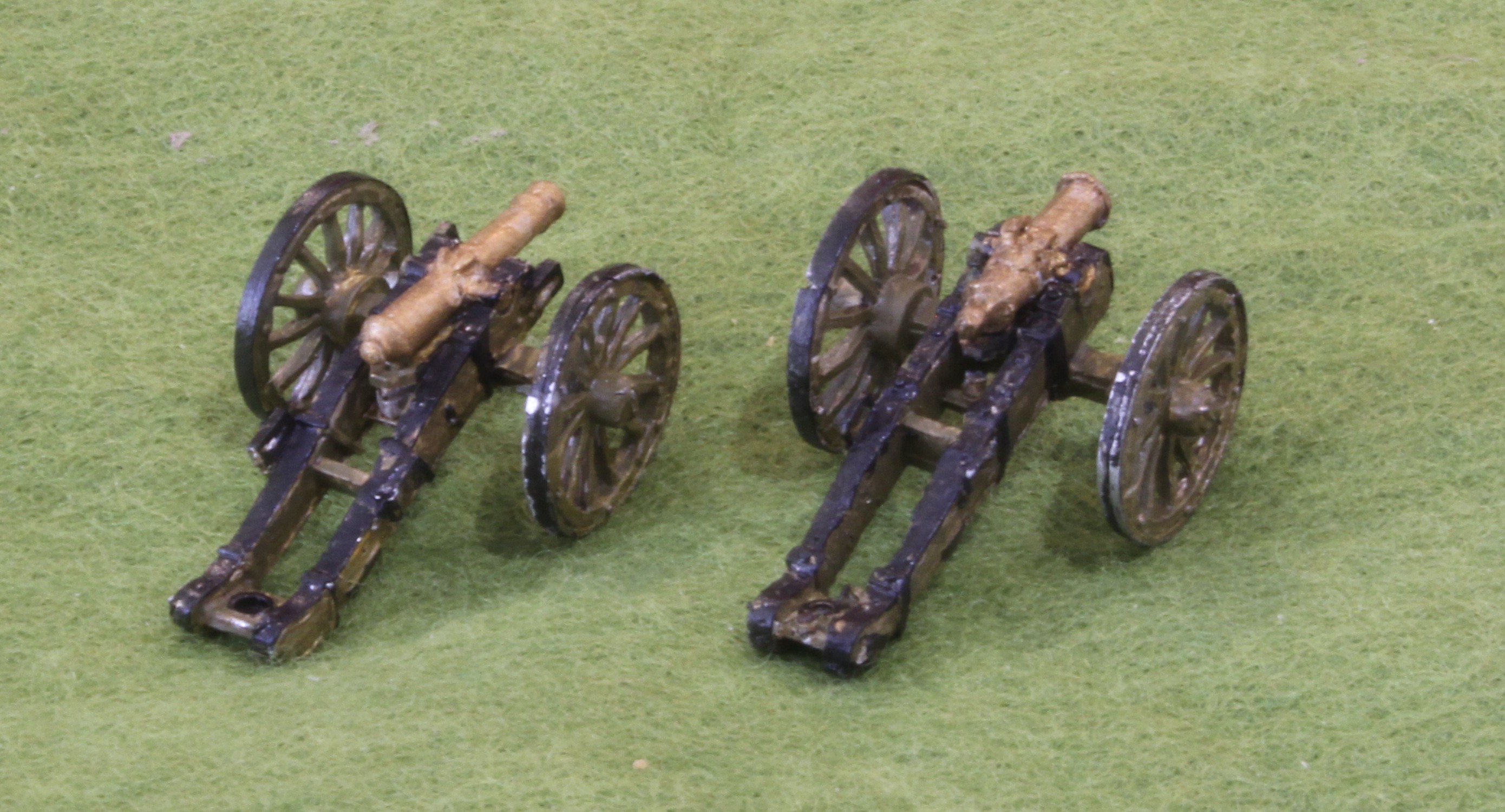
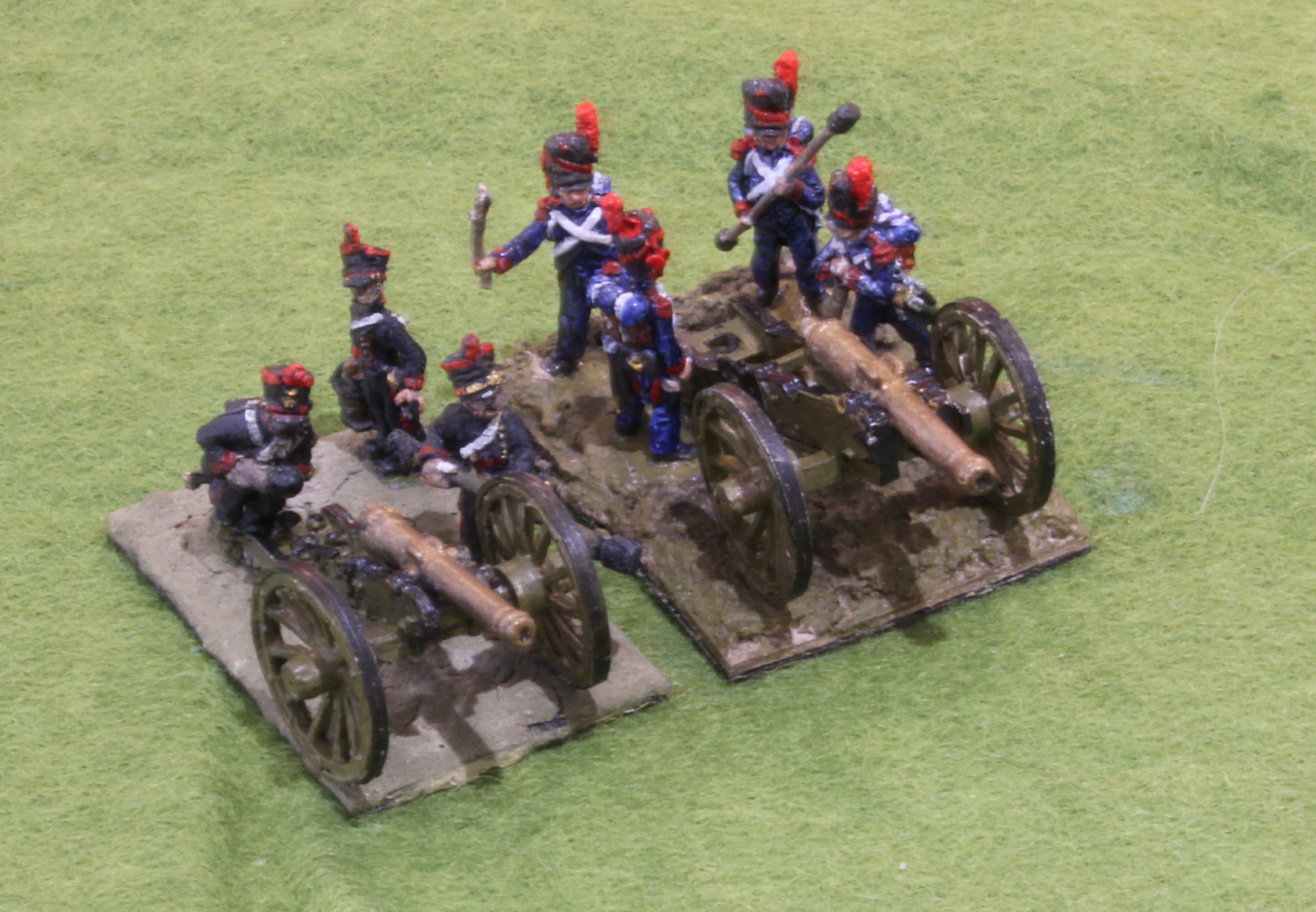
    And here is the 6 pouce next to the original AB Prussian “7pdr”. The Prussian howitzer wheels are too flat – a common problem with AB models – but these can be bent into shape with pliers. Apart from the flat wheels, and mounting the wrong sized barrel, the AB model is a beauty, incidentally. Note that the AB French model doesn’t have the distinctive trail handles, which it really should. I haven’t had the patience to add them in this case!

    AB howitzers

    Next article: the 24pdr howitzer


  • French artillery in 1/100: Part 5 the 6pdr


    Systeme_An_XI_cannon_de_6_Douay_1813

    The French 6pdr, introduced after 1803, may have been the most produced artillery piece in the Napoleonic Wars (the Austrian 6 pdr, produced over a longer period, may have rivalled it – or perhaps the Russian 6pdr). The  Russians alone had captured over 184 by 1813 (mainly through the 1812 debacle, no doubt). Many more were cast in 1813, so that at Waterloo Napoleon had 142, not counting Grouchy’s corps. Compare that to the 92 8pdrs in use in 1806, as production ceased, according to DDS. And yet in most literature, until recently, it was as if this weapon did not exist. A picture of one in Chandler’s standard work The Campaigns of Napoleon is described as an 8pdr. Unfortunately 15mm figure manufacturers have taken their cue from this silence. So finding models of them to support a 15mm French army has been more than a small problem.

    The 6pdr was the central product of the An XI review of French artillery instituted by Napoleon in 1803. It was to replace both the 4pdr and 8pdr, allowing more standardisation across the army. The advantages over the 4pdr were easy to see – the feeling that the lighter piece was not up to the task was widespread. The replacement of the 8pdr was more contentious. But in Napoleon’s view the advantages of the heavier weapon were trumped by those of the new one. Perhaps he could see, in a way that junior artillery officers could not, that lighter weapons meant more of them.

    It was also a step towards standardisation with other armies, allowing greater interchangeability of ammunition. The 6pdr was the standard calibre for all other major nations, and most of the minor ones too. Although each nation’s version of the pound was different (there were about 8 French livres to 9 English pounds, for example), the calibres were generally more similar than this might suggest. According to DDS the French 6pdr had calibre of 96mm (to the nearest mm – this was not a precision age), and so were the Austrian and Russian weapons. For the Prussians it was 94mm, though, the British ploughed their own furrow with 93mm. Interestingly the Austrian ball was quite a bit smaller than the French one (just over 90mm compared to 94mm), but the charge behind it was 93mm. All this meant that some interchangeability was feasible, although the dynamic properties would have differed.

    The new French 6pdr was part of a more general redesign. It inherited a some of the design features of the Gribeauval system – the big wheels and the less angular look (though the trail was straighter) – but it changed a lot too. This included peripheral features such as the carriage of the ammunition coffret (the small chest carried on the trail in the old system), and the use of trail spikes to manoeuvre the piece – which gave raise to the distinctive trail handles. The result was a piece that bore a family resemblance to the old 8pdr, but was notably different. The barrel was shorter and much lighter. In common with most other An XI barrels, it did not have the central reinforcing rings, giving it a smooth appearance that is distinctive from all or nearly all its peers in other nations. The carriage was about the same length as the 8 pdr, but lighter, straighter and had the characteristic upturned end. There were three rather than two sets of metal reinforcing bands on the trail, with the front two in different positions. And there was no second set of trunnion recesses for transport mode. There were no trail handles, no recesses for the coffret and the iron axle was encased in a larger wooden one.

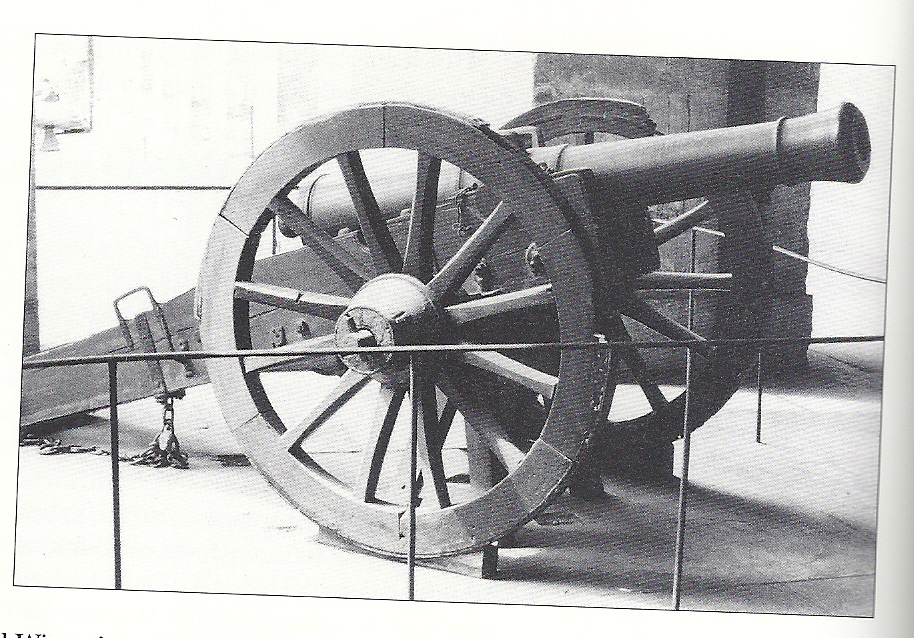
    All this was too much for the field officers, who criticised the new weapon compared to their beloved 8pdr. The new design was said to be  not as robust. In response, modifications were made. Back came the trail handles and the coffret recess; the wooden axle casing went. DDS says that the barrel was redesigned to be much bigger: “in effect, a lightweight version of the Gribeauval 8-pdr”. All these changes together they refer to as the “M1808” system. But how radical were the changes in fact? From a modeller’s perspective they appear to be pretty superficial. There is a drawing of the “new” weapon in DDS, and pictures of a scale model in the Musée de l’Armée at Les Invalides. Added to that evidence is the above picture of an example of an actual piece in Les Invalides (dating it is said from 1813 – though probably only the barrel’s date is known for sure). I have found a much older picture from les Invilades of what is surely the same piece:

    6 pdr Invilades

    It is clear from this evidence that carriage much the same as before. It’s the same shape; the bands are in the same places. That leaves the almost superficial detail of the trail handles, with the recesses for the coffret and the axle representation not being things that a typical 15mm model deals with.

    And what of the bigger, heavier barrel? The barrel in the drawing has the same dimensions as the original, and that seems be true of the two photos too. The Royal Armouries has no less than 9 French 6pdr barrels, captured at Waterloo and all cast in 1813 (five in France, three in the Netherlands and one in Italy). These are 166cm or 168cm muzzle to breech ring (four of the French ones are 166cm; one of the French ones and one of the Dutch ones is 168cm, the lengths of the others isn’t mentioned in the Armouries catalogue) . The French ones are all 390 to 392Kg (the one measured Dutch one about 380Kg).  According to DDS’s statistical table the original barrel length was 166cm and weight 390Kg. Their “M1808” version is described as being 180cm and 392Kg. The 180cm measurement appears to include the button at the end, where it would conform to the 168cm Waterloo ones, and the weight is the same as the old version – so it doesn’t look as if they have firm data for the “M1808” barrel. The 1813 barrels conform to the original 1803 pattern, and I have yet to see any decent evidence that the heavier barrel was actually ever produced. Of course they might have been, and in the desperate circumstances of 1813 they might simply have gone back to the earlier design because of metal shortages. But show me a real living example of the bigger barrel!

    Here is an extract from the Royal Armouries catalogue showing the entry for one the 6pdrs; note the lack of central reinforcing rings – and the notes on dimensions. The howitzer entry below it is also interesting, but more of that in my next post.

    Royal Armouries

    A further development is mentioned in DDS. It is that in January 1814 Napoleon ordered that old 8pdr carriage was to be adopted for all field ordnance, including the 6pdr, the 12pdr and the howitzers. But I wonder what evidence there is that this was ever adopted? Alas the carriages from the Royal Armouries 6pdrs were lost in a fire in the 19th century. Six of the barrels are on display at the Tower of London, but on modern (1950) reproduction carriages, based, I understand, on the Gribeauval 4pdr. My working assumption must be that the Waterloo 6pdrs looked like the example in Les Invalides.

    And so to my models. In my collection I had three AB 6pdrs already. These were the only attempt at a 6pdr available at the time, but I found them deeply unsatisfactory. Firstly the wheelbase was much too wide – wider, even, than the 12pdr. But this may have been corrected somewhat since, judging by the LittleArmies blog, though still out by about 1mm. Second the carriage is simply an 8pdr one without the second trunnion recesses. The trail handles are also missing on mine – though these look as if they have since been added in, judging by the picture on the Fighting 15s website (and LittleArmies’ blog). There is no upturned trail end. The trail is bit narrow and straight rather than splayed, as with the 12pdr, but I am not so worried about that for the 6pdr, and it looks fine next to the AB 12 pdr anyway. This might be a fair representation of a post 1814 carriage, but I don’t think that there were many of these, if any. Unfortunately in the confusion over my last reorganisation all the barrels got muddled up, and I can’t comment on the accuracy of the barrel length. But I can say for sure that it has central reinforcing rings – and they’re still there.  Apart from these admittedly major problems, the usual very high standard of detailing from AB is there. I decided to keep them, but with 1mm or so taken off each axle end, and with the central reinforcing rings filed off the barrels. Whether these barrels are the originals, or whether they come from Battle Honours (BH) 8pdrs I can’t say!

    Also from my bits and pieces, I had some old BH Prussian 6pdrs. The carriage looked rather suitable, being of the right dimensions, and with the trail bands in more or less the right place. With new wheels (taken from Blue Moon French or Prussian pieces – which I may yet regret when I come to complete my Prussian artillery project) and barrels from AB/BH, with the central rings filed down, I had a passable version of the original An XI 6pdr.

    But I need serious numbers of the 6pdrs for my 1815 games, and if I ever get into 1812 and 1813/1814. I set a target at this stage of 12. That means I couldn’t just mess with my existing bits and pieces, I needed new stock. Fortunately, there’s a new kid on the block: Blue Moon. They do a 6pdr (in the usual packs of 6). This does have some issues. The barrel has the central reinforcing rings (and the dolphins are a bit vague), and the elevating plate sits far too low. The trail cheeks are also a bit thick. But filing down the barrel and with a new plastic card elevating plate (I simply glued the back end of one to the back of the barrel) and we were away. This is a very acceptable model. I have six of these to bring my total to 12 – and I know I can knock up many more if need be.

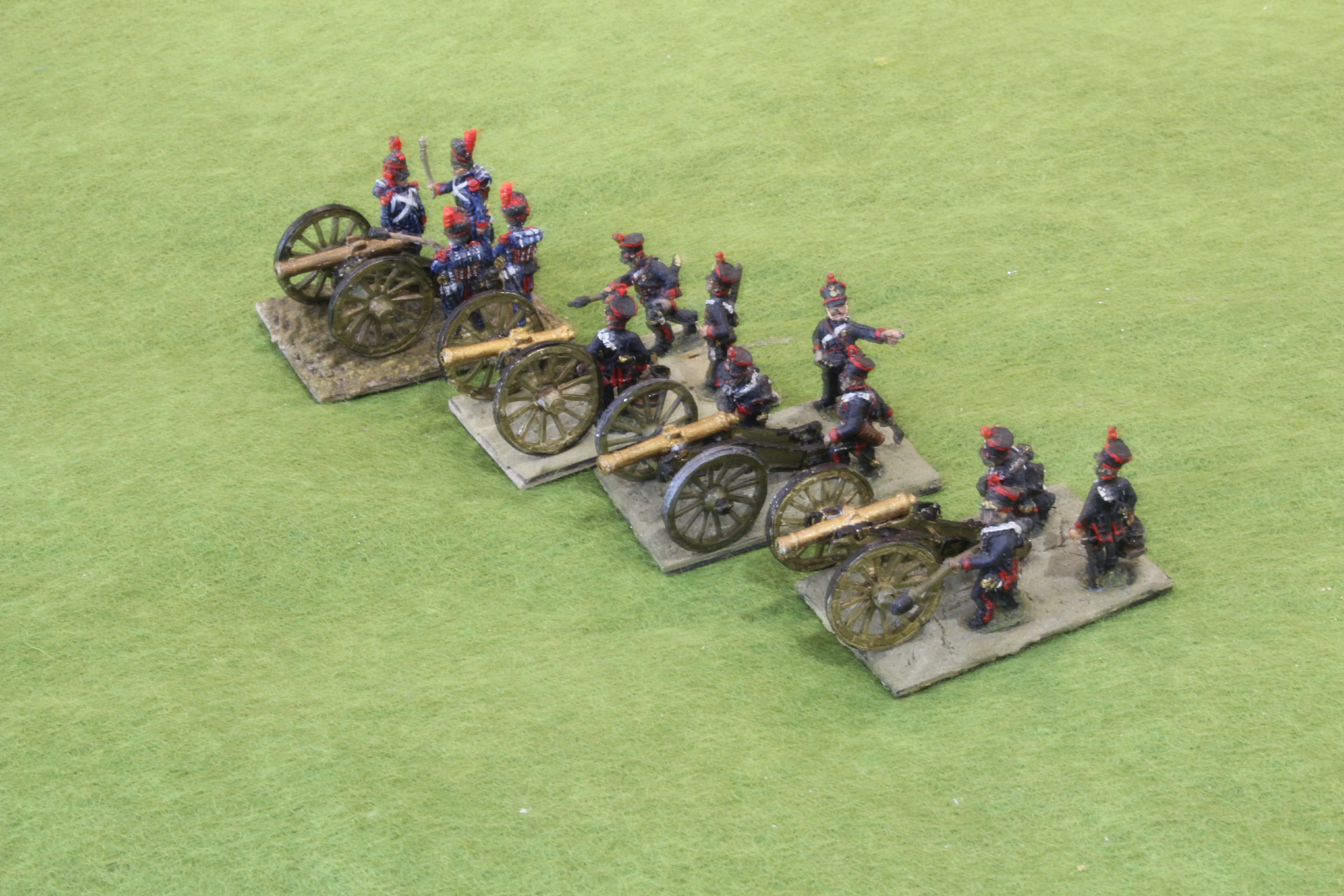
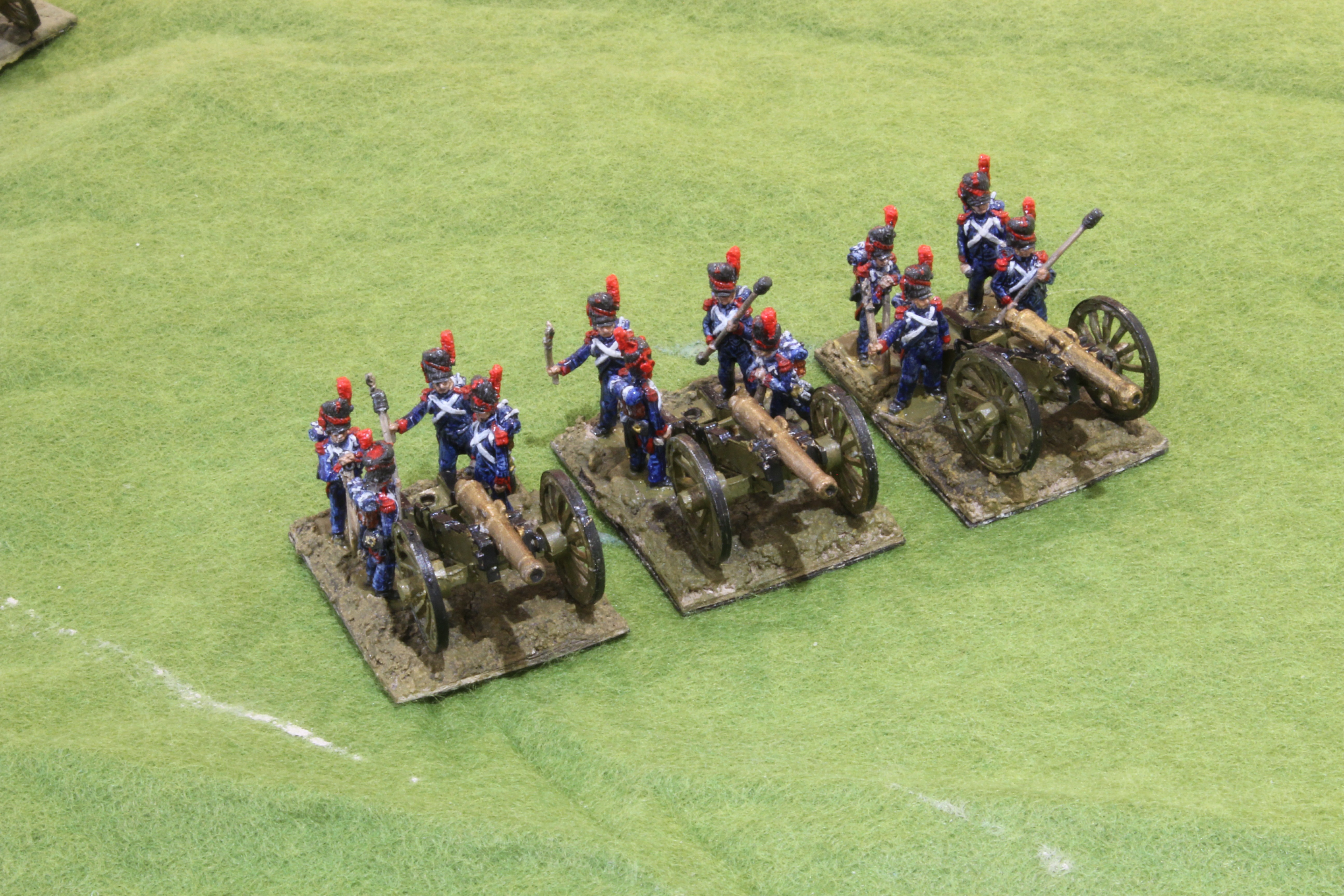
    Here are the three variations with the usual crew figures. At the front is the BM, next is the AB, behind that is the BH Prussian conversion, and finally the 8pdr for comparison.

    6pdrs 1

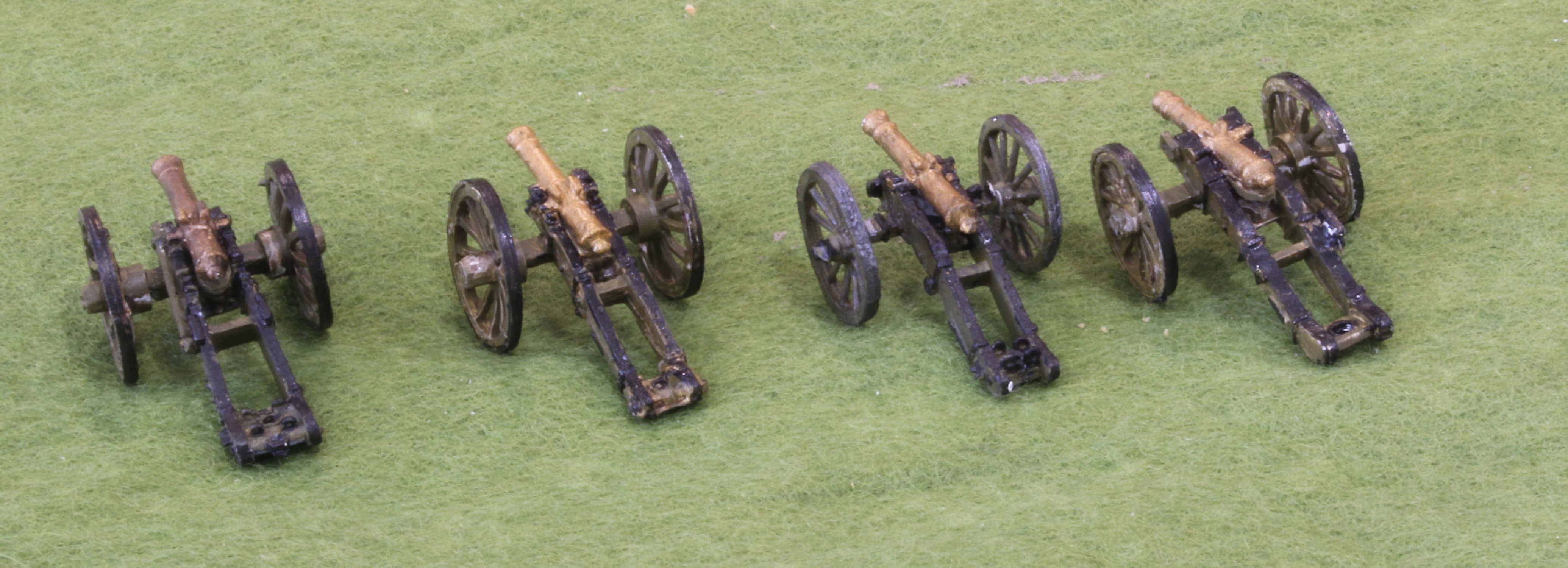
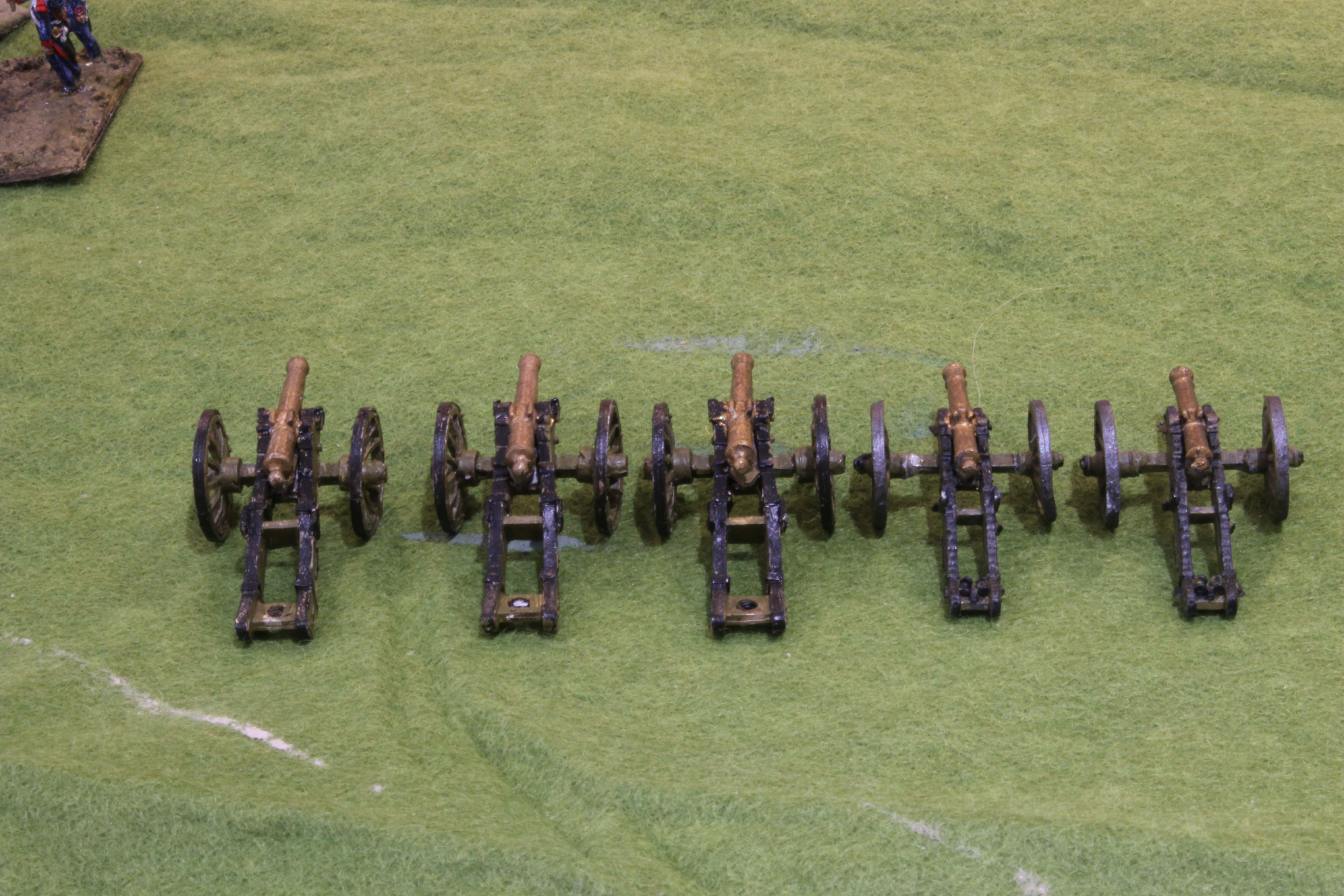
    Here they are again, without the crews, from right to left: the 8pdr, the BH Prussian conversion, the AB and the BM.6pdrs 2

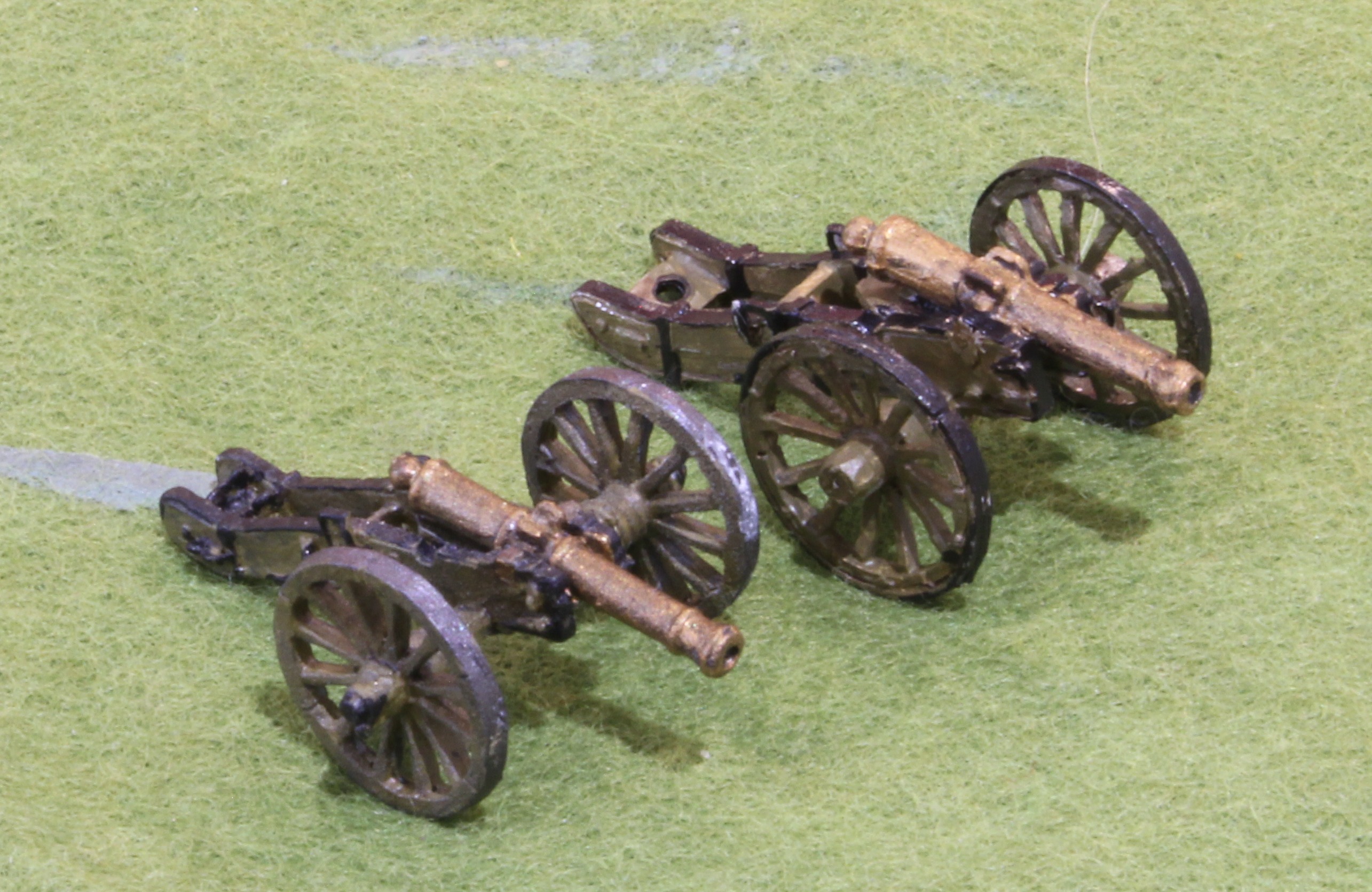
    And a comparison of the the AB and BM models. The AB with the classic bent 8pdr carriage is to the left. It is difficult to see the shape of the BM model, but there is a marked uptick at the end of the trail, though not as marked as the real thing. The BM model is freshly painted for this photo, and could do with a little touch up, at bits of white undercoat are showing through! The AB carriage (not the tube) is an old paint job, with a darker interpretation of the carriage colour.

    6pdrs 3

    If you are starting from scratch I would recommend using the Blue Moon 6pdrs, with the same modifications noted above if those details bother you. The only serious alternative is the AB version, which is at least available singly – but you may have to narrow the wheel track, and really should file down the barrel rings.  Warmodelling/Fantassin claim to do a 6pdr, but I wouldn’t touch it. The carriage is all wrong, and not very nicely modelled either. I have not actually seen any others.

    Next article: the 6in howitzers

  • French artillery in 1/100: Part 4 – the 12pdr

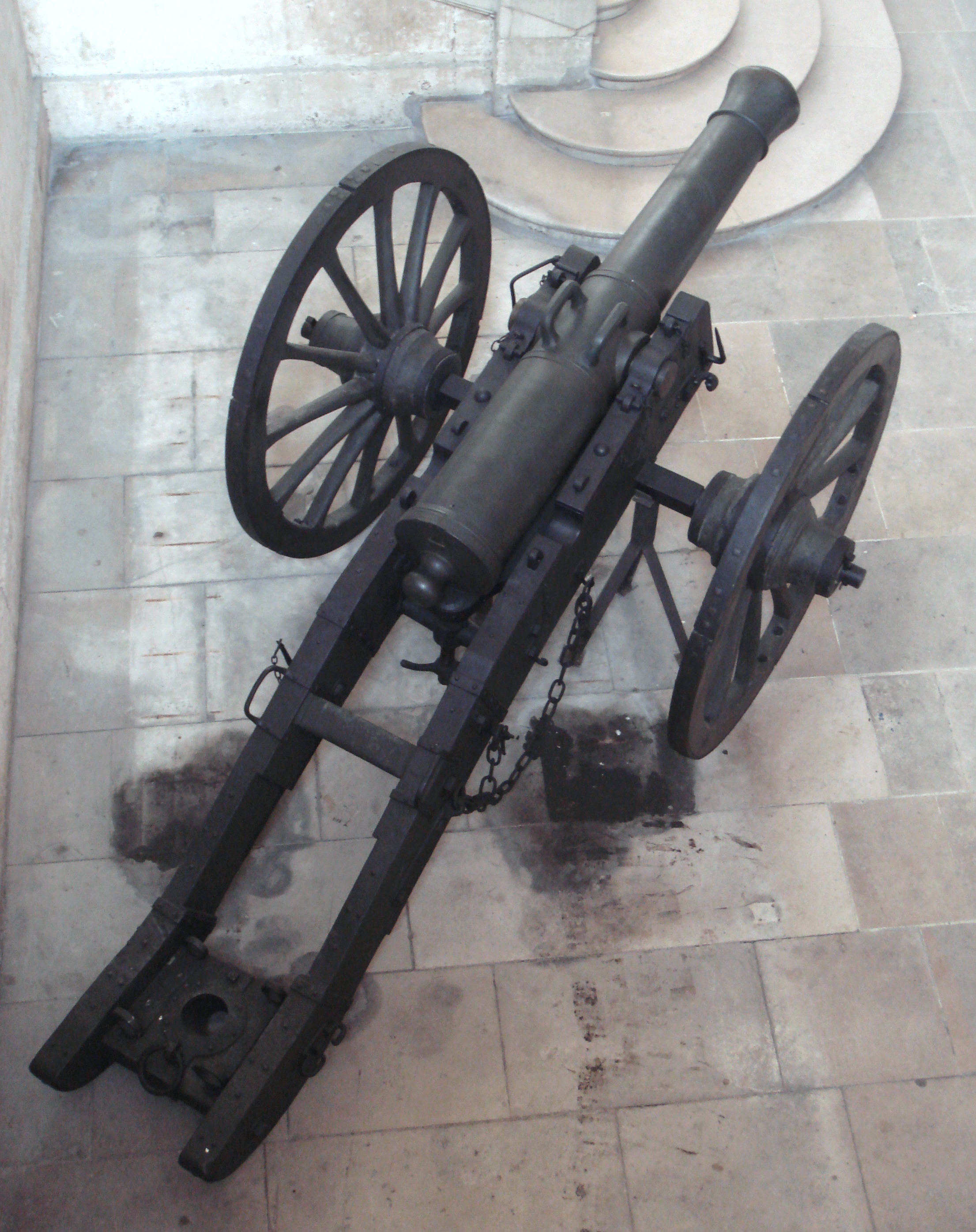
    Gribeauval_cannon_de_12_An_2_de_la_Republique_top_viewAnd now for the big one. The 12pdr was the standard reserve artillery piece in the French army. These weren’t used in great numbers but they might described as “charismatic”. 12pdr batteries were present at army corps level, and the Imperial Guard had a number of batteries, the elite of the French artillery.

    The best known version was the Gribeauval one. The picture above is from Les Invilades, the French army museum in Paris, and dates from about 1794, apparently (that may just be the barrel, though). It’s a big brute. Funnily enough the carriage dimensions aren’t that different from the 8pdr (though beware a misconverted metric measurement for cheek length in the dimensions given in RC – the Osprey). The wheels are the same diameter (146cm) and the axle the same length (209cm). The cheek length is 302cm compared to 286cm, and the cheeks are thicker. The overall appearance of the carriage is beefier than for the 8pdr. And the barrel is much bigger of course (211cm from muzzle to base ring, as opposed to 184cm – more misconversions in RC, incidentally): 880Kg, as opposed to 580Kg. Incidentally DDS suggests that the 12pdr barrel was 985Kg in weight, but the two 1794 examples in the Royal Armouries are slightly under 880Kg, the weight given in RC.

    How the weapon evolved during the wars is not so clear, though. In the An XI review the 12pdr was retained but redesigned. The barrel was nearly the same length, but a bit lighter at 760Kg. Like other An XI designs the barrel did not have the reinforcing rings at the centre, the barrel being smooth from the breach ring up to the muzzle zone. The carriage was also of similar general dimensions to the old one, but straighter, lighter and with the characteristic upturned end. The axle had a wooden casing, the two trunnion positions were a bit closer together, and there was an additional metal band near the axle, between the trunnion recessess – probably the easiest way to tell the difference at a quick glance (though the second reinforcing band on the trail is further back than the Gribeauval design too). Remarkably, one of these carriages is at Les Invilades (with a broken wheel – pictures feature in both RC and DDS):

    12 pdrIncidentally this shows the trail handles, which were not part of the original An XI design. The barrel on this weapon, however, is not the An XI 12pdr (you can see the reinforcing rings in the centre) – it looks like the Gribeauval version.

    Were many of these newer designs ever made? It’s hard to tell. According the DDS the An XI system was suspended in 1805, and by 1808 the original Gribeauval designs were reverted to, subject to some modifications. Old pieces were converted. DDS says that all the An XI 12pdr carriages had been replaced by 1812. In which case for one to have survived is quite remarkable. Alternatively it might be that “replacement” did not involve much more than adding the trail handles (visible in the picture above) and other accoutrements required for the old system for manhandling the guns, and recesses for stowing the ammunition coffret on the trail in transit. If so quite a few modified An XI carriages might well have survived until the disaster of 1812.

    What did the post-An XI 12pdrs look like? These are referred to as “M1808” by DDS, but I think this system of classification (Original An XI = M1803, etc.) suggests more system and uniformity than there really was, as well as being a modern artefact. DDS carries a couple of pictures of later carriages. One is one of the Royal Armouries pieces, thought to have been captured at Waterloo; the other dates from 1821 and is at Les Invilades. The former has a distinctly turned up trail end, but otherwise looks very similar to the 1794 picture above. The 1821 one is not a complete picture – the trail ends are not shown – and I can’t even be certain it is different from the “1794” one in the first picture above. It may well be my imagination, but I think that both of these later carriages look a bit lighter than the older one, though.

    I’m sure none of the original Gribeauval pieces were withdrawn after 1803. Many tubes from the 1790s or even earlier still survive. DDS count just 20 French made 12pdrs in service in 1807, so it would seem that the army had quite a reserve of old barrels, unused perhaps because of the shortage of horses. A number of An XI pieces were made and then subject to relatively minor modifications. Then a number of post An XI pieces were made, often remounting old tubes. Amongst the 58 captured French 12 pdrs brought to Moscow on the Tsar’s orders in 1813, the tube manufacture dates are 1767 to 1811, with only 15 post 1803. No doubt further tubes were cast in 1813 – but none has popped up in any of the publications that I have read. In fact no tubes later than the 1790s have – which makes judging the appearance of later castings difficult to judge.

    Now for my models. I already had two AB 12pdr models. While being generally unenthusiastic about them, I haven’t rejected them. What I don’t like is the trail, which has quite a small gap between the cheeks and there is no splay. But from most angles they are quite reminiscent of the Royal Armouries Waterloo piece, without the turn-up at the trail end. One good feature of the AB models – which Battle Honours (also by Anthony Barton) also reflects – is that the elevating plate is in the right place, rather than being way below the barrel, which Blue Moon tends to get wrong. I wanted at least three more pieces though. I was put off BM by LittleArmies‘ review of their 12 pdr. The trail was 36mm long – 5/6mm too big, though it did have a nice uptick at the end, signifying a late war carriage.

    But then I had a look at the BM French howitzer carriage. This is way too big for the howitzer itself  – my biggest disappointment with Blue Moon, and of which more later. But the carriage and wheels work as the basis for a 12pdr. It is a tad overscale, but tolerable – and better over than under for this piece. The carriage required a few modifications. The rear trunnion recesses had to be cut and filed out. The rear of the elevating mechanism had to be cut out, and an elevating plate (plastic card) put in. A transom (also plastic card) had to be added in between the trail cheeks. The barrels were supplied from stock (I think from old Series 2 Minifigs), though the trunnion slots were a bit deep and I filled them with a little plasticine. In the end I had something quite pleasing, which I think looks the part next to my other models, rather better than my AB piece.

    Here are the three converted 12pdrs with AB Old Guard crew figures:

    3 12pdrs

    And here is a rear view of all five, with the two AB models to the right:

    5 12pdrs

    And finally a comparison between the AB and the conversion a bit closer up:

    2 12pdrs

    So how would I recommend readers get their own 12pdrs without going through the conversion palaver? Well I have said that the AB version is perfectly acceptable, and you can buy them singly at £2.40 each. My worry is that they do not look at their best next to Blue Moon 6pdrs, with their heavier and wider trails – and the BM 6pdr is nicer than the AB version (more of that later). The BM 12pdr might be worth trying if you don’t mind finding £12 for 6. The carriage is too long, but the other dimensions look OK. Better too big than too small for this one. You will not find anything suitable in Old Glory, Fantasin/Warmodelling or Battle Honours. All of these try putting a 12pdr tubes on an 8pdr carriage (though in the Warmodelling case, this isn’t too bad size-wise, it’s just rather vaguely modelled). As this is quite a widespread practice, buying this one on spec is not advisable. You might even attempt my conversion using the BM howitzer parts – but you will need to find some 12pdr barrels from somewhere.

    And if you want to do the An XI 12pdr? You can get the barrel by filing down the central reinforcing rings from the Gribeauval version, but the carriage looks a tall order. The BM 12 pdr is the closest, though too long. Converting it would be hard work though. For me this is the one that got away – I would have liked one of these in my collection!

    Next article: the 6pdr


  • French artillery in 1/100 Part 3: the 8pdr

    Now on the the most well-known of Gribeauval’s designs: the 8pdr. According to the old wargamers’ beliefs, which are remarkably persistent, this was the main piece in use by the French throughout the wars. Every 15mm figure manufacturer has a go at this one.

    The 8pdr seems to have been well liked by the artillery men that served it, who forgave its weight. One aspect of the weight was that a second set of trunnion recesseses was required, and the barrel (580kg) had to be moved between them each time the weapon was limbered or unlimbered. No doubt this was easy enough for a practised crew. The weapon had more hitting power than almost all its field opponents (usually 6pdrs – the British 9pdr was the exception, and this could match it). Perhaps that gave the crews a better sense of security in the counterbattery exchanges which were so much a feature of the wars.

    But the weapon was less popular with the war ministry. The extra weight meant more expensive metal. A typical 6 pdr weighed just 400kg. And no doubt this discrepency applied all the way down the line: the cost of ammunition, and the number of horses and caissons need to shift things around. So in the An XI reforms of 1803 it was decided to phase the 8pdr out.

    This meant that probably not all that many of them were manufactured. In the pre-Empire era the French were notoriously short of artillery. This persisted into the early Empire when several corps were kitted out with captured artillery, such as Austrian 6pdrs. And after that they were officially obsolete. So they would have missed out on the big manufacturing push in the early Empire period.

    Still, they continued in use after 1803. No doubt the field units were reluctant to give them up, and the first priority was to replace the captured guns with the new 6pdrs. According to the orders of battle for the 1809 Austrian campaign, quite a few units were still equipped with 8pdrs. This included the horse artillery supporting the cuirassier divisions – showing that the piece’s weight was not too much of an obstacle even for use by the horse arm. By 1812, though, they were gone, except in Spain. There were none at Waterloo.

    As with the 4pdr, though, they experienced a bit of an afterlife in the Pensinsula. This was partly because the Spanish had them, and it was convenient for the French to take these over. Some divisional batteries used them, but they were also used in a reserve artillery role, in place of the  12pdr. Nearly as many of them were at Vitoria as 4pdrs – though how many of them were actually in use, rather than left on the Park, is an open question. (As it happens I suspect that all, or almost all, of them were brought into action in that battle, mostly as reserve artillery, and the 12 pdrs were left in the Park).

    That wasn’t the end of the story though. The post-Napoleonic regime brought them back for use in the horse artillery, and their use continued beyond 1827.

    There are no photographs of surviving 8pdrs with original carriages – which means that probably none have survived. Oddly enough I haven’t even seen any detailed drawings either. There is a rather fine model in the French Army Museum, which gets a lot of pictures in the publications, though, so I suspect that detailed drawings do exist. A few barrels survive, including one in Britain’s National Armouries.

    For my models I wanted just three of these, enough for the artillery-light Peninsula and revolutionary wars battles, and to play a role in any 1809 scenarios. I decided to assemble them from bits and pieces I had to hand, rather than buying them new. I took the carriage from my Old Glory pack. These are quite nice, at about the right scale. It is nicely detailed, and I find the proportions are pleasing to the eye. There’s a slight splay on the trail, which not all models attempt. A trail spike is moulded stowed on one side, which won’t be to everybody’s taste (the same is true for my Battle Honours 4pdrs). The main problem is that the elevating plate is too low for the firing position – though works perfectly well for the travelling position on the rear trunnion recesses.

    The trouble with the OG models is that the wheels are too small (though at least they can be reused for the 4pdrs!), and the barrel doesn’t work. The wheels look quite nice – but I want to acheive the big-wheeled look in my models. Truth be told I’m not entirely sure which barrels came from which models with my old bits and pieces, but I’m not that impressed with the ones I think are from OG (nor the ones I know came with the OG Prussian pack). The three OG carriages I was using (with their original wheels) had barrels borrowed from (I think) BH 8 pdrs (where the carriage is not as nice). I took the wheels from the Blue Moon French howitzers. This pack was a major disappointment, of which more later, so sparing three pairs of wheels was not a difficulty.

    As for the barrels, my BH ones would have done at a pinch, but they were a tad small. The main problem with them was that they did not look much different in size from the Blue Moon 6pdr barrels – and I needed them to look substantially bigger (while being clearly distinguishable from 12pdrs). I found one really nice barrel, though I don’t know where it came from (it might be a very underscale BH 12 pdr). The other two were, remarkably enough, taken from my series 2 Minifigs Austrian 6pdrs, which says something about the accuracy of those old ranges! I cut the rear portion of the elevating plate from from plastic card and glued it to underneath and the back of the barrel.

    The overall result was quite pleasing. This picture shows the three with OG horse artillery crew figures on my old basing system. The two Minifigs barrels are closest to the camera:

    8 pdr models 2

    A rear view without the crews (on an uneven cloth!):

    8 pdr models 3

    And here next to my 12pdr, the latter with AB Guard foot crew figures:

    8pdr12pdr models

    How would I recommend readers model the 8pdr from scratch? No need to repeat my palaver. Based on LittleArmies‘ reviews, the Blue Moon 8pdr is probably perfectly good, if your budget can stretch a pack of 6 for £12 in the UK. AB also do an 8pdr, though I haven’t seen it and neither did LittleArmies. But I have seen their 6pdr and 12 pdr and a picture. It is likely to be nicely detailed, with the trails dead straight and a little narrow. But the wheels will be about the right size, and the elevating plate probably in the right place. And you can buy them one at a time (at £2.40 here in the UK). If you are using the 12pdr and 6pdr from AB (which I will post about in due course), then this may be the best choice.

    As I have already said, I don’t like the BH 8pdr, even if it was readily availalble; the OG version has the problems I have mentioned, as well as being sold in packs with crew (though these should be usable, unlike the BH ones). Incidentally, LittleArmies has two different versions of the OG artillery, neither of which match mine, though he wasn’t entirely sure where his originated from. So there’s also a risk that what you get now does not match ones I had in my 1809 Horse artillery pack, bought before Timecast days. The Warmodelling/Fantassin models are really quite horrid, and I would avoid them. LittleArmies says the XAN version works well, though I would find the wide carriage a bit off-putting. I haven’t seen the Minifigs version, but they tend to be a bit small. There will be many others out there which I haven’t seen, of course.

    Next article: the 12pdr

  • French Artillery in 1/100 Part 2: Gribeauval and the 4pdr

    4pdrMy first item is the 4pdr Gribeauval gun. I’ll start with an introduction to the
    Gribeauval system. Gribeauval was an officer who learnt much of his trade in the Austrian army, and who overhauled French artillery in the 1770s. His name has become practically synonymous with French artillery of the era.

    Gribeauval instituted a whole system – this included artillery pieces, carriages, limbers and caissons, and standard methods for moving and handling the guns. This level of standardisation was revolutionary, and resisted at first. But it brought French artillery of era up to being the best in the world.

    Gribeauval’s artillery had a number of characteristic features that gave them a distinctive appearance, when compared to other artillery of the time. They had big wheels, an elevating plate and screw underneath the barrel, the trail had a distinct kink and a curved end, the axles were metal rather than wood, and there were distinctive trail handles poking up from the middle of the trail brackets (part of the system of manoeuvring the piece). Apart from the elevating plate (not visible) and the trail handles (not present on this example), these are visible on the picture of a 4pdr above (captured by the Portuguese at Vitoria in 1813, and probably originally in Spanish service). Soft metal models, such as the miniatures I use, do not attempt to model the axle, which is rather thin, but otherwise all these features should be part of a model.

    Three field artillery pieces were part of system: 4pdr, 8pdr and 12pdr. A 6in (or rather 6 pouce; pouce = thumb =inch – the French inch is distinctly bigger than the Imperial one now in use) howitzer is also associated with the system, but this was introduced in the 1790s, or perhaps slightly earlier. More on that later. The 4pdr was associated with horse artillery (or light artillery in French terminology).

    But the lightness of the piece came at a cost in hitting power, and there was also a cost to not standardising ordnance across the light and field arms. In most field conditions it was perfectly possible to use the 8pdr in the horse artillery role, and this was frequently done. So the 4pdr was scheduled to be phased out by the time we reach the Imperial era, when a 6pdr was to replace both the 4pdr and 8pdr.

    But it lived on in three contexts. First because it took time to replace it in early campaigns; there still quite a number used by horse batteries in the 1809 campaign against Austria, for example. Second, in Spain and Portugal the rougher terrain and type of fighting made it lightness more useful, and in any case they took over quite a few from the Spanish army, which had also adopted the Gribeauval system. It was the most often used calibre for divisional batteries, as well as horse batteries, there. More were in use at Vitoria as late as 1813, than any other calibre. And thirdly they were used as regimental artillery in the campaign against Russia in 1812.

    I have quite often run Peninsula battles, and have an eye on the early Imperial ones, so I wanted quite a few of these: six in fact. I’m lucky though, because the Battle Honours “Light artillery” pieces are quite a good fit, and I’ve got lots of them. These may in fact be meant to be 6pdrs in a smaller scale (BH are generally smaller than 1/100), but no matter. The barrel is about right; the carriage is a bit long, but not by much. The wheels would do, but are a bit small  (they should be over, not under 13mm in diameter). As it happens I have plenty of wheels of the right size from BH 8pdrs or Old Glory artillery – I substituted the latter. Another nice thing about these models is that the elevating plate is high enough (just – the tube does point up a little). Sorted. Here are a couple of pictures of the end result, with an 8pdr for comparison. The crews are Old Glory horse artillery, and the basing is the old one. My miniatures photography skills need a bit of work too:

    4pdr8pdr models 2

    4pdr8pdr models 1

    But for any readers who want to make 4pdrs from what is currently available, this is not a viable route. I bought my models when BH were a going concern and sold their artillery in packs of three, without crew. They then went out of business. Recently they resurfaced, sold by TimeCast in packs with crew. TimeCast have stopped selling them but OldGlory15s.com in the US still seem to. But I don’t know which pieces are in which pack. I would be guessing if I suggested the horse artillery had these! Besides the figures are a bit small and will probably be unusable (the Guard Horse artillery ones certainly are); the 8pdrs and 12 pdrs might provide a few usable parts but no more.

    A better bet are Blue Moon. These are about the only manufacturer producing new models in this scale right now. The have an awkward practice of selling their artillery in packs of 6 for £12. But according to LittleArmies they are quite similar to the BH ones, only with wheels that are even smaller. You can choose to live with this, or you can try hunting for bigger wheels from somewhere. Mine were from Old Glory (French horse artillery – but Prussian foot artillery would do also). At least the crew figures are more usable than those from BH, though I generally prefer Blue Moon. A think the big-wheeled look is so part of the appearance of French artillery, that I would find the small wheel size very off-putting.

    AB, the Rolls Royce of 15mm figures, don’t do a 4pdr. Old Glory provide standard 8pdr carriages with different barrels. Warmodelling do the same, though I haven’t bought their 4pdr (I have the 6, 8 and 12pdr and howitzer, to my great regret – they are pretty much unusable). Minifigs do a 4pdr, but I’m wary after trying their howitzer, which came out too small.  I can’t speak for anybody else.

    Next article: the 8pdrs

  • French artillery in 1/100. Part 1 – setting the scene

    Over the last months I have been overhauling and re-basing my French army. Apart from looking a bit tired I had two problems. First the infantry (all in 15/18mm scale, or 1/100) were based in one rank on a single base, one inch (25mm) wide and half an inch deep. I am moving to one inch squares, with the figures in two ranks of three. These look much better and are easier to handle. The deeper bases create a host of problems for game mechanics, especially in the grand tactical games that are my main focus, but I have decided to take those challenges on. The second change was artillery, where the bases are too deep (40mm for the most part – a shade over 1.5 inches). This was messing up limited tabletop space. So I am cramming them onto shallower bases (a bit wider if need be) with fewer crew figures.

    The first task was rebasing my mainly 1809 Old Glory infantry, which are the backbone of the army. This involved some conversions (mainly head changes) to get the elite company poses looking consistent, and painting up skirmishers (which came from Blue Moon rather than OG). This is now done, bar finishing touches to the bases. That still leaves the Imperial Guard, which I will leave for later. The next task is the artillery, where I don’t just want to rebase, but I want to completely overhaul my rather inadequate models, to align them better with what is currently known about them, and allow later campaigns (especially Waterloo) to be depicted more faithfully.

    I have been researching this for months. My aim is to have a complete range of models representing all the main field artillery types in use by the French, and substantial numbers of 6pdrs, which I currently lack.

    You would think that for something  as basically factual as this, it would be not too hard to work out what these various pieces looked like. But in fact the information out there is mired in muddle and misinformation. When I started the hobby in the 1970s, all the English language literature suggested that the French operated the Gribeauval system with the use of 4pdr, 8pdr and 12pdr guns an 6in howitzers throughout the wars. In fact it turns out that from 1803 these weapons were being replaced by a new system, the An XI, instituted by Napoleon. By Waterloo most of the artillery were 6pdr guns and 24pdr howitzers (actually a bit lighter than the old “6in” ones). Unfortunately most 15mm figures ranges were cast when the old story was still current, and when good data on the newer pieces were scarce.

    Two more recent publications have helped somewhat. The first, in 2003, was the Osprey booklet Napoleon’s Guns 1792-1815 (volume 1 is the relevant one) by René Chartrand (which I’ll call RC). Then came Napoleonic Artillery in 2007, Anthony and Paul Dawson and Stephen Summerfield (DDS). These are big advance, but I have found inaccuracies in each.

    The truth is that there isn’t all that much good data out there. Few examples of the pieces survive with their original carriages – though more of the tubes do. There are some technical drawings – which exert a disproportionate influence over how the weapons are represented. There are also some official papers and some contemporary tables giving some measurements. This was before the age of precision manufacturing and machine based mass production.  Standardisation was the theory, but less so the practice. Carriages might be made without detailed drawings to work from, or the drawings might be lost. Changes might be improvised in the field without any clear records. That leaves plenty of gaps into which people must speculate.

    I am not attempting accurate representations of the pieces – that is too much. My objective is similar to that of artists – to get something which is recognisable – and also I want the models to look more or less right next to each other.

    And before I move on to the detail, I want to say a bit about my collection to date. I started building my 15mm armies in the 1980s, using early (series 2 I think) Minifigs. I didn’t take to their artillery, and I quickly replaced them with Battle Honours in the 1990s. But I didn’t particularly like these either (or the heavier pieces and howitzers anyway), so I brought in a few Old Glory and AB models. That leaves me with a lot of old bits from which to make my models – especially including a few Austrian and Prussian models that I have acquired along the way. In order to help readers without these resources, though, I will offer guidance on how to reproduce these from stuff that is currently available.

    What I haven’t done, though, is gone on a spree of buying all the models that are available from the different manufacturers. I have made a few speculative buys of French and Prussian pieces (I am assembling a late Prussian army too – and their later pieces were quite similar to the French ones). I must particularly acknowledge a debt to fellow London blogger LittleArmies, whose review of 15mm models, including exchanges on TMP, has been of enormous value.

    I must also acknowledge help from author Kevin Kiley, who helped me find a number of very useful drawings, supplying me with scans of a number of them. Plus a number of contributors to TMP – including Stephen Summerfield (of DDS) – who have taken the trouble to illuminate a number of details.

    Next article: Gribeauval and the 4pdrs

  • Bloody Big Battles goes to Waterloo

    BBB Waterloo startAlas the rest of my life intrudes and my wargaming projects proceed at the pace of a snail. When my friend Rob suggested that we celebrate the bicentennial of Waterloo in the only way you really can, I was unready. My rules are still in pieces, untested, and probably unfit. Even my French army was off its bases as part of an overhaul and rebasing exercise (Rob provides the Allies). The house was entering chaos as a major kitchen rebuild was just starting.

    But these challenges help to focus the mind. I could get a reasonable number of French infantry ready. In spite of the domestic chaos I could get a temporary 3ft by 4ft table up for a day. But with limited numbers of figures available, and an even smaller table than usual, what rules to use? I thought of doing a tactical game, representing part of the bigger battle, another encounter or some wholly made-up scenario. And then I remembered Bloody Big Battles. This set of rules, written by Chris Pringe, is meant for a later era – the European conflicts from the Crimean War to the Franco-Prussian war. I had bought them because we considered their use for an 1866 game (Austro-Prussian War), but rejected them as we preferred the less abstracted feel of Bruce Weigle’s 1866. I had read on TMP that they could be used for the Napoleonic wars, which were not at such a technological distance from Crimea after all. These should fit the bill nicely – designed as they are for such large scales. I could even bring in my newly painted Prussians. We were on!

    Apart from the scramble to get enough of my French ready, the two big challenges were to get the rules and table ready. On re-reading BBB there seemed a serious deficiency in its treatment of cavalry. They used the same figure scale (1,500 per base), but were treated in much the same way as infantry, except with more mobility and limited firepower. This might be appropriate for the later era, when cavalry’s role was somewhat peripheral, and where they were dominated by firepower. But the Napoleonic era was different – the rules would not produce anything like the seminal Waterloo events of the charge of the Union Brigade, or the French cavalry charges. A major aspect of Napoleonic warfare was lacking. A second deficiency was the lack of any rules that would cater for the fortified outposts of Hougoumont and La Haye Sainte, so important to the actual battle. To rectify these gaps, and fix one or two other things, I put together some house rules. These weren’t my finest hour, as things proved, but more of that later.

    So far as the table was concerned, the challenge was harder. I have struggled to produce adequate representations of relief for my games. The more games I play, the more important I think this part of a simulation is. Terrain is a wonderful, complex thing that does not follow standard shapes. Dropping standard hills and other items onto a flat tabletop does not work. The gentle, rolling terrain of the Waterloo campaign are a big challenge. This folds in the terrain may not be big, but they are vital to an appreciation of the battles. How to create terrain quickly?

    The solution I opted for this time was to buy 60cm by 40cm by 10mm cheap sheets of styrofoam, sold for packaging (not the denser insulation material) and a hot knife. I then built the table up in contours, representing about 10m relief (ignoring the edges), fixing everything in place with masking tape. This took a few hours the day before – longer than I had hoped. Over the styrofoam went the standard felt blanket, with the help of some pins and water spray to help it conform more closely. The rivers, roads, woods, etc were hastily added using masking tape, green flt and a few stock items of 10mm and 6mm scenery (in spite of 15mm figures!). You can see the result in the picture above of the start of the game. The non-relief bits (especially the rivers) looked awful, but they are a work in progress. The relief looked fine though, and was the best I have produced for any of the games I have hosted. My main learning is that it would have been better to build up modules, of say 30cm by 60cm, rather than build the whole table up with interlocking bits of foam. This makes dismantling, storage and reassembly much easier – and may even be quicker to put together – as working on such a large canvass can do your head in a bit.

    And so the 18th June arrived and we were set.

    The course of the battle

    The game started at 11am in game terms, and about the same in real time, with the historical start positions and using Napoleon’s battle plan. My memory of the exact sequence of events is a bit vague, but this is my general recollection.

    On the French left things got off to a bad start when Jérôme refused to move. Foy attacked Hougoumont in his place, and suffered a -5 dice difference on the assault, which left him retreating with a base loss. Subsequently Jérôme did move in and capture Hougoumont, which proved much easier under my rules than I intended. There was a counterattack by the Guards, but Jerome held on. But he made no headway. He lacked support on the ground to his right, which was dominated by the British artillery. French artillery reinforcements did help reduce the British artillery, and an attack by the cuirassiers on the Guards as they counterattacked was beaten off. The French dithered a bit, though managed to take La Haye Sainte after d’Erlon’s failure there.  But as the British threw all their horse artillery in to create a 3 unit grand battery (supposedly over 100 guns), Bachelu and Foy were thrown into the centre in an attack right along the line. The cuirassiers took on the newly arrived artillery. But this attack failed, apart from disrupting the British artillery. Foy and Bachelu were wiped out, leaving Jérôme isolated.

    On the French right things went worse still. Although the initial French bombardment made some headway, the leading French division in the centre was disrupted by long range artillery, meaning that the attack was severely weakened, and failed across the line. At one point the British conducted a vigorous counterattack with Picton and Bijlandt, which attracted a cavalry charge, which bounced off. As the battle progressed three of d’Erlon’s divisions were destroyed. One by cavalry, another by a good throw on combined artillery and infantry fire, and the third from a double draw in an assault which took out 2 bases.  Durutte managed to take the Papelotte complex and hold it for a while, but was eventually ejected with loss. Eventually the French threw in the cavalry and the Middle Guard in a general attack across the front (as already referred to). The Middle Guard made some headway, but in the end the attack failed, and the Middle Guard was destroyed. The British lost Picton and Best and a light cavalry unit. They brought in their heavy cavalry and the Brunswick division to shore things up.

    The French did quite successfully keep the Prussians at bay though. The Prussians were as aggressive as they could be, and drove the French back some distance, causing some losses on Lobau. But by 7pm they had not got beyond the Papelotte complex. The Prussians had overwhelming numbers, but found it difficult to advance quickly enough.

    It was about this point that I threw in the towel as the French player. I had very little infantry left. Reille was reduced to an isolated Jérôme. D’Erlon had a weakened Durutte, drawn into holding the Prussians back. That left two Guard units. The British infantry was a bit battered but still looked very robust. The French cavalry was faring much better though – but there was little it could do against all that infantry!

    This was how things looked at the end:

    Waterloo BBB the endOverall verdict on the battle

    The game followed the overall historical path – except that the British did not suffer as heavily, the French cavalry fared better, and the Prussians did not advance as quickly. My performance as Napoleon was a bit tired – I needed to fight a tighter, more vigorous game in those early moves.

    The game was affected by the rules. My rule modifications on outposts and cavalry both worked badly. The former were much too easy to take, but cavalry had very little ability to make much headway against infantry – though did not suffer heavy losses.

    Also I was a bit generous with the British. On the right they had two big, six base units, rated as veterans. The French mainly had three base units, rated as Trained. The big units had a lot of stamina, while the smaller units disappeared after their second base loss.

    We were unfamiliar with the rules – and the tactics that were needed to succeed. We didn’t play them accurately either. We weren’t recovering losses until very late in the game, or reducing fire from disrupted units.

    For the attacker the best tactics seem to be to create disruption and then take advantage using fresh troops before the other side had the opportunity to recover. By and large that disruption comes from Defensive fire and assaults resolved in the enemy’s previous phase – or a failure to recover from disruption inflicted in your previous move.

    Reflections

    Scales

    With 1,500 men per base (750 cavalry in my adaptation), against the recommended 1,000 for the ground scale, I was expecting it to relatively uncluttered. It wasn’t. True, Reille looked a bit spread out at the start, and there was room enough to deploy the British – but the French reserve areas were very congested. And as the forces closed it got very crowded. Similarly with the Prussian attack – though Lobau did look a bit challenged to defend his front, that worked out OK in practice.

    I think 1,000 per base might just have worked. It would certainly have reduced the number of three base units – which lacked stamina. But with my DTN rules have 750 infantry or 250 cavalry per base – and that adds up to a major design problem. A shame because the distance scale worked fine for Dining Table brief – in what was a historically compact battlefield. I want to leave four foot tables for bigger battles so changing the distance scale isn’t really on.

    Core rules

    Unfamiliarity didn’t help us – but I was struck by the strength of the core design, reducing complications to the minimum. The temptation is often to add details, but further thought often suggests that the concern is met within the rules. Overall they fitted the dining table brief rather well. They gave a decent two player game in a relatively confined space. The core mechanism, adapted from the ACW Fire & Fury rules, is quite an elegant one, if a little abstract.

    Still there are frustrations:

    • Firing was very hit and miss – by and large needing high scores to inflict disruption and very high ones to inflict base losses. Mostly it was a lot of dice throws to no effect. The heavy lifting in the combat rules was done by the Assault. This was the main reason, I think, that cavalry got away with so few losses. This is partly a common problem with representing small but cumulative losses on such granular units – a bane of many rules that are designed to play fast. It may be that the original rules are too harsh on smoothbore muskets – it is less easy to criticise the artillery rules.
    • The Assault was rather unsatisfactory process. I remember my friend George complaining about it when we rejected it for an 1866 scenario. Looking back at his emails I think the rules as written are not as bad as we feared – apart from the cavalry v infantry problem. I didn’t think that there was anything inherently unsatisfactory with the way the factors were calculated, apart from the special situations covered by the house rules. Two things jarred. First was that the process of comparing the difference between two dice scores and then modifying is quite hard work, especially if the modifiers work in two directions. Second the “draw” result results in two lost bases, which is a very severe result, especially if it repeats, when dealing with typically quite small units.
    • Command and control works purely through an activation step with a modifier for being within radius of a leader. I prefer something more hierarchical and based on PIPs.
    • There seems quite a serious advantage for larger units. Smaller units are liable to disappear as they hit the minimum unit size. The two 6-base veteran British units (Alten and Clinton) proved very hard to make headway against.
    • “Low on ammo” is a particular irritant to many with this rules system. It is interesting that Chris retained it. You need some kind of mechanism to ensure that artillery especially doesn’t just fire forever – but since an 11 or 12 was required for any decisive result, it immediately posed a penalty. It’s quite hard to reconcile this with historical narrative.
    • Charges against artillery. What happens? The rules are unclear about what happens when they are disordered and compelled to retreat – do they limber? Subsequent close reading gives the result that losing artillery are silenced – which means limber up and disappear. My feeling is that unsupported artillery should be a bit more vulnerable.
    • Silencing artillery. Sound in principle, but making them limber up and retreat doesn’t feel right – though this may just be the easiest play mechanism to get the right overall outcomes.
    • Artillery is dealt with very abstractly, with each unit representing 36 guns. I don’t think this approach worked too badly overall – but the frontage of 150m for a unit would take many fewer pieces. So it is possible to build a very compact grand battery, able to deliver a huge weight of fire on a single unit. When Wellington did just this in the game by bringing forward his horse artillery reserves.

    Overall I think some of this is because of poor calibration for the Napoleonic era, since we used the original fire factors, for example. A bit of recalibration and tweaking could accomplish much. .

    House rules

    A bit of a disaster, which rather spoiled the game. A lesson to be learned there! Always play test.

    I think halving the number of men per base worked OK for cavalry. I’m not sure that reducing their vulnerability to firing was right. The big trouble was that it was much too hard for cavalry to overcome infantry. The new Square mode proved largely irrelevant – but cavalry also needed to suffer more (I had assumed that defensive firing would do the trick – but this did no damage in multiple attacks). This needs recalibrating.

    The outposts proved quite easy to take. The terrain plus points were matched with depth formation and numerical superiority – even as I limited the latter to one point. Attacker occupation was unclear.

    I added an artillery bounce-through rule which worked OK, though I hadn’t defined whether it affects the low on ammo rule. However there was nothing stopping the British engaging in offensive fire – to quite good effect. Wellington didn’t do this in the historical battle because it made his artillery more vulnerable to counterbattery fire. I had deliberately not created a rule to reflect this, as it would be another bit of complexity.

    I also incorporated a horse artillery rule, since both sides were able to deploy it on a grand-tactical scale – this worked quite well.

    Resources

    If you are interested in using BBB yourself for Napoleonic battles, or want to look in closer detail on how I set up the Waterloo battle, then I have posted resources here, under Waterloo. The rules have been revised to take account of many of the issues mentioned above, though I have not had the courage to recalibrate the firing rules. BBB is available from a variety of dealers, like Caliver Books here in the UK

    Unfortunately the one thing that is missing is the table map. This is on a very non-digital piece of squared paper with pencil and crayon markings on it – with features other than contours only vaguely represented. Doing a digital version would not be impossible, but would take more time than I’m prepared to give! On contact I can email a scanned version though.

  • Borodino by Alexander Mikaberidze

    This book (published in 2007) has become the definitive book on the great battle of 1812, as the Russians downloadsought to stop Napoleon as he approached Moscow. It is not quite the biggest or bloodiest battle of the era – but it wasn’t until the First World War that as many combatants were killed in a single day.  It lies almost at the point when Napoleon’s military career turned from triumph to disaster. Both sides claimed victory. Tactically the French had the better of the day – with the Russians abandoning the field overnight. But the Russian army was unbroken, and soon enough turned the tables on the French.

    One of the many recent developments in the writing of Napoleonic history has been the availability of Russian sources. The Russians kept rather extensive records, perhaps contrary to western European prejudices. However in the Soviet era history was regarded as a purely political exercise. Access was restricted only to historians who would offer a politically correct version of events – which meant glorifying the Russian achievement rather than trying understand what happened and why. Mr Mikaberidze examines the sources afresh, as well as giving interesting details on the historiography of the battle.

    The book mainly focuses on the events of the the three days: the battle of Shevardino on 5 September, the main battle on 7 September, and the moves on the day in between. Events leading up to the battle, and after it, are covered only briefly – though he does review the criticism of Barclay and his replacement by Kutusov in some depth. The point of view is distinctly Russian, which compensates for the distinctly French-sided view of earlier histories in English – reflecting the availability of sources, as well as the language skills of British and American historians. Which is not to say that the French-Allied side of things is neglected in this book.

    What the book does best is to analyse each episode. He describes the various accounts, and then evaluates which he thinks is closer to the truth. This is good, solid history. He doesn’t follow the fashion of adding colourful novel-like descriptions of events, filling in the missing bits from his imagination. Or the alternative fashion of relying too heavily and uncritically on eye-witness accounts to carry the narrative. He does quote eye-witnesses extensively – and this gives a lot of colour – but he evaluates them too. Controversies are dealt with in some depth. By the way various myths are dealt with – for example that the early death of Russian artillery commander Kutaisov meant that many Russian reserve batteries were never deployed. This is just untrue.

    If the book has a failing, it is that the analysis does not go up a level. I find two issues of particular of interest. The first was Napoleon’s conduct. Mr Mikaberidze pretty much accepts the standard view that had Napoleon been more vigorous he could have achieved a much more decisive result, missing more than one opportunity – most famously not committing the Guard, but also exploiting some of his earlier success more decisively. Interestingly this view is not shared by the great military philosopher Clausewitz – who was actually at the battle, working for the Russians as a staff officer. This is quite interesting. What would have been the practical outcome of a “more decisive” result? It would not have hastened the capture of Moscow, which Napoleon thought would end the war. Neither, on the way things actually worked out, would it have made much difference to the catastrophe that enveloped the French later. It might have taken a little longer; the French might have got a few more men out. Would these extra achievements have warranted extra risk or damage to the Allied army? A discussion on this would have been illuminating – and may have gone some way to explaining Napoleon’s apparent apathy. He surely was physically ill – but perhaps he saw no reason to rise above that. The reason that the French Empire’s glory days were behind it was less perhaps that his generalship deteriorated, and more that his opponents made fewer mistakes.

    A second question I find of interest, given my interest in simulation – though it’s not one that I have seen discussed properly anywhere – is the discrepancy in losses between the two sides. The French-Allied losses across the two days of battle were in the region of 35,000 men from an army of over 130,000. The Russians had a similar number of men, or perhaps more, although it included 30,000 or so Opolchenye – militia of much diminished military value, that was not heavily engaged – but their losses were significantly higher – perhaps as many as 45,000. Given that they adopted a defensive posture, this raises the question of why they suffered higher losses. A similar discrepancy does not emerge in the great battles on the Marchfeld against the Austrians in 1809. The Russian tendency to use dense formations in the face of artillery fire is often mentioned – but the French clearly attacked in dense formations as well. To me it speaks of the highly effective use of artillery by the French army in support of its attacks – though it is still a bit of a mystery. It also is striking that no major formation on either side broke. This may reflect the nature of the fighting, as much as the motivation of the troops.

    These are quibbles though. There is a lot of material in the book that will allow simulators to gauge the realism of their models. This book inspires me to take this battle on as a future project. Even if hat will not be for some time to come!

  • A Bold and Ambitious Exercise – the British in the low countries in 1813-1814

    This book covers a neglected episode in the Napoleonic wars: the British Bergen-op-Zoomexpedition to the low countries (on the modern Dutch-Belgian border), which had its climax in a disastrous attack on the fortified town of Bergen-op-Zoom. It is written by Andrew Bamford, and it is a thoroughly competent work. It forms an intriguing backdrop to the Waterloo campaign rather over a year later.

    There isn’t a huge amount of history to tell. The book briefly covers an earlier episode when British troops cooperated with Wallmoden’s force, including the battle of Gohdre. There were three actions of significance. Two attacks on the Antwerp suburb of Merxem, and the attack on Bergen-op-Zoom. Mainly the book is about the dealings with the nascent government of the Netherlands under the Prince of Orange, and various Prussian, Russian and Saxon allies, as well as Bernadotte, as Crown Prince of Sweden. This is an interesting vignette on how allies behave to each other, weigh strategic priorities and behave with incomplete information. The way in which the British scraped together the forces required for the mission, in spite of Wellington’s still raging campaign in Spain and the south of France, as well the USA’s attack on Canada, is also interesting. The force was an odd mix of veterans and raw troops. Its leaders, from Peninsular veteran Graham down, where generally quite capable.

    The writing of military history in this era is no longer a mainstream pursuit, and is largely left to enthusiasts and amateurs, with the odd professional whose main expertise is elsewhere. So the quality tends to be very uneven. Mr Bamford handles his task confidently, being able to tackle grand politics down to small-scale tactics with ease. Some of his arguments about who was to blame for what, building on old controversies, is a bit laboured, but overall the book is very well written. Thankfully he resists the temptation to fill in colour (“the sun glinted on the frosted trees, etc. ..” Yuk!). In common with so much British writing, the sources are almost entirely British; for all that it does not feel biased.

    I have only a few quibbles with the book. The maps aren’t very good. A strategic map would have been useful; the general map of the campaign area is very bare. The plans of Bergen-op-Zoom are not as helpful as they should be (I can’t tell the difference between ditch or rampart; there are no streets) – though the ones of Merxem are good. On the great battle itself I was left with a puzzle. The most important question to my mind was whether if the largest incursion, made by General Cooke with the Guards, amongst others, had been more active, could the town have been taken? This is mentioned as question, and Cooke’s passivity is criticised – but an analysis of his options and how plausible each was would have been useful. Could he have forced his way through to the Antwerp Gate and secured it?

    What else did I get from this book? I am struck with how well even this scratch British force performed, which says a lot for the traditions of the British army. Command broke down in the battle of Bergen-op-Zoom (generals behaving like subalterns was one contemporary criticism), but troops and officers behaved bravely and fought well. I would like to understand a bit more about how this sort of success was achieved.

    Another intriguing point is how the political connectedness of the Guards casts a shadow on the writing of history. The conduct of the two senior Guards men, Cooke and Lord Proby, was questionable to say the least. But all the official criticism was heaped on others (especially the dead General Skerett) – and history has tended to follow their lead. And the whole episode is neglected, lest serious questions are posed. Some say that too much glory is given to the Guards at Waterloo (largely the same units – the second battalions) – which seems to reflect the same phenomenon, if with rather less justice. Also that Guards generals (the convention was that Guards could not be led by mere line officers) were often unenterprising, as Cooke was in this case. Proby, who was duly promoted to generalship later, is portrayed as downright defeatist and even (though Mr Bamford does not use the word, I will) cowardly. This Guards immunity is something historians and simulators need to allow for.

    The attacks on Merxem lack the meat to make into a good wargame.  The attempt on Bergen-op-Zoom is another matter. It would be hard to do. You would need a much better map of the town than the ones in the book, though. And how you would allow for the fog of war and difficulties in communication I don’t know. But the forces are well balanced, and it should be an exciting game.

    Three of the four British attacks gained entry to the town, and the forces on the failed attack were switched rapidly to one of the successful points. That gave the British more troops in the town than the French – but the British did not seem to know what to do once they got in. The French did not understand where the British were coming from at the start, and tended to overreact. But they acted decisively and made use of their central position. These are exactly the elements of a good game.

    .

  • Quatre Bras – Prelude to Waterloo.

    Field Quatre brasThis book Follows Andrew Field’s book Waterloo – the French Perspective. This in turn follows a book on Talavera. I have read both earlier books. The book on Waterloo was excellent, though I was less impressed with his book on Talavera. And I would recommend this latest book to anybody who wants to understand more about the Waterloo campaign. It does not add all that much on the battle itself, but it still presents one of the most coherent narratives that you will find. It would, however, have worked better as a bigger book, written before rather than after his Waterloo one, and taking in the battle of Ligny.

    Mr Field’s chosen angle is to concentrate on French sources. This redresses a gross imbalance in English language accounts, which depend heavily on British witnesses. More recently Germans have been getting the prominence they deserve, and even Dutch sources are being brought into the picture. The problem with focusing on French sources, though is that they are comparatively scarce, and most of those that exist have in fact been quite well used. Indeed it might be said that Mr Field’s job has already been done by Henry Houssaye, the French historian of the late 19th Century, who successfully married British research with a clearly French perspective to produce one of the best accounts of the 1815 campaign. Still further sources have emerged in the subsequent century, and Mr Field’s works offer more depth. But their main value is in the analysis. 19th Century historians can’t resist a rather polemical approach – deriving a lot of energy from attributing blame to this or that individual. Modern tastes are to understand “What happened and why,” to quote A.J.P. Taylor. So it isn’t enough to conclude that Ney, for example, was grossly negligent (or not) – we want to understand why he did what he did. This is the main focus of this work.

    French sources on the battle of Quatre Bras itself are few. So few that in his recent book on the battle Mike Robinson ignored the French side of story altogether, to give his dramatic blow by blow account, drawing together individual accounts from British, Netherlands and Brunswick armies. Mr Field’s book serves as a complement. He covers the French side of the battle itself – but he takes a step back to look at the way the campaign evolved, the communications between the French commanders, and their strategic and grand-tactical decisions. Inevitably the marches and countermarches of Drouet d’Erlon’s corps, which failed to intervene in either of the twin battles of Quatre Bras and Ligny, commands much attention. This is thoroughly warranted, as it was one of the most important episodes of the 1815 campaign.

    For a wargamer like me, this can be a tad boring. It does throw light on grand tactical communications and decision making – which is part of army level gaming – but you want more of the gritty battle detail. Field’s work here is a bit thin, but what there is is excellent. It is a succinct and coherent. He can fill in the gaps a bit too much with speculation (especially the fighting in the Bois de Bossu), but there’s a strong guiding narrative, backed up by some very clear battle diagrams. Since the French held the initiative for most of the day, you really have to look at their side of the story to try and make sense of it all. So this work is far superior to Mr Robinson’s in overall coherence. He also offers some interesting observations on French tactics – especially the use of skirmishers by the French, and the way their infantry seemed to avoid close combat with the British. For those interested in battle tactics, this is one of the most interesting aspects of an interesting battle.

    He is generally convincing on the bigger picture too, pointing out the problems of command in Napoleon’s hastily assembled army. Ney had no time to prepare for the campaign, and started it with a single staff officer. He points out that a lot of the vagueness in and orders was because of incomplete information, and the hope that matters would be clarified in the next hour. Things were no better on the Allied side. He attributes blame for the day’s mistakes quite fairly between Ney, d’Erlon and Napoleon. Any wargamer wanting to model the French army in 1815 should allow that command was not as polished and coherent as it had been in earlier campaigns.

    There are some niggles though. Mr Field is an ex-army officer, and is relatively new to serious history. He is getting better at it, but a certain lack of confidence still manifests itself. Some of his points end up being a bit laboured. He is also not as steeped in Napoleonic military matters as long-term wargamers like me (though slicker and more professional historians make mistakes too). For example he seem to think that French light Infantry regiments were specially trained light infantry on the British model. In fact they operated on the same tactical doctrines as all French infantry, where all infantry were expected to cover both light and line duties – though by tradition the Light regiments were favoured for light infantry tasks. Also I think a deeper understanding of tactics would arise by studying theatres where the British were not involved – a common failing for British historians.

    Speaking of which, the battle of Ligny is a bit of hole in the account, when it is trying to take a strategic view of events. I think the work would have been more successful if this battle had been brought into scope fully – though it would have made for a longer book. I think there are revealing similarities and contrasts between the two battles – and it would certainly help get a deeper understanding of Napoleon’s views. That’s a quibble though – it is easy enough to understand why he didn’t do so.

    A couple of other niggles. One of the crucial points about the day’s events is why Ney did not concentrate the forces on his wing more quickly. Mr Field shows some understanding of this, but I would like to have seen a bit more analysis to get an understanding of how easy this would have been to achieve in practice. A second is that the commentary on tactics could have been deeper – though he already goes further than many authors. In particular I’m not entirely convinced that the French dependence on skirmishers was purely a tactic to avoid confrontation with the British. Bachelu’s division, in particular, had suffered badly in its first encounter with Picton’s division. Perhaps after this it was simply too weak to consider anything more solid than skirmishing, relying on cavalry to do the rest. French accounts are thin, but an attempt to follow through what happened by regiment and battalion would perhaps reveal more about why things happened the way they did.

    But these are minor quibbles in a work that is well worth reading. A century on, some might ask what the point is of yet more historical writing on the campaign. The answer is that so much of what has been written is formulaic and simply rehashes the work of its predecessors. There are too many ripping yarns and gratuitous controversies – and not enough of what happened and why. I am glad to say that Andrew Field’s work is about these last questions.